DbcultAccessing Vault...
9/10
Senior Film Conservator
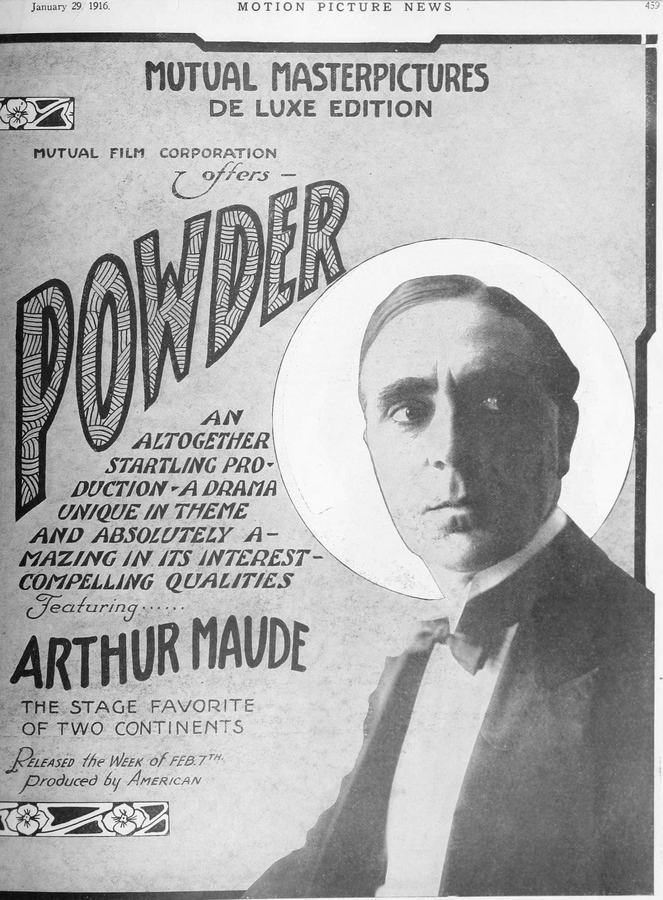
A definitive 9/10 rating for a film that redefined the boundaries of cult cinema. Powder remains a cornerstone of transgressive art.
The celluloid reels of 1916 more often conjure images of Chaplin’s tramp or Griffith’s battalions, yet lurking in that same cinematic kiln is Powder—a volatile, long-unheralded chamber-drama that detonates the sanctimony of neutrality while foreshadowing the industrialised slaughter of the twentieth century. Director Leon D. Hirsch stages his parable inside a world of charcoal-streaked skies, iron catwalks and the ceaseless hiss of nitrate, crafting what might be the first true anti-trust thriller: a trust not of railways or oil, but of death itself.
Where German Expressionism would later tilt sets into Caligari-like angles, Hirsch tilts morality. His frames remain architecturally level yet psychologically skew: low, cavernous lighting carves Brand’s face into a gargoyle of greed, while Jan’s close-ups glow with a chiaroscuro that oscillates between halo and horn. The powder mill—an infernal cathedral of brass gauges and sweating pipes—exhales hellish steam that drifts across the lens like the ghost of wars yet declared. It is impossible to watch these sequences without recalling the incandescent foundry vistas in Strike, yet Hirsch predates Eisenstein’s montage pyrotechnics by almost a decade.
Judson Brand, essayed with granite-jawed conviction by veteran stage tragedian George Ahearn, is less human than element: a humanoid compound of mercury and brimstone. His entrepreneurial zeal is so pure it circles back into nihilism—he sells to both monarchies with the impartiality of gravity. Lizette Thorne’s Jan is the narrative’s catalyst rather than its conscience; she triggers reactions without being consumed by them, a political reagent who slips between ideologies like a spy swapping passports at a fog-shrouded checkpoint.
William A. Carroll’s Fosdick arrives as the film’s moral ligament, all trembling idealism and Fabian pamphlets, yet the screenplay denies him sainthood. His refusal to compromise pushes Elinor (Constance Crawley) into patriarchal cross-hairs, illustrating how absolutism—whether pacifist or profiteer—shrapnels everyone nearby. Crawley’s silent eloquence is reminiscent of her earlier turn in A Question of Right, though here her gaze carries a steelier glint, as though each blink tallies the mounting butcher’s bill.
The plot’s clockwork is wound by espionage rather than romance. Every whispered pact breeds a counter-pact; every cheque carries a hidden clause written in invisible ink. Jan’s acquisition of Fosdick’s cancelled donation literalises cinema’s newfound faith in the document as weapon—a harbinger of the cheque-book journalism that will electrify later noirs. When she brandishes the slip before Chairman Hayes, the moment crackles with proto-cybernetic tension: information itself becomes payload, prefiguring the forged ledgers in post-war Kurosawa or the dossier machinations of Hitchcock’s Secret Agent.
Meanwhile Marshall Brand’s excursion through the war-ravaged hinterland supplies the film’s most cold-blooded sequences. Hirsch intercuts the heir’s delighted telegrams with tableaux of scorched orchards and refugee caravans, achieving a dialectical montage avant la lettre. The heir’s epiphany arrives too late—he is killed by a shell of his father’s making—yet the camera refuses him a martyr’s halo; his corpse lies half-buried in chalky soil, a ledger sheet fluttering against his boot like a final, useless surrender.
Silent-era melodrama frequently chains its women to railroad tracks; Powder hands its heroines the switch-lever. Jan commands the narrative’s geopolitical chessboard more adroitly than any male envoy, while Elinor’s breach of filial obedience ignites the film’s emotional powder-keg. Their final walk—unescorted, unrepentant—toward a Red Cross ambulance feels quietly revolutionary, a coda that whispers: reconstruction, too, can be matriarchal.
Viewed alongside Strike or A Fool There Was, the film forms a triptych of early twentieth-century moral contagion: capitalism as seducer, worker as rebel, arms dealer as death-merchant. Its topical resonance ricocheted through American newsreels already saturated with Lusitania outrage; exhibitors in St. Louis reportedly appended live recitations of Wilfred Owen to screenings, fusing art and agit-prop into a single combustive evening.
Yet unlike the hammer-blow didacticism of later wartime cinema, Powder retains a bruised ambiguity. Brand’s conversion is neither baptism nor absolution; it is the hollow gesture of a man whose god—profit—has already died on the battlefield of his own making. The final intertitle, flashed over a field of white crucifixes, reads: "The mills are silent; the world is not." The absence of orchestral swell leaves the audience stranded in that silence, forced to listen for the distant thunder of the next conflict.
Ahearn’s granite profile could have been chiselled onto a coin of the realm, yet his eyes—black, minute, restless—betray the terror of a titan who senses the earth spinning off its axis. Thorne pirouettes from coquette to conspirator with balletic economy; her half-smile when she slips the cheque into her reticule is silent cinema’s equivalent of a loaded wink. Carroll risks priggishness but injects Fosdick with tremulous urgency—watch his hands shake as he claws through the fuse-lit mill, a Quixote clutching not lance but fire extinguisher.
In support, Jack Farrell’s Burghoff radiates Prussian menace without caricature, while Arthur Maude’s Von Halstyn provides a velvet contrast, proving that villainy, like brandy, comes in many proofs. Crawley’s Elinor, though nominally the ingénue, undercuts the archetype with glances that linger a frame too long on her father’s empire, as though calculating the cost of every girder.
Cinematographer Lucien Andriot, later famed for Flying Down to Rio, here channels a Germanic gloom. Arc-lamps rake the factory floor, turning each airborne dust mote into a micro-meteor; the silver-nitrate grain swarms like gnats around the arc-light, lending every shot a faint pesticide shiver. The explosion sequence—achieved with a miniature mill, sugar glass, and a naphtha jet—unfolds in multiple angles that prefigure modern action cutting, yet the debris is composed of ledgers, contracts, and cancelled cheques: a literal confetti of capitalism.
Restoration efforts by EYE Filmmuseum (2019) salvaged a 35-mm Dutch distribution print, revealing tinting schemes that alternate between arsenic-green for interiors of conspiracy and bruised-rose for domestic interludes. The result is an artefact that feels eerily contemporary; one could splice monochrome scenes into Boardwalk Empire without tonal whiplash.
Though released sans official score, contemporary exhibitors recommended a patchwork: Saint-Saëns’ Marche Militaire for diplomatic salons, Mendelssohn’s Hebrides overture for the mill exterior, and—most subversively—Debussy’s "Footprints in the Snow" beneath the final funeral cortege. Such juxtapositions weaponised irony long before post-modern playlists.
Despite critical praise in Moving Picture World, Powder vanished from American screens after 1918, victim to both anti-German sentiment and the perception that its pacifist pallor undermined Liberty Bond drives. European prints circulated longer, influencing the bleak industrial tableaux of Obozhzhenniye krylya. Today it survives as a ghost in academic footnotes, a cautionary filament connecting the Gilded Age’s robber barons to the military-industrial complexes of later centuries.
Watch it not as antique curiosity but as prologue: every drone strike, every lobbyist’s loophole, every humanitarian crisis commoditised on the nightly news feels prefigured in Brand’s smoking mills. Hirsch’s film whispers a century-old warning that still echoes in gun-metal fog: when commerce and carnage share a cradle, no bunker can muffle the eventual blast.
IMDb —
1924
Community
Log in to comment.