DbcultAccessing Vault...
Cult Review
Senior Film Conservator
Is this ancient revival worth your time in the 21st century? Short answer: Yes, but only if you treat it as a séance rather than a movie night.
This film is for the historian, the theater geek, and the lover of the avant-garde; it is absolutely not for anyone seeking the narrative polish of a modern blockbuster or even the slapstick energy of Why Girls Say No.
1) This film works because it captures the authentic, sun-drenched atmosphere of the Delphic landscape, turning the theater itself into a living character.
2) This film fails because its static, wide-angle cinematography refuses to engage with the intimacy of the characters' suffering.
3) You should watch it if you want to see the exact moment when 20th-century modernism attempted to shake hands with 5th-century BCE tragedy.
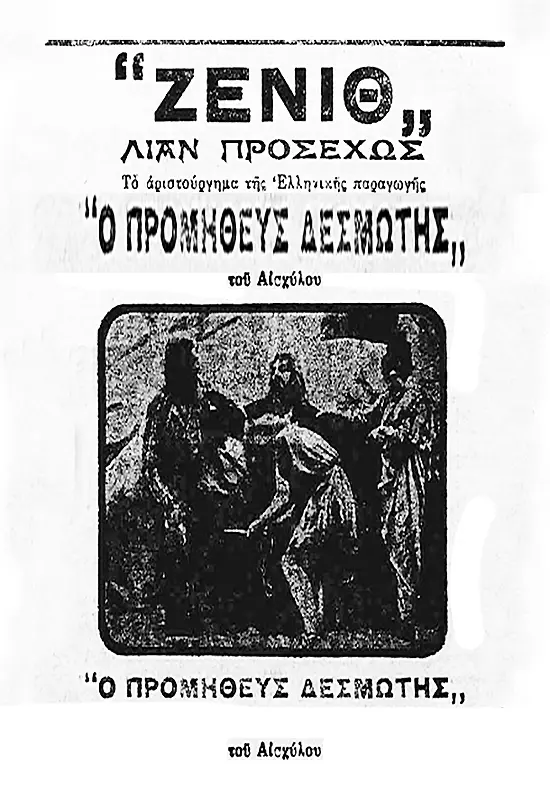
Promithefs desmotis is not a film in the way we understand it today. It is a document of a dream. In 1927, Eva Palmer-Sikelianos and her husband Angelos Sikelianos sought to establish Delphi as a global center for peace and art. This film is the visual record of their first major success. Unlike the studio-bound dramas of the era, such as The Hope, this production breathes the thin, dry air of the Greek mountains.
The film captures the performance of Giorgos Bourlos as Prometheus. He is not just acting; he is channeling. His movements are stiff, stylized, and grand. He is a statue that has suddenly found a voice, though the silent medium ironically strips that voice away, leaving only the harrowing geometry of his posture. The way he clings to the rock is not a feat of stunt work, but a display of endurance. It is grueling to watch. It should be.
The real star of this film is the Chorus. Led by Koula Pratsika, the Oceanids move with a fluidity that contrasts sharply with the rigid suffering of Prometheus. Their costumes, hand-woven by Eva Palmer-Sikelianos herself, catch the natural light in a way that modern synthetic fabrics never could. In one specific scene, the Chorus descends into the orchestra of the Delphic theater, their movements mimicking the waves of the sea. It is a masterclass in group choreography.
While Hollywood was perfecting the close-up in films like The Sea Tiger, the directors here opted for distance. They wanted the viewer to feel the scale of the mountains. This was a bold choice. It was also a frustrating one. By keeping the camera back, we lose the micro-expressions of pain on the faces of actors like Christina Kalogerikou. We see the myth, but we rarely see the human beneath the mask. It is cold. It is distant. But it is undeniably beautiful.
If you are looking for a story that moves at the pace of Taming the West, you will be bored to tears within ten minutes. This film is a slow burn—actually, it is more of a slow freeze. It demands that you sit in the silence and contemplate the weight of the stone and the heat of the sun. It is a meditation on defiance.
However, for those interested in the evolution of cinema, it is essential. It represents a branch of film history that almost died out: the filmed stage play as a high-art document. It doesn't try to be 'cinematic' in the way Wild Beauty does. It tries to be eternal. It almost succeeds. It’s flawed. But it’s vital.
The acting style will be the biggest hurdle for contemporary audiences. In 1927, the 'Delphic' style was about reviving the ancient 'Deltos'—a specific way of moving and speaking. On film, this looks like extreme over-acting. Every gesture is magnified. Every tilt of the head is a declaration. When Prometheus is confronted by Hermes, the physical tension is palpable, but it feels more like a wrestling match of silhouettes than a dialogue.
The pacing is glacial. Because the film follows the structure of the play exactly, there are long stretches of 'statis' where nothing happens but the wind moving through the robes of the Chorus. Compare this to the brisk narrative of Up in the Air, and you’ll realize that Promithefs desmotis was operating in a completely different temporal reality. It isn't trying to entertain you. It is trying to transform you.
Pros:
- Unmatched historical authenticity.
- Breathtaking use of natural Greek landscapes.
- A rare look at the 1920s avant-garde theater movement.
- The Chorus choreography is genuinely hypnotic.
Cons:
- Static cinematography can feel repetitive.
- The lack of sound masks the rhythmic beauty of the original Aeschylus text.
- It feels more like a museum exhibit than a movie.
To understand where this fits, one must look at other films of the era. While The Barnstormers was playing with the tropes of modern life, Promithefs desmotis was digging into the dirt of the past. It shares more DNA with the epic reconstructions like The Courtship of Myles Standish, but without the Hollywood sentimentality. It is a brutal, sun-scorched vision of punishment.
One surprising observation is how 'punk' the film feels. There is a raw defiance in the way it ignores all the 'rules' of 1920s filmmaking. It doesn't care about the 180-degree rule. It doesn't care about star power. It only cares about the Titan and the rock. This gives it a strange, modern edge that you won't find in Ashamed of Parents or God's Law and Man's.
The use of light is perhaps the film's greatest technical achievement. Filmed entirely outdoors, the production relies on the harsh Greek sun to create deep, obsidian shadows. This creates a high-contrast look that emphasizes the texture of the stone. You can almost feel the heat radiating off the screen. In the scenes involving Io, played with a frantic energy by Nina Delivoria, the shadows seem to chase her across the stage, heightening her sense of madness.
However, the lack of camera movement is a double-edged sword. It allows us to appreciate the geometry of the theater, but it also creates a sense of detachment. We are voyeurs at a distance of fifty feet. We are not in the pit with Prometheus; we are in the cheap seats. This was likely a limitation of the equipment and the location, but it defines the viewing experience. It is a panoramic tragedy.
Promithefs desmotis (1927) is a difficult, stubborn, and ultimately rewarding piece of cinema. It refuses to meet the audience halfway. It demands that you come to it, that you learn its language, and that you respect its silence. It is not a 'good movie' by standard metrics, but it is a monumental piece of art. If you can handle the stillness, you will find a haunting beauty that modern CGI-heavy epics can never replicate. It is a ghost of a performance, captured on silver nitrate, refusing to be forgotten. Watch it for the history. Stay for the mystery of the Chorus. It works. But it’s flawed. And that is exactly why it matters.

IMDb 3.6
1926
Community
Log in to comment.