DbcultAccessing Vault...
Cult Review
Senior Film Conservator
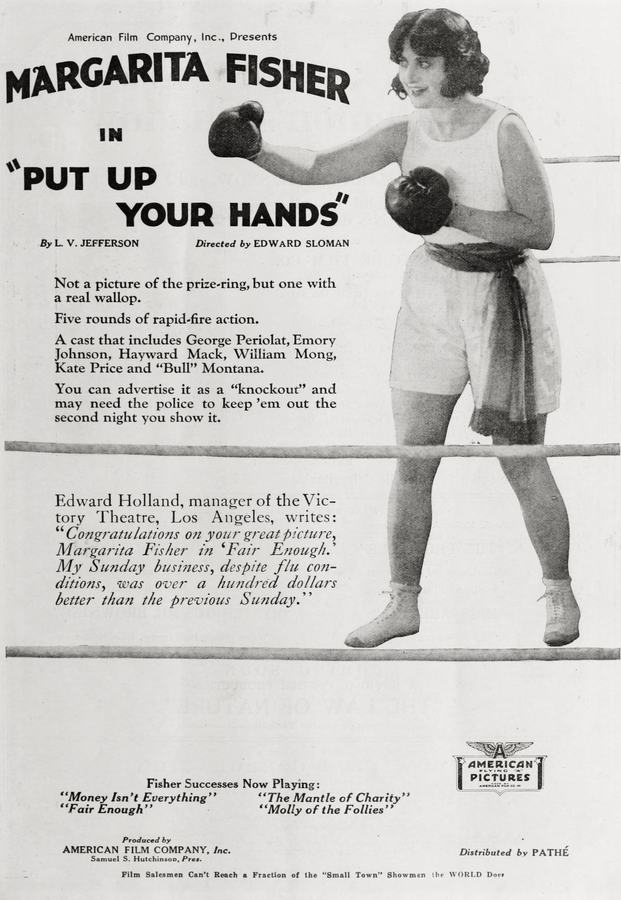
In the pantheon of silent cinema, few figures radiate the sheer kinetic audacity of Margarita Fischer. While the 1919 landscape was often dominated by the ethereal waifs of Griffith or the stoic heroes of Hart, Put Up Your Hands! offers a refreshing, almost anarchic deviation from the norm. It is a film that doesn't merely ask for your attention; it demands it with a metaphorical left hook. As we dissect this L.V. Jefferson-penned narrative, we find a work that sits at the intersection of social satire and frontier adventure, pre-dating the screwball comedies of the 1930s by over a decade.
"Olive Barton is not merely a character; she is a seismic event in silk and leather, a disruption of the Victorian equilibrium that still haunted the American psyche in the wake of the Great War."
The film opens with a sequence of delightful subversion. Olive Barton, portrayed with a magnetic vibrancy by Fischer, is introduced not as a debutante preparing for her coming-out, but as a pugilist in training. The setting—a high-society tea for a new minister—is the perfect foil for her rebellion. When Olive stages a boxing match as the centerpiece of the afternoon’s entertainment, the resulting shock among her elders isn't just a comedic beat; it's a profound statement on the shifting paradigms of gender. Unlike the protagonist in The Beauty Market, who navigates the complexities of social status through more traditional means, Olive chooses physical confrontation as her primary mode of expression.
The narrative shifts gears when Olive’s father is summoned to the West to oversee his mining interests. In a move that mirrors the stowaway tropes of the era, Olive sneaks into his private railcar. This transition from the manicured lawns of the East to the rugged topography of the West is handled with a visual dynamism that highlights the film's thematic core: the reclamation of the self through the untamed environment. Here, the film shares a spiritual kinship with The Little Boss, where the Western setting serves as a liberating space for female agency.
Upon arrival, Olive encounters Leonard Hewitt (Emory Johnson) and the wonderfully monikered 'Highball' Hazelitt. The initial meeting is steeped in the classic silent film trope of mistaken identity. Olive, ever the enthusiast of the dramatic, mistakes the mining engineers for bandits. This misunderstanding serves as a catalyst for a romantic subplot that avoids the saccharine pitfalls seen in contemporary works like May Blossom. Instead, the chemistry between Fischer and Johnson is built on mutual respect and shared competence, a rare commodity in 1919 cinema.
Perhaps the most radical element of Put Up Your Hands! is Olive’s decision to convert the local saloon into a gymnasium. In the context of the Temperance movement and the impending Prohibition, this act is laden with political symbolism. She is not merely replacing alcohol with exercise; she is transforming a site of male-dominated vice into a communal space of physical empowerment. This transformation is depicted with a series of vignettes that showcase Fischer’s comedic timing and athletic grace. It is a far cry from the existential isolation found in Ene i verden, focusing instead on the power of community and the physical body.
The conflict escalates as a conspiracy against her father's mine comes to light. This plot point allows the film to transition into a more traditional action-adventure mode, yet it remains anchored by Olive's ingenuity. She isn't the victim waiting for rescue; she is the architect of the counter-conspiracy. Her ability to navigate the treacherous waters of mining politics and physical danger places her in a league with the protagonists of high-stakes dramas like A Diplomatic Mission, though Olive possesses a raw, visceral energy that is entirely her own.
Technically, the film benefits from the sharp cinematography common to the late 1910s, utilizing natural lighting in the Western exteriors to create a sense of sprawling possibility. The editing keeps a brisk pace, ensuring the transitions between the slapstick humor of the gym and the tension of the mining plot feel cohesive. While it may lack the haunting psychological depth of Fesseln or the tragic weight of Love Never Dies, its levity is its greatest strength. It provides a blueprint for the modern action heroine—one who is allowed to be funny, flawed, and fiercely independent.
Margarita Fischer’s performance is a masterclass in silent expression. She uses her entire body to communicate Olive’s restless spirit. Whether she is throwing a punch or navigating a romantic misunderstanding, there is a sense of genuine joy in her movements. This is not the calculated performance of a star playing a role; it is an actress inhabiting a philosophy. In comparison to the more rigid performances in Legion of Honor, Fischer feels modern, almost anachronistic in her vitality.
The film’s climax, involving the foiling of the mine conspiracy, is a satisfying payoff to the themes of competence and courage established early on. Olive’s victory is not just a financial one for her father; it is a personal vindication. She has proven that her 'unconventional' nature is not a liability but her greatest asset. The romantic resolution with Leonard feels earned, a partnership of equals rather than a surrender of her identity.
Looking back from a century’s distance, Put Up Your Hands! serves as a vital reminder of the diversity of early cinema. It challenges the notion that silent films were purely melodramatic or simplistic. It captures a moment in American history where the old world was clashing with the new, and women were increasingly demanding a place in the center of the frame. While it might be overshadowed in history books by epic productions like 1810 o Los libertadores de México, its cultural footprint is significant in the evolution of the female-led comedy.
The film also touches upon the darker side of industrialism—the greed and treachery inherent in the mining boom—though it keeps the tone light enough to remain an entertainment. This balance is difficult to strike, as seen in the more somber The Escape or the mystery-laden Zelyonyy pauk. Yet, director James Cruze (and writer Jefferson) manages to weave these threads into a tapestry that is both engaging and thought-provoking.
Ultimately, Put Up Your Hands! is a triumph of spirit. It is a film that celebrates the 'shocking' and the 'unconventional,' suggesting that perhaps the world needs a bit more of Olive Barton’s pugilistic enthusiasm. It stands as a testament to Margarita Fischer’s enduring talent and a fascinating artifact of an era in flux. For those seeking to understand the roots of the modern independent woman on screen, this film is not just an option; it is an essential text. It avoids the moralizing found in The Yellow Traffic or the philosophical questioning of The Question, opting instead for a joyous, kinetic affirmation of life and liberty.
As the final frames roll and Olive secures both her father's legacy and her own future, the viewer is left with a sense of exhilaration. It is the same feeling one gets after a hard-fought match or a long journey. The film, much like its protagonist, refuses to be contained. It is a loud, proud, and beautifully executed piece of silent art that deserves a prominent place in the conversation of early 20th-century cinema. It is the moment of victory, not just for Olive, but for a new kind of storytelling—a sentiment echoed in the thematic resonance of The Moment of Victory, yet achieved here with a singular, pugnacious charm.
IMDb —
1920
Community
Log in to comment.