DbcultAccessing Vault...
Cult Review
Senior Film Conservator
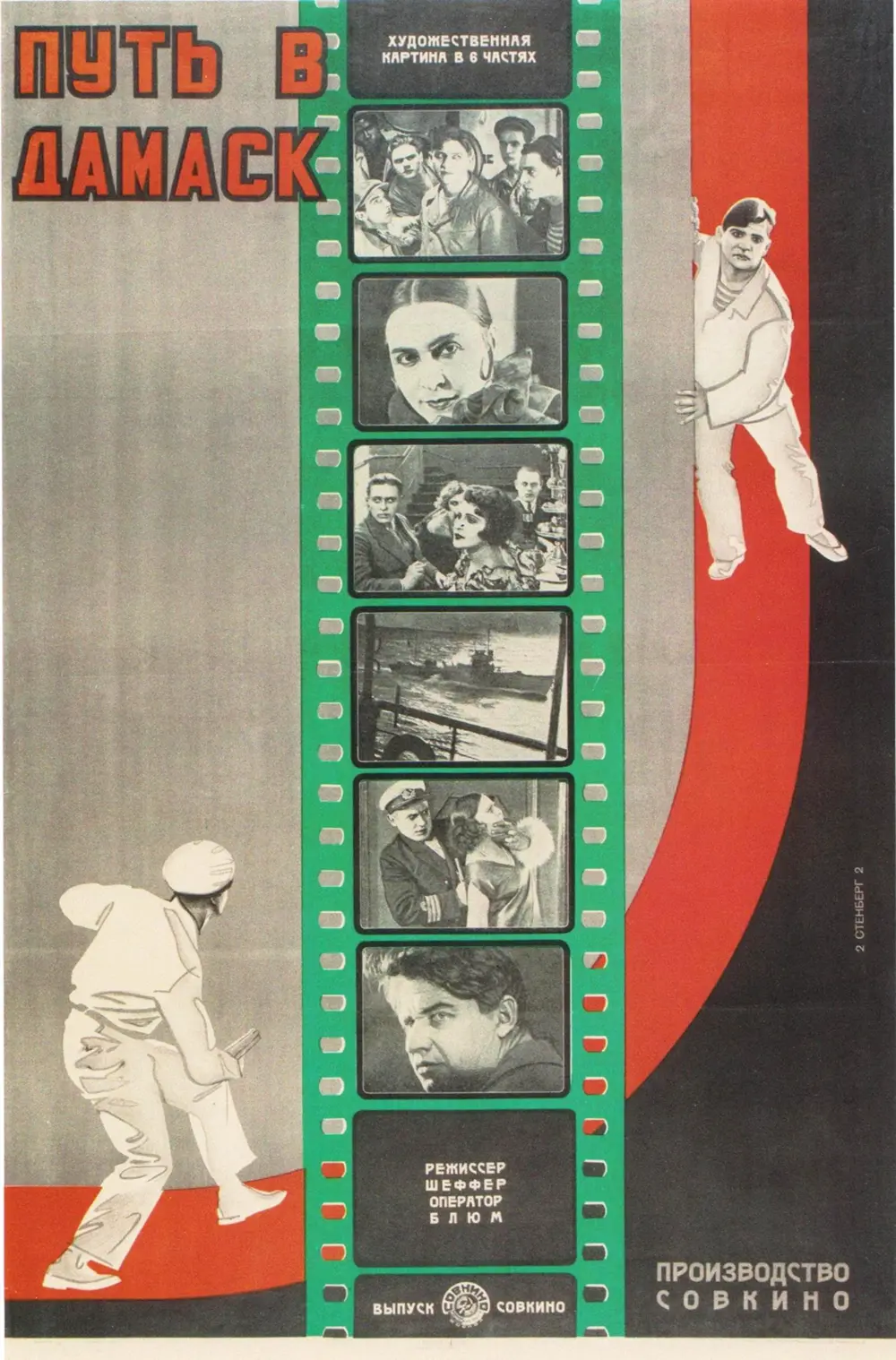
Is Put v Damask a film you should spend your evening with? Short answer: No, unless you are a dedicated historian of silent-era propaganda or a student of early Soviet montage. It is not a film designed for leisure; it is a film designed for indoctrination.
This film is for those who find beauty in the mechanics of early 20th-century political messaging and those who can appreciate the technical craft of directors who were working under the heavy thumb of state oversight. It is definitively NOT for anyone looking for a casual narrative, a romantic subplot that feels earned, or the slapstick levity found in Felix Gets the Can. It is heavy. It is deliberate. It is, at times, exhausting.
This film works because its visual language is remarkably consistent, using harsh lighting and industrial geometry to mirror the internal rigidity of its characters.
This film fails because it treats its human subjects as mere cogs in a political machine, draining the story of genuine emotional resonance.
You should watch it if you want to see how cinema was used as a weapon to reshape the collective consciousness during the late 1920s.
Put v Damask is a difficult recommendation for the modern viewer. If your definition of a 'good movie' involves character arcs that feel organic, you will be disappointed. However, if you view cinema as an archaeological site, this film is a goldmine. It offers a window into a world where the 'Road to Damascus' metaphor was stripped of its religious divinity and replaced with the secular 'truth' of the proletariat. It is a fascinating, if joyless, experience.
The screenplay by Stanislav Weiting-Radzinsky and Aleksandr Rubinshteyn is less of a story and more of a manifesto. In 1927, the Soviet film industry was moving away from the avant-garde experimentation of the early 20s and toward a more rigid, pedagogical style. Put v Damask sits right at this crossroads. The dialogue (via intertitles) is punchy and declarative. There is no room for subtext here. When a character speaks, they are speaking for a class, not for themselves.
Take, for example, the scene where Nikolay Sinelnikov’s character first encounters the industrial collective. The camera doesn't focus on his face; it focuses on his hands and the machinery. This is a deliberate choice to decenter the individual. Compare this to the character-driven melodrama of The Devil's Circus, where the individual’s plight is the center of the universe. In Put v Damask, the individual is a problem to be solved by the state.
The direction is efficient but cold. Every frame feels like it was approved by a committee. There is a specific moment in the second act where a group of workers are framed against the horizon—a classic Soviet trope—that feels so staged it loses all sense of reality. It is beautiful in its symmetry, but it is the beauty of a blueprint, not a painting.
Oksana Podlesnaya provides one of the few glimpses of humanity in the film. Her performance is grounded in a sort of weary realism that feels out of place in such a heightened political atmosphere. While the men are busy being symbols of strength or corruption, Podlesnaya’s eyes suggest a person who is simply trying to survive the transition. Her performance reminded me of the grounded vulnerability seen in The Girl from Beyond, though much more constrained by the script's demands.
Aleksandr Antonov, a stalwart of the era, brings his usual physical gravitas. He doesn't act so much as he looms. His presence is a reminder of the physical cost of the revolution. However, the chemistry between the cast is non-existent. They don't interact like people; they collide like tectonic plates. This is likely intentional, but it makes for a very dry viewing experience.
The acting style is noticeably different from the theatricality of Revenge. Here, the actors are instructed to be 'types.' Sinelnikov is the 'Convert,' Antonov is the 'Reliable Worker,' and so on. It is a chess match where the pieces are made of flesh and blood.
If there is one reason to watch Put v Damask, it is the cinematography. The use of shadow is masterful. There is a sequence in a dimly lit basement that rivals the expressionism found in Der Berg des Schicksals. The way the light carves out the actors' features makes them look like statues. It is high-contrast, high-stakes visual storytelling.
However, the pacing is where the film truly struggles. Unlike the brisk, rhythmic editing of 100% Nerve, Put v Damask lingers far too long on static shots. There is a ten-minute sequence involving the reading of a manifesto that feels like an eternity. The filmmakers seem terrified that if they cut away, the audience might miss the message. It results in a film that feels twice as long as its actual runtime.
The editing lacks the 'attractions' of Eisenstein. It is more linear and traditional, which ironically makes its propaganda feel even more heavy-handed. There is no intellectual montage here, only the slow, rhythmic beating of a drum. It is a blunt instrument. But it’s flawed.
One surprising element of Put v Damask is how much it borrows from religious hagiography. Despite the film's aggressive secularism, the structure is identical to a saint's life. The protagonist suffers, sees the 'light' (in this case, the light of the party), and is reborn. The 'Damascus' in the title is not just a clever reference; it is a confession. The Soviet state was building a new religion, and this film was one of its primary liturgical texts. This creates a strange tension where the film is constantly denying the spiritual while using spiritual tools to move the audience.
Put v Damask is a film that demands to be studied rather than watched. It lacks the charm of Tramp, Tramp, Tramp the Boys Are Marching and the suspense of Das Gefängnis auf dem Meeresgrund. It is a product of its time—a time when the screen was a pulpit and the audience was a congregation. If you can stomach the didacticism, you will find a film that is technically proficient and historically vital. If you can't, it will feel like a ninety-minute lecture. It is a monumental achievement of style over substance. It is a relic. It is hard to watch. But for the right person, it is essential.
"The camera in Put v Damask doesn't capture life; it captures an argument. It is a visual debate where only one side is allowed to speak."

IMDb 6.1
1930
Community
Log in to comment.