DbcultAccessing Vault...
5.8/10
Senior Film Conservator
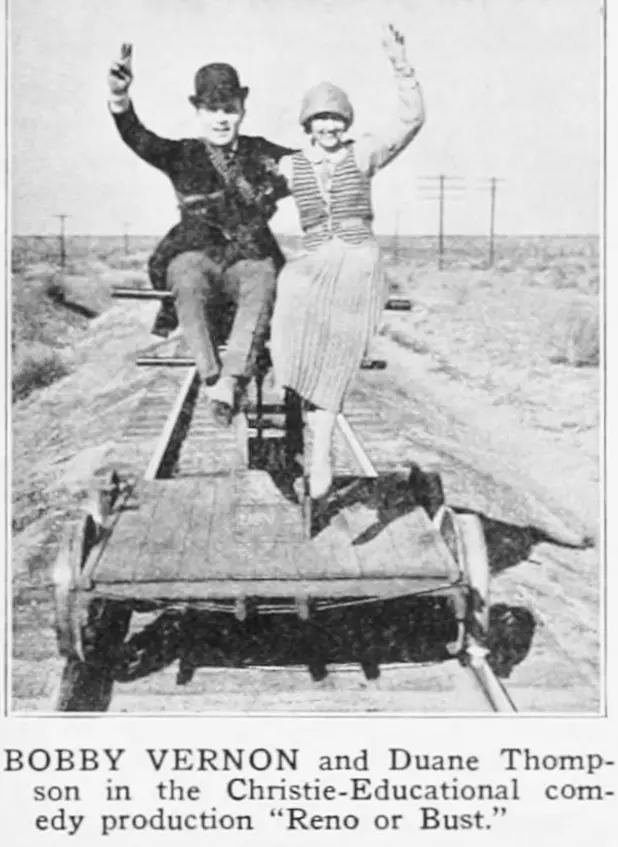
A definitive 5.8/10 rating for a film that redefined the boundaries of cult cinema. Reno or Bust remains a cornerstone of transgressive art.
In the pantheon of silent-era comedies, Reno or Bust emerges not merely as a relic of 1924, but as a vibrant, pulsating example of the 'boy-meets-girl-meets-obstacles' trope pushed to its absolute kinetic limit. Directed with a frantic grace that characterizes the mid-twenties output of the era, the film centers on Bobby Vernon, an actor whose boyish charm often masked a relentless physical tenacity. Unlike the more somber explorations of morality found in The Warfare of the Flesh, this film leans into the absurdity of social gatekeeping, specifically the meddling influence of a mother-in-law who views marriage as a strategic alliance rather than a romantic union.
The narrative propellant is the elopement of Bobby and Duane (played with a delightful, spirited energy by Duane Thompson). Their union is a direct challenge to the domestic hegemony established by Duane’s mother, portrayed by Lila Leslie with a chillingly comedic severity. When the elopement is discovered, the response is not merely a scolding but a complete geographical and legal extraction. The girl is whisked away to Reno, the then-notorious capital of quick-fix divorces, a setting that provides the film with both its title and its thematic urgency. The concept of Reno as a 'cleansing' ground for unwanted marriages was a common cultural touchstone, much like the moral dilemmas presented in Betrayed, though here it is played for laughs rather than melodrama.
Bobby Vernon’s performance is a masterclass in the 'determined underdog' archetype. As he follows his bride to Nevada, the film transitions from a domestic farce into a high-octane pursuit movie. The moment Bobby arrives in Reno, he is greeted not with the open arms of his beloved, but with an arrest warrant. This shift introduces a layer of tension that elevates the slapstick; the stakes are no longer just romantic, but legal. The 'merry chase' that ensues is choreographed with a precision that rivals the best work of the period, echoing the frantic energy of Oh Mary Be Careful.
What distinguishes Reno or Bust from its contemporaries like Stranded is the sheer ingenuity of the protagonist. Bobby doesn't just run; he outmaneuvers. The sequence involving the police patrol wagon is a highlight of 1920s comedic engineering. By luring his pursuers—including the mother-in-law and the hand-picked rival—into the enclosed wagon, Bobby effectively flips the script on his captors. He transforms a symbol of state authority into a mobile prison of his own making. This subversion of the 'law and order' trope is particularly satisfying, providing a catharsis that is often missing from more traditional romantic comedies of the time.
The film’s third act takes a turn into the surreal as Bobby drives the hijacked wagon out into the barren desert. Here, the landscape serves as a narrative crucible. Away from the civilizing (and constraining) influence of the city and the courtrooms, the characters are stripped of their social armor. Bobby’s threat to leave them as 'prey for wild animals' is a deliciously dark comedic beat that highlights the desperation of his love. It is a moment of coerced reconciliation that, while perhaps problematic by modern standards, fits perfectly within the heightened reality of silent farce.
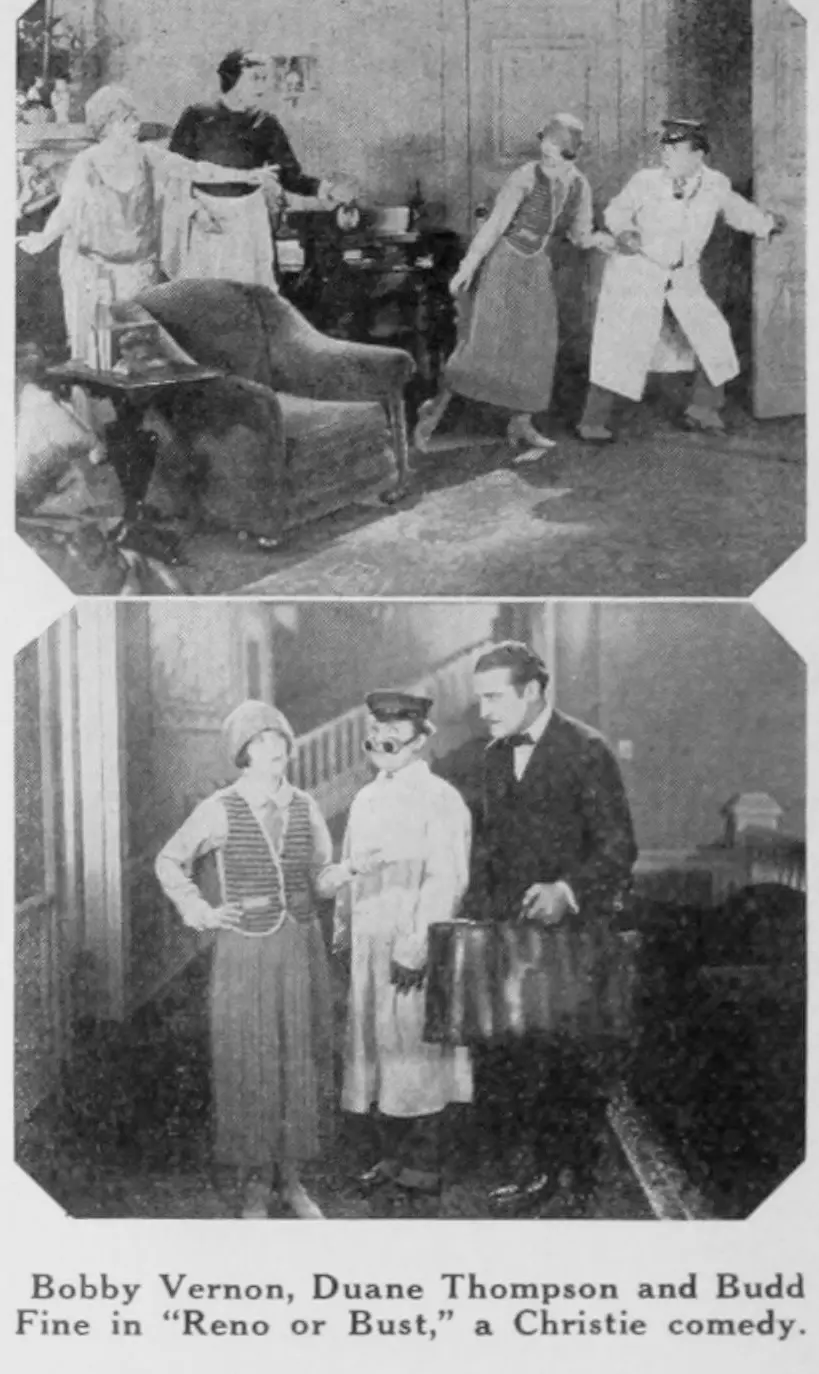
The physical environment of the desert provides a stark contrast to the earlier scenes of domestic opulence. The dust, the heat, and the isolation force the mother-in-law to finally capitulate. This 'trial by fire' (or rather, trial by sand) is a recurring motif in films that deal with the breaking of societal bonds, much like the thematic undercurrents in Nobody's Wife. The resolution—a second marriage ceremony performed on the spot—is the ultimate victory for Bobby, proving that in the world of Frank Roland Conklin's writing, persistence and a bit of kidnapping are the keys to a happy ending.
The writing by Frank Roland Conklin deserves significant praise. Conklin had a knack for structures that felt both spontaneous and meticulously planned. The way the plot threads of the 'rival' and the 'police intervention' weave together in the final act is a testament to his craftsmanship. The film avoids the sluggish pacing that sometimes plagues silent features, maintaining a tempo that feels incredibly modern. In many ways, the rhythmic editing here is more sophisticated than what we see in The Gates of Gladness, focusing on the visual gag as the primary driver of the story.
The supporting cast, including Billy Bletcher and Budd Fine, provides the necessary friction for Bobby’s antics. Bletcher, in particular, brings a physical presence that contrasts beautifully with Vernon’s smaller, more agile frame. The visual comedy of the 'big man versus little man' is utilized here to great effect, though it never feels like a tired cliché. Even the bit parts, like those played by Blanche Payson and Victor Rodman, contribute to a sense of a fully realized, albeit chaotic, world. This ensemble approach to comedy is what makes the film feel so lived-in and energetic.
To fully appreciate Reno or Bust, one must understand the 1920s obsession with Reno. It was the 'Gretna Green' of divorce, a place where the rigid marital laws of other states could be bypassed. By setting the film there, Conklin was tapping into a zeitgeist of rebellion against Victorian morality. While a film like Alkohol might deal with the darker side of social vices, Reno or Bust treats the breakdown of marriage as a playground for comedic invention. It suggests that the institutions of society are merely obstacles to be navigated by the clever and the bold.
The film also touches on the idea of the 'rival'—the man selected by the mother who represents everything Bobby is not: stability, wealth, and maternal approval. This character, played by Jay Belasco, is a perfect foil. He is the 'safe' choice, the choice of the establishment. Bobby’s victory is not just over the mother, but over the very idea of an arranged or 'sensible' life. This theme of youthful exuberance vs. stodgy tradition is a hallmark of 1920s cinema, also seen in works like A Flirt There Was.
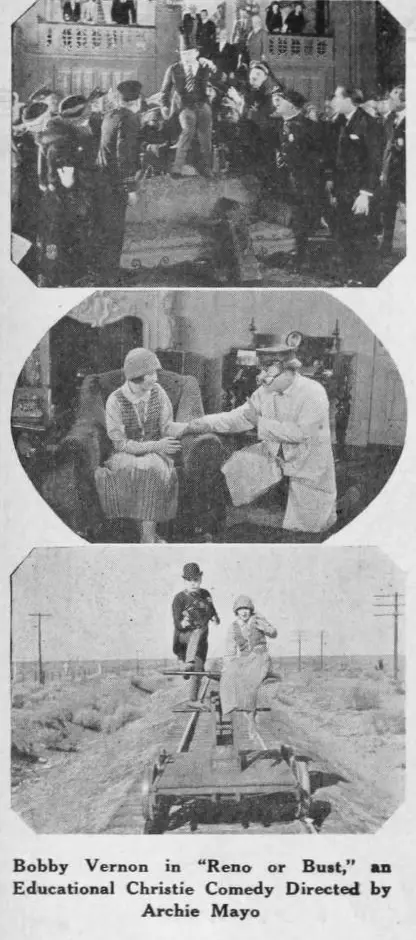
Visually, the film utilizes its locations with remarkable efficiency. The transition from the claustrophobic interiors of the mother's house to the wide-open, threatening expanse of the desert mirrors the emotional journey of the protagonists. The cinematography captures the dust and the grit of the chase, making the slapstick feel grounded in a tangible reality. When Bobby is driving that patrol wagon, you can almost feel the rattle of the chassis and the heat of the Nevada sun. This level of immersion is what separates the great silent comedies from the merely functional ones, much like the difference between a standard drama and something as visually arresting as The Yellow Handkerchief.
The title cards in Reno or Bust are also worth noting. They are punchy, witty, and often provide a rhythmic counterpoint to the action. They don't just explain the plot; they add a layer of authorial voice that enhances the 'blogger' feel of the narrative. It’s as if the writer is winking at the audience, acknowledging the absurdity of the situation while simultaneously heightening the stakes. This meta-textual awareness is a sophisticated touch that points toward the future of film comedy.
In the grand scheme of Bobby Vernon’s career, Reno or Bust stands as a definitive work. It encapsulates his persona—the boy who would go to any lengths for love—and places him in a scenario that maximizes his physical talents. While it may not have the historical weight of a documentary like With Our King and Queen Through India, it possesses a different kind of truth: the truth of the human spirit’s refusal to be managed by overbearing parents or restrictive laws. It is a celebration of the 'bust'—the willingness to lose everything for the sake of a single, meaningful 'yes.'
Comparing it to A Girl at Bay, we see a similar focus on a woman in peril, but in Reno or Bust, the 'peril' is a divorce she doesn't want, and the 'hero' is a man who uses a police van as a getaway car. It is this subversion of expectations that keeps the film fresh nearly a century later. The final image of the desert wedding remains one of the most iconic and satisfying conclusions in silent comedy, a testament to the power of a well-executed gag and a heartfelt performance.
Ultimately, Reno or Bust is a reminder of a time when cinema was discovering its own power to move, to thrill, and most importantly, to make us laugh at the very things that try to control us. Whether you are a fan of the strange creatures in Capitan Groog and Other Strange Creatures or the grounded drama of The Idler, there is something in this film's relentless energy that is universally appealing. It is a high-speed journey into the heart of matrimonial madness, and it is a trip well worth taking.
As we look back at the filmography of the 1920s, it is easy to get lost in the big names and the heavy dramas. But films like Reno or Bust and The Fotygraft Gallery remind us that the heart of the medium has always been entertainment. It’s about the chase, the girl, the narrow escape, and the triumph of the underdog. It’s about the audacity to say, 'if you won't let us be married in the city, I'll drag you into the desert and make you watch us do it there.' That is the spirit of Reno or Bust, and it is a spirit that never goes out of style.
IMDb 4.6
1915
Community
Log in to comment.