DbcultAccessing Vault...
Cult Review
Senior Film Conservator
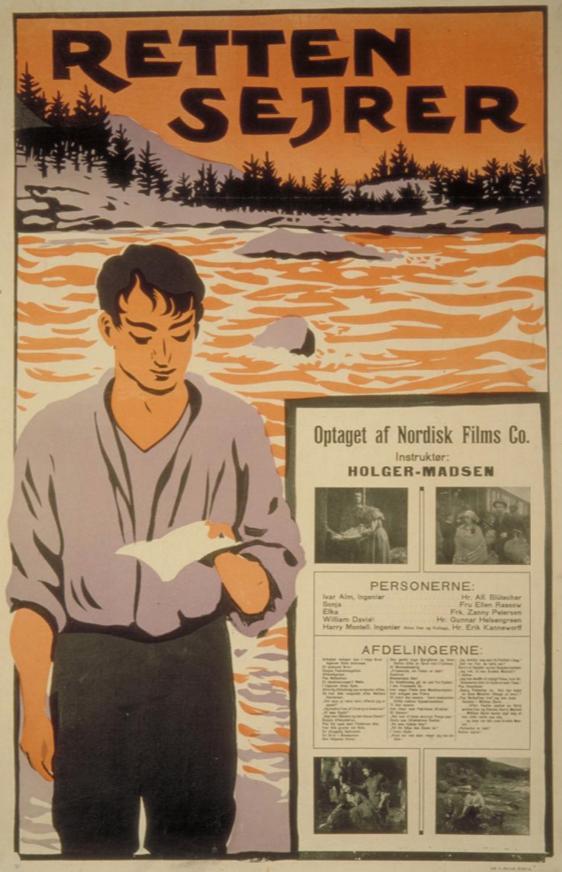
In the pantheon of early Scandinavian cinema, few works articulate the paralysis of the human will with such agonizing precision as Retten sejrer. The title, translating to 'Justice Prevails,' carries a heavy, almost sardonic weight when viewed through the lens of modern existentialism. It suggests a cosmic order that is indifferent to the individual's happiness, focusing instead on a cold, structural equilibrium. This film is not merely a cautionary tale; it is a structuralist dissection of the inevitability of failure. The protagonist’s journey is less a series of choices and more a slide down a frictionless slope toward a predestined catastrophe. Unlike the more optimistic narratives found in Branding Broadway, where transformation seems achievable through sheer force of personality, Retten sejrer posits that our characters are our fates.
Nils Asther, an actor whose facial topography seems designed to map the nuances of internal torment, delivers a performance that anchors the film’s loftier philosophical ambitions. His presence on screen is magnetic, yet he possesses a peculiar fragility—a sense that his character is perpetually on the verge of being shattered by the winds of circumstance. This fragility is essential to the film's central conceit: the choice between two women. While contemporary audiences might view this as a simplistic trope, Nils Krok’s screenplay elevates it into a profound meditation on the 'deleterious attraction.' The 'bad' woman is not a cartoonish villainess but a mirror of the protagonist's own unacknowledged shadows, making his attraction to her both understandable and terrifying.
The brilliance of Nils Krok lies in his ability to weave social commentary into the fabric of a psychological thriller. In Retten sejrer, the two women represent more than just individual personalities; they are manifestations of the protagonist's divided soul. The virtuous woman offers a life of stability, a path that aligns with the societal expectations of the era, much like the moral frameworks explored in A School for Husbands. However, the 'other' woman—the one who is 'bad' for him—represents a wild, untamed agency that the protagonist lacks. Her presence in the film acts as a solvent, dissolving his resolve and exposing the hollowness of his moral convictions. This is a theme that echoes through the annals of silent cinema, finding a darker, more nihilistic expression here than in the adventurous spirit of The Raiders.
The narrative structure of the film is a masterclass in tension. Krok does not rely on cheap twists or sudden reversals. Instead, he builds a sense of dread through the slow, methodical accumulation of small compromises. Each time the protagonist moves away from the 'good' path, the camera lingers on his face, capturing the precise moment where regret meets resignation. This is cinema as a moral crucible, a theme also present in A Man's Prerogative, though Retten sejrer handles the fallout with a significantly more somber touch. The film suggests that 'justice' is not about reward, but about the inevitable consequences of one's nature.
Visually, the film utilizes the limited technology of its time to create an atmosphere of suffocating intimacy. The use of shadow is particularly noteworthy; the 'bad' woman is often framed in low-key lighting that emphasizes the contours of her face, while the 'good' woman is bathed in a softer, more diffused glow. This visual shorthand reinforces the internal conflict, making the moral stakes of the film instantly legible to the audience. The cinematography doesn't just record the action; it interprets it, much like the expressionistic flourishes found in Ikeru Shikabane. The environments themselves—the cramped interiors and the stark, unforgiving landscapes—serve as metaphors for the characters' psychological states.
Alf Blütecher and Gunnar Helsengreen provide robust support, their performances grounding the more ethereal qualities of the film. Blütecher, in particular, brings a sense of gravity to the proceedings, acting as a foil to Asther’s more mercurial energy. The interactions between these men highlight the social pressures that dictate the protagonist's choices. In a world where reputation is everything, the protagonist’s inclination toward the 'wrong' woman is not just a personal failing but a social transgression. This layer of social critique makes the film a fascinating companion piece to The Hidden Scar, where past secrets and social standing collide with devastating results.
When we examine Retten sejrer alongside other works of the era, its unique bitterness becomes even more apparent. While Don Juan treats the pursuit of the 'wrong' woman as a grand, albeit tragic, adventure, Retten sejrer strips away the romanticism. There is no glory in the protagonist's obsession, only a wearying sense of duty to his own destruction. It shares a certain spiritual DNA with Resurrezione, particularly in its focus on the cyclical nature of sin and the difficulty of true atonement. However, where Resurrezione offers a glimmer of spiritual hope, Retten sejrer remains firmly rooted in the material world, where 'justice' is a physical law rather than a divine grace.
The film also contrasts sharply with the lighter, more deceptive narratives of The Love Swindle. In the latter, deception is a game, a tool for social mobility or romantic conquest. In Retten sejrer, the protagonist is the one being swindled, not by another person, but by his own instincts. The 'wrong' woman doesn't need to lie to him; her very existence is the trap. This deterministic view of human attraction is a precursor to the noir sensibilities that would dominate cinema decades later. It suggests a world where the individual is a passenger in their own life, watching through the window as they are driven toward a wreck.
Why do we choose the path that leads to our own suffering? This is the central question that Retten sejrer refuses to answer with platitudes. The film posits that 'Fate' is not an external force, but the sum of our internal contradictions. The protagonist’s inability to choose the 'good' woman is not a lack of intelligence, but a lack of resonance. The 'good' woman represents a version of himself that he cannot inhabit—a life of peace that feels, to him, like a life of boredom. The 'bad' woman, conversely, offers a high-stakes emotional volatility that feels more 'real' to his tortured soul. This psychological nuance is what prevents the film from becoming a mere morality play. It is a tragedy in the truest sense: the protagonist’s downfall is caused by the very qualities that make him human.
This theme of the 'will' being subverted by deeper, more primal forces is also explored in Wo ein Wille, ist ein Weg, though that film focuses more on the triumph of the will over external obstacles. Retten sejrer is the inverse; it is about the defeat of the will by internal ones. It suggests that 'where there is a will, there is a way' is a cruel joke when the 'way' you are willed toward is a cliff edge. The protagonist’s struggle is a silent scream against the inevitability of his own character, a theme that resonates with the claustrophobic tension of Through the Wall.
As we look back at Retten sejrer from a century’s distance, its power remains undiminished. It stands as a testament to the sophistication of early Danish and Swedish cinema, which was often years ahead of its time in terms of psychological depth. The film avoids the easy sentimentality of Pots-and-Pans Peggy or the escapist thrills of Madame Spy. Instead, it invites the viewer into a space of profound discomfort. It asks us to confront the possibility that our lives are governed by forces we can neither understand nor control.
The performance of Erik Kanneworf adds another layer of texture to the film, providing a sense of the broader community that watches and judges the protagonist’s descent. This social surveillance is a key component of the film’s 'justice.' The community is the mechanism through which fate is enacted. In La loca del monasterio, the religious setting provides a framework for madness and redemption; in Retten sejrer, the framework is the secular, unforgiving world of the bourgeoisie. There is no monastery to retreat to, no divine forgiveness to seek—only the cold comfort of a justice that has finally caught up with its subject.
Ultimately, Retten sejrer is a film of 'nattliga toner'—nightly tones—much like the melancholic atmosphere of Nattliga toner. It is a work that exists in the shadows, speaking to the parts of us that we prefer to keep hidden. It is a masterpiece of silent cinema that demands to be seen not just as a historical curiosity, but as a vital, breathing piece of art that continues to challenge our understanding of choice, consequence, and the dark machinery of the human heart. The 'victory' of justice in the end is a pyrrhic one, leaving the audience with a sense of profound loss and an unsettling realization: that fate does indeed tend to choose the wrong path for us, and we, in our tragic humanity, are all too happy to follow.
IMDb 5.1
1929
Community
Log in to comment.