DbcultAccessing Vault...
Cult Review
Senior Film Conservator
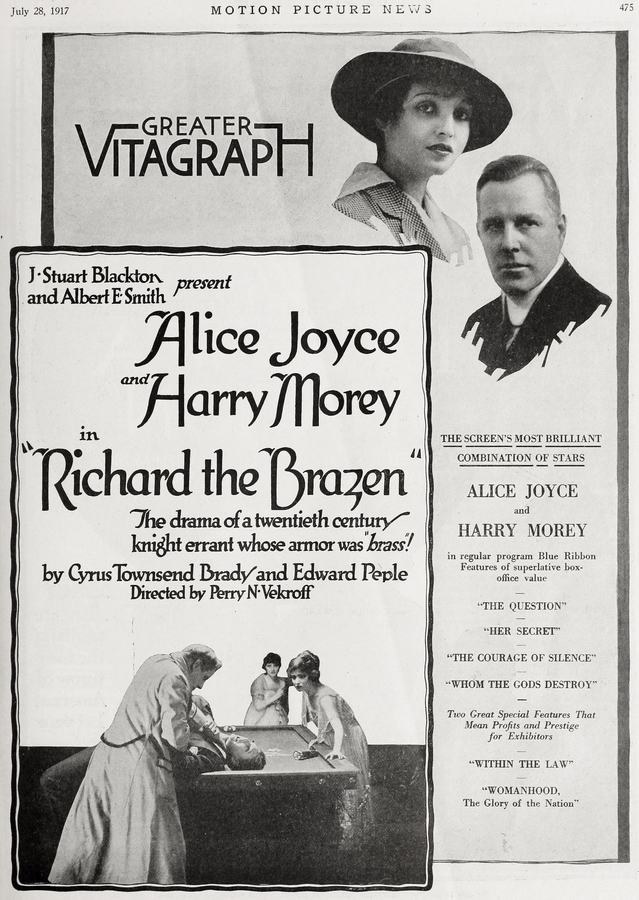
Greetings, fellow cinephiles! Today, we're dusting off a cinematic gem from the nascent days of filmmaking, a delightful confection from 1917 that perfectly encapsulates the romantic spirit and daring escapades of its era: Richard the Brazen. In an age dominated by flickering shadows and expressive gestures, this film, directed by George D. Baker, unfurls a narrative steeped in the kind of charming pretense and heroic derring-do that captivated audiences then, and still holds a peculiar allure now. Forget the bombast of modern blockbusters for a moment, and let’s immerse ourselves in the elegant simplicity and profound emotional resonance of early silent cinema.
At its core, Richard the Brazen is a spirited exploration of identity, honor, and the enduring power of love, all wrapped in a wonderfully improbable plot. Imagine a character plucked from the pages of a chivalric romance, yet firmly planted in the burgeoning 20th century, hailing not from Arthurian legend but from the sun-baked plains of Texas. This is our protagonist, Richard, a man imbued with an inherent nobility and a penchant for audacious action, qualities that set him apart from his more conventional contemporaries. He is, as the original synopsis so eloquently put it, "a modern knight who has all the flourish and daring of the knights of old." This juxtaposition of ancient virtues with a modern setting provides much of the film's unique charm and thematic depth. His journey begins across the vast expanse of the Atlantic, accompanying an English peer, a friend whose aristocratic bearing offers a stark contrast to Richard’s more rugged, though no less refined, American sensibility.
The inciting incident, a seemingly innocuous accident, serves as the pivotal hinge upon which the entire narrative swings. It's a classic cinematic trope, yet handled here with a certain flair that feels fresh even today. Circumstances conspire to force Richard into a radical transformation: he must assume his friend's exalted title, his impeccable valet, and even the friend's distinguished monocle—a symbol, perhaps, of the very class he is temporarily appropriating. This sudden immersion into an aristocratic persona, far removed from his Texan roots, immediately sets the stage for both comedic misunderstandings and profound emotional introspection. The film masterfully navigates the tightrope between lighthearted deception and the genuine pangs of a heart entangled in a web of its own making.
It is under this borrowed identity that fate, with its characteristic dramatic flourish, orchestrates a meeting that will irrevocably alter Richard’s trajectory. He encounters the very woman he had, until then, worshipped from afar in England—a figure of ethereal grace and unattainable beauty who had existed only in the realm of distant admiration. This serendipitous, or perhaps predestined, encounter elevates the stakes considerably. Now, the modern knight must not only maintain his elaborate charade but also, and more perilously, court the object of his affections under false pretenses. The burgeoning romance, therefore, is not merely a tale of two hearts converging, but a delicate dance between genuine affection and the ever-present threat of exposure. Every stolen glance, every whispered compliment, every shared moment is imbued with a delicious tension, a silent question of how long this fragile illusion can endure.
The success of a silent film, particularly one reliant on intricate emotional dynamics, rests squarely on the shoulders of its performers. In Richard the Brazen, we are fortunate to witness the talents of Alice Joyce and Harry T. Morey, two luminaries of the silent screen, whose abilities to convey complex feelings through gesture, expression, and subtle movement are nothing short of remarkable. Alice Joyce, in particular, shines as the object of Richard’s devotion. Her screen presence is captivating, a blend of elegance and vulnerability that makes her character instantly sympathetic and her predicament, caught unwittingly in Richard’s deception, genuinely poignant. Joyce’s portrayal is nuanced, suggesting a woman of depth and discernment, one who is drawn to Richard’s inherent nobility even through the layers of his assumed identity.
Harry T. Morey, as the eponymous Richard, carries the weight of the film with admirable conviction. His performance is a masterclass in silent film acting, balancing the swagger of a Texan gentleman with the awkwardness of a man playing a role he was not born to. Morey imbues Richard with a palpable earnestness, ensuring that his deception, while potentially problematic, never feels malicious. Instead, it stems from a place of genuine affection and a desire to win the lady’s heart, a common enough motivation in romantic narratives. His physicality, especially in the film’s climactic moments, conveys both strength and a certain boyish charm, cementing his status as the "modern knight." The chemistry between Joyce and Morey is undeniable, a silent dialogue of longing and affection that transcends the lack of spoken words. They communicate volumes with their eyes, their posture, and the delicate interplay of their hands, drawing the audience into their burgeoning romance.
The supporting cast, featuring talents like Charles Wellesley and Agnes Ayres, further enriches the narrative tapestry. Wellesley, likely playing the actual English peer, provides a crucial counterpoint to Morey's assumed persona, while Ayres, though perhaps in a smaller role, contributes to the overall atmospheric authenticity of the setting. It’s a testament to the directorial vision of George D. Baker and the writers Cyrus Townsend Brady, Edward Peple, and A. Van Buren Powell that even with the limitations of the era, they managed to craft a story with such compelling characters and emotional depth. The film’s success lies not just in its engaging plot but in the ability of its cast to breathe life into these archetypal figures, making them relatable and endearing despite the passage of more than a century.
Beyond the surface romance and adventure, Richard the Brazen delves into fascinating thematic territory. The most prominent, perhaps, is the exploration of modern chivalry. Richard embodies a timeless ideal of heroism, courage, and honor, proving that such virtues are not confined to medieval tales but can manifest in any age, even in a Texan gentleman of the 20th century. This idea resonates profoundly, suggesting that true nobility stems not from inherited titles or social standing, but from innate character and actions. It challenges the rigid class structures prevalent in early 20th-century society, positing that a man's worth is defined by his deeds, not his birthright.
The theme of identity is equally central. Richard's assumption of his friend's title forces him to confront questions of who he truly is and what constitutes authenticity. He is compelled to navigate a world of aristocratic pretenses, constantly aware that his true self is hidden beneath a carefully constructed facade. This tension between his genuine Texan identity and his adopted English peerage creates both dramatic irony and moments of genuine pathos. The film subtly asks: does the title make the man, or does the man elevate the title? Richard's journey unequivocally suggests the latter, asserting that his inherent bravery and uprightness are far more valuable than any inherited appellation. This struggle with dual identities can be seen echoed in other silent era narratives dealing with social mobility and hidden pasts, though perhaps not always with such a lighthearted touch as seen in The Scarlet Runner, which also features characters navigating complex social landscapes.
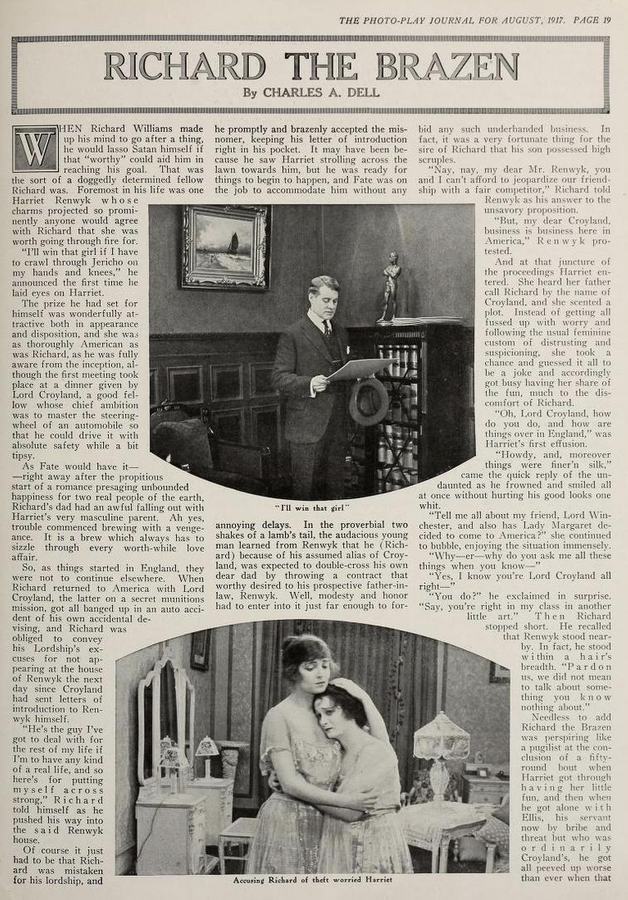
Moreover, the film touches upon the societal facades that individuals often adopt. The world Richard enters is one where appearances can be deceiving, where titles and manners often mask true intentions or character. His own deception, though born of circumstance and romantic impulse, mirrors the broader societal tendency to present a curated version of oneself. The ultimate unraveling of his masquerade, therefore, becomes a triumph of authenticity over artifice, a powerful declaration that truth, in the end, will prevail. This narrative arc, where a false situation culminates in a revelatory crisis, is a potent storytelling device, capable of both thrilling and satisfying the audience's desire for justice and genuine connection.
In an era devoid of synchronized sound, the art of cinematic storytelling relied heavily on visual eloquence, meticulous pacing, and the judicious use of intertitles. Richard the Brazen exemplifies this mastery, employing a narrative rhythm that keeps the audience engaged without ever feeling rushed or sluggish. Director George D. Baker, along with his creative team, understood the delicate balance required to convey plot intricacies and emotional nuances through purely visual means. The camera work, while perhaps rudimentary by today's standards, is effective in establishing settings and focusing on the expressive faces of the actors. Close-ups, though less frequent than in later decades, are strategically deployed to highlight moments of intense emotion or significant realization, drawing the viewer deeper into the characters' inner worlds.
The intertitles, far from being mere plot facilitators, often serve as an additional narrative voice, sometimes injecting humor, sometimes providing crucial exposition, and at other times amplifying the emotional stakes. They are crafted with a literary sensibility that complements the film's romantic tone, acting as a bridge between the visual spectacle and the audience's comprehension. The editing, too, plays a vital role in building suspense and accelerating the pace towards the dramatic climax. The cuts are purposeful, guiding the viewer's eye and maintaining a coherent flow, a skill that was still very much in its formative stages during this period of filmmaking. One can draw parallels to the crisp narrative drive found in other serials and adventures of the time, such as The Ventures of Marguerite or Neal of the Navy, which similarly relied on dynamic visual storytelling to keep audiences on the edge of their seats.
The film's sets and costumes, while perhaps not extravagant, are meticulously designed to evoke the specific social milieus—from the refined elegance of English aristocracy to the more understated comfort of Richard’s true background. These visual cues, alongside the actors' performances, work in concert to create a believable world, allowing the audience to suspend disbelief and fully invest in the romantic predicament. The contrast between Richard's initial Texan attire (implied, perhaps, before his transformation) and the tailored suits and monocle of the English peer would have been a visual shorthand for his assumed identity, instantly communicating his new role. This attention to detail, even in the silent era, speaks volumes about the dedication to craft that characterized early cinema.
As the narrative progresses, the complications stemming from Richard's false situation inevitably escalate, weaving a tighter and tighter net around our resourceful hero. The romantic tension is palpable, the fear of exposure a constant undercurrent. This intricate web of deception, however, is not destined for a slow, agonizing unraveling. Instead, it culminates in a stirring and surprisingly visceral confrontation that serves as the ultimate crucible for Richard’s true character. The film delivers a thrilling fight with a burglar, a classic dramatic device that allows for a swift, decisive resolution to the masquerade.
This nocturnal struggle is more than just a mere action sequence; it is the moment of truth, the ultimate test of Richard’s inherent bravery and physical prowess. Stripped of his borrowed title and aristocratic facade by the sheer urgency of the situation, Richard must rely solely on his innate courage and strength. It is in this raw, unvarnished display of heroism that his true identity, his genuine nobility, shines brightest. The fight sequence itself, while likely choreographed with the conventions of 1917 cinema, would have been a heart-pounding affair for contemporary audiences, a testament to Morey’s physical acting and the director’s ability to stage compelling action without dialogue. The stakes are not just the recovery of stolen goods, but the revelation of Richard's very soul.
The aftermath of this dramatic scuffle is the moment of catharsis. The true state of affairs is revealed, the layers of pretense peeled away, exposing the Texan scion beneath the English peer. Crucially, this revelation does not diminish Richard in the eyes of the woman he loves; rather, it elevates him. His actions in defending her, his undeniable bravery, prove that his worth lies not in a title, but in his character. He is "restored to his rightful title as scion of a Texas family," a resolution that is both satisfying and deeply romantic. It reinforces the film's central message: true heroism and love transcend superficial social distinctions. This kind of dramatic reveal, where a character's true colors are shown under duress, is a timeless storytelling trope, seen in everything from high drama to lighthearted comedies, and it’s executed here with a charming sincerity that speaks to the era’s sensibilities. One might even compare the dramatic reveal of character through action to films like Doctor Neighbor, where hidden truths come to light, albeit in a different context.
Watching Richard the Brazen today is more than just an exercise in historical appreciation; it's an opportunity to connect with the very foundations of cinematic storytelling. It reminds us of an era when narrative clarity, emotional sincerity, and compelling performances were paramount, unassisted by the elaborate technological wizardry we often take for granted. The film serves as an excellent benchmark for understanding the evolution of romantic adventures in cinema. Its straightforward yet engaging plot, driven by a charming protagonist and a captivating leading lady, paved the way for countless romantic comedies and dramas that would follow.
The film's enduring appeal lies in its timeless themes. The struggle for identity, the pursuit of love against odds, and the triumph of genuine character over superficial appearances are narratives that resonate across generations. While the stylistic conventions of 1917 might appear quaint to a modern eye, the emotional core of the story remains remarkably potent. It’s a testament to the power of well-crafted storytelling and the universal language of human emotion, conveyed with such skill by actors like Alice Joyce and Harry T. Morey. When we consider other films of the period, such as Ramona or Law of the Land, we see a consistent thread of narratives exploring societal expectations, personal integrity, and the often-challenging paths to true love and self-discovery. Richard the Brazen fits perfectly into this rich tapestry, offering its own unique flavor of romantic escapism.
In conclusion, Richard the Brazen stands as a charming, if perhaps lesser-known, example of early silent cinema's capacity for engaging entertainment. It’s a film that celebrates the spirit of adventure, the allure of romance, and the fundamental belief in the triumph of inherent goodness. For those curious about the roots of cinematic narrative, or simply seeking a delightful escape into a bygone era of dashing heroes and elegant heroines, this film offers a rewarding experience. It reminds us that even without spoken words, the grand narratives of human experience can be told with profound clarity and captivating grace. It is a cinematic whisper from the past, still capable of stirring the heart and reminding us of the timeless allure of a true "modern knight."
IMDb —
1924
Community
Log in to comment.