DbcultAccessing Vault...
Cult Review
Senior Film Conservator
T
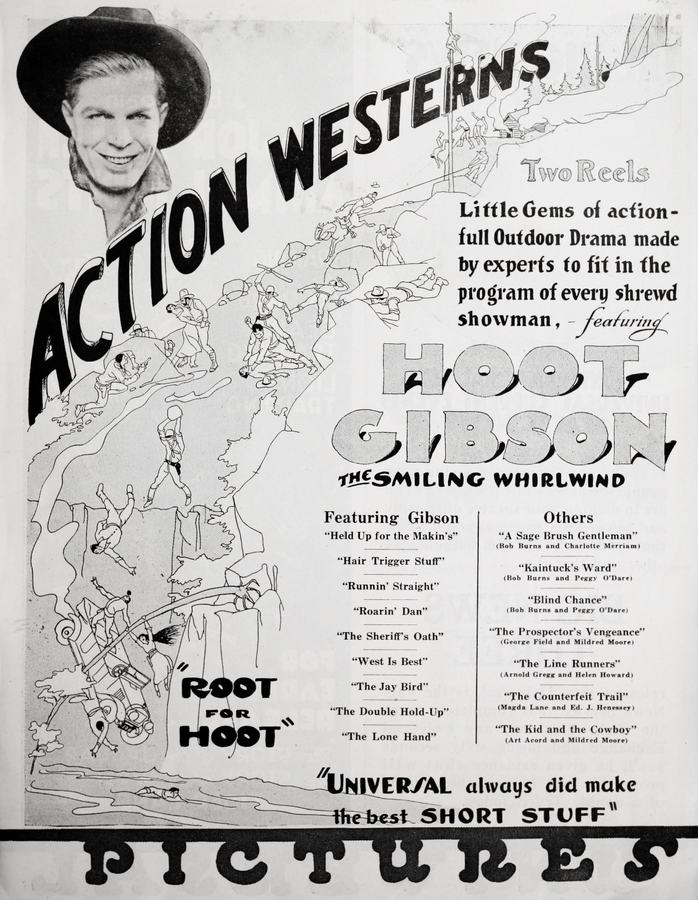
he silent era of the Western genre often oscillates between the stark, gritty realism of William S. Hart and the acrobatic, populist charm of Tom Mix. Somewhere in the golden middle sits Hoot Gibson, an actor whose screen presence in Roarin' Dan (1922) encapsulates a very specific American transition. Directed with a keen eye for spatial dynamics by the uncredited yet capable hands of the era, and penned by Arthur Henry Gooden, this film is far more than a standard horse opera. It is a nuanced character study wrapped in the leather and dust of a cattle town, exploring the friction between the untamed spirit of the pioneer and the encroaching domesticity of the 20th century.Hoot Gibson’s Dan is introduced not as a paragon of virtue, but as a man governed by the whims of the deck and the roll of the dice. Unlike the stoic heroes of later decades, Dan is "roaring" in his appetites—a wild cowboy whose good intentions are frequently sidelined by a crippling addiction to gambling. This flaw makes him remarkably modern. While films like The Craving dealt with darker, more visceral addictions, Roarin' Dan treats gambling as a social malaise that threatens the very fabric of the frontier community. Gibson plays the role with a breezy nonchalance that masks a deeper insecurity, a performance that anticipates the "charming rogue" trope that would dominate cinema for the next hundred years.
The cattle town itself serves as a character—a liminal space where the law is often a suggestion rather than a mandate. In this environment, Dan’s gambling isn't just a personal failing; it's a symptom of a world without anchors. The cinematography captures the vast, indifferent horizons of the West, contrasting them with the cramped, smoke-filled interiors of the saloons where Dan loses his wages and, incrementally, his dignity. This juxtaposition is vital; it highlights the tragedy of a man who has the entire wilderness to conquer but chooses instead the claustrophobia of the card table.
Enter the schoolteacher, played by the luminous Ethel Shannon. In the lexicon of the Western, the schoolteacher is the ultimate symbol of civilization. She represents the alphabet, the rule of law, and the moral order. However, Shannon’s character avoids the trap of being a mere Victorian scold. She possesses a proactive agency that was relatively progressive for 1922. When Dan is falsely accused of a robbery—a narrative pivot that forces the audience to confront the fallibility of frontier justice—it is she who steps into the breach.
Her rescue of Dan is not merely a legal or physical salvation; it is a spiritual awakening. This thematic arc of "redemption through the feminine gaze" is a staple of the era, yet here it feels earned. The chemistry between Gibson and Shannon provides a soft counterpoint to the ruggedness of the cattle drives. Unlike the more urbanized social conflicts found in Reggie Mixes In, the stakes in Roarin' Dan are primal. If Dan fails to reform, he doesn't just lose his social standing; he loses his soul to the dust.
Technically, the film utilizes the grammar of the early 1920s with surprising sophistication. The use of tinting—sepia for the dusty trails, deep blues for the treacherous nights—enhances the emotional resonance of the scenes. When Dan is facing the false accusation, the lighting shifts, casting longer, more expressionistic shadows that mirror his internal turmoil. This visual depth is reminiscent of the atmospheric tension found in The Woman in Black, though applied here to the wide-open spaces of the plains rather than a gothic interior.
The pacing of the film is relentless, mimicking the heartbeat of a man in a high-stakes poker game. Arthur Henry Gooden’s script avoids the flowery verbosity of many silent intertitles, opting instead for a directness that suits the setting. The dialogue, when it appears, is sharp and purposeful. There is a sense of economy here; every frame is designed to move Dan closer to his inevitable crossroads. The robbery sequence itself is choreographed with a clarity that many modern directors would do well to study. It isn't about explosions or rapid cuts; it’s about the geography of the crime and the mounting evidence that slowly entangles our protagonist.
"Roarin' Dan is a testament to the power of silent cinema to convey complex moral transformations through the sheer magnetism of its performers and the stark beauty of the natural world."
To fully appreciate Roarin' Dan, one must look at its contemporaries. While The Unpainted Woman explored the hardships of rural life through a more melodramatic lens, Roarin' Dan maintains a certain optimism. It believes in the possibility of the individual to change, provided they are given a reason to look beyond the immediate gratification of the win. It lacks the cynical edge of The Yellow Menace, focusing instead on the internal threats to the American dream—laziness, vice, and the abandonment of responsibility.
Furthermore, the film’s treatment of the "cattle town" as a microcosm of society is fascinating. It is a place where reputations are built on the strength of one’s word, making the false accusation against Dan all the more devastating. In a world without digital footprints or forensic science, a man's character is his only currency. This is a theme explored in different contexts in films like Den sorte Kugle, where the weight of a single action can define a lifetime. For Dan, the accusation is a mirror; it shows him what the world thinks of a gambler, and he realizes he doesn't like the reflection.
The collaboration between Gibson and Gooden resulted in a film that feels remarkably cohesive. Gibson’s physicality is on full display; he rides with an effortless grace that reminds the viewer he was a real-life rodeo champion before he was a movie star. This authenticity grounds the film. When Dan is on his horse, he is in his element, a stark contrast to the fumbling, desperate version of himself seen in the gambling dens. This duality is the heart of the film: the man the West made him, versus the man the town is breaking.
The supporting cast, including Mrs. Kruge and Leo Pattee, provide a solid foundation for the central drama. They represent the community that Dan is inadvertently hurting with his lifestyle. Their silent judgments carry weight, adding a layer of social pressure that makes his eventual reformation feel like a victory for the entire town, not just for himself. It is this sense of communal healing that elevates Roarin' Dan above the level of a mere adventure story. It is a narrative about reintegration—the wild cowboy finally coming home to himself.
In the grand tapestry of 1920s cinema, Roarin' Dan stands as a vibrant, if sometimes overlooked, thread. It lacks the avant-garde experimentation of European imports like Jan Vermeulen, der Müller aus Flandern, but it possesses a rugged American sincerity that is equally compelling. The film understands that the most dangerous frontier isn't the one with outlaws and indigenous conflicts, but the one located within the human heart.
The resolution, while predictable by modern standards, is delivered with a genuine emotional wallop. As Dan turns his back on his old vices, the screen seems to brighten, the compositions becoming more balanced and harmonious. It is a visual representation of a mind finding its center. For those interested in the evolution of the Western, or for those who simply enjoy a well-told story of redemption, Roarin' Dan is an essential watch. It reminds us that even the loudest "roar" can be channeled into something constructive, and that sometimes, the most heroic thing a man can do is stop running from himself and start listening to the quiet voice of his own better instincts.
Reviewer’s Note: While often compared to lighter fare like Hot Dogs or the pastoral comedy of Our Friends the Hayseeds, Roarin' Dan carries a moral weight closer to The Two Edged Sword. It is a pivotal work in Hoot Gibson's filmography that deserves a modern reassessment.
IMDb —
1920
Community
Log in to comment.