DbcultAccessing Vault...
5.8/10
Senior Film Conservator
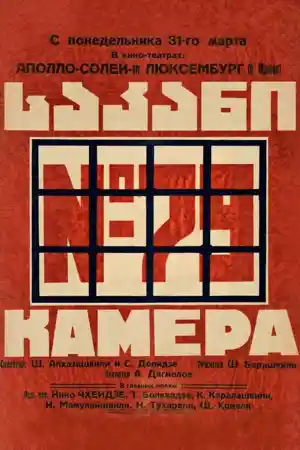
A definitive 5.8/10 rating for a film that redefined the boundaries of cult cinema. Sakani 79 remains a cornerstone of transgressive art.
If you have a soft spot for grainy black-and-white films where people communicate mostly through intense staring, then yes. You should watch Sakani 79 if you like history or just want to see how directors handled tension before they had loud soundtracks to do the work for them.
But if you hate reading title cards or get bored when a scene stays in one room for ten minutes, you will probably want to skip this one. It’s a movie for people who like to look at the textures of old walls and the sweat on an actor's face.
The movie is set in a prison, specifically cell number 79. It follows a revolutionary who is basically just waiting for something bad to happen while the world outside is changing.
It was directed by Siko Dolidze back in 1924 or 1925, and you can tell they didn't have a massive budget. Honestly, the lack of money makes it feel more real, like you're actually trapped in that damp cell with them.
The first thing I noticed was the lighting. It isn't that clean, perfect lighting you see in modern movies that try to look 'old.'
It's messy. The shadows are thick and black, and sometimes they swallow half of the actor's face.
There is this one shot where the main guy, played by N. Tukhareli, is just sitting in the corner. The light from the tiny window hits his eyes just right, and he looks absolutely terrified without saying a word.
It reminded me a bit of the vibe in The Whirlwind, though that one had a lot more going on outside. Here, the smallness is the whole point.
The pacing is... well, it's a silent movie from the twenties. It moves at its own speed, which is usually 'slow' followed by 'very fast' when something dramatic happens.
I noticed that the extras in the background sometimes look like they aren't sure where to stand. In one scene with a guard, a guy in the back just sort of wanders out of frame for no reason.
It’s these little imperfections that make me like it more. It feels like a group of people actually making something, not a factory product.
The acting is very physical, which is standard for the era. Lots of clutching at chests and throwing arms up in the air.
Sometimes it’s a bit much. Like, we get it, you’re sad, you don’t need to collapse onto the floor three times in a row.
But then there are these quiet moments that hit harder. When the prisoner is just looking at a piece of bread, it feels heavier than any of the big action scenes.
Speaking of big scenes, the revolution stuff feels a bit disconnected from the prison stuff. It's like two different movies fighting for space.
I preferred the prison parts. They felt more honest and less like a history lesson.
If you’ve seen Children of Fate, you know how these early Soviet-era films love their drama. Sakani 79 is no different, but it feels a bit more personal because of the cell setting.
There is a specific moment where a letter is delivered. The way the character's hands shake while opening it is actually really well done.
I think the film is better when it stops trying to be a 'big story' and just focuses on the guy. The politics are there, but the human fear is what stays with you.
I did find myself checking how much time was left around the forty-minute mark. It starts to repeat itself a little bit, with a lot of walking back and forth in the cell.
It’s not as tightly edited as The Final Close-Up, which kept me a bit more hooked. But for what it is, it works.
The title cards are okay, though some of them feel a bit preachy. That’s just the style of the time, I guess.
I loved the way the camera lingered on the textures of the prison uniforms. You can almost feel how itchy and cold that fabric must have been.
I wonder if people back then found it as claustrophobic as I did. Probably more so, since the history was fresher for them.
Compared to something like Mammy, this is obviously way more serious and dark. It doesn't want to make you feel good; it wants to make you feel something.
Anyway, it’s a solid piece of Georgian cinema. It’s not a masterpiece that will change your life, but it’s a very good way to spend an hour if you want to see some real cinematic grit.
Just don't expect a happy ending or a lot of jokes. It’s a movie called Cell 79, after all. What did you expect?
I’ll probably think about those shadows for a few days. They really did a lot with very little back then. It makes you realize that you don't need a hundred million dollars to make a scene feel heavy.
If you're looking for more from this region, maybe check out Something Different, but Sakani 79 is a better place to start for the pure drama of it all.
I'm glad I watched it, even if I needed a nap afterwards to recover from all the staring.
IMDb —
1917
Community
Log in to comment.