DbcultAccessing Vault...
5.8/10
Senior Film Conservator
A definitive 5.8/10 rating for a film that redefined the boundaries of cult cinema. Vanity Fair remains a cornerstone of transgressive art.
Stepping back into the nascent days of cinema, one encounters a fascinating landscape where literary giants were eagerly translated onto the silver screen, often with a bold and sometimes surprisingly nuanced hand. Among these early adaptations, the 1915 rendition of William Makepeace Thackeray's monumental novel, 'Vanity Fair,' stands as a testament to the era's ambition. Directed by Charles Sumner Williams and starring the formidable Minnie Maddern Fiske as the iconic Becky Sharp, this silent film offers more than just a historical curiosity; it provides a compelling glimpse into how complex character studies and sprawling social critiques were articulated without the aid of spoken dialogue. It's a journey into a world where expressions, gestures, and intertitles bore the entire weight of narrative and emotional conveyance, a challenge that, in the right hands, could yield astonishing results.
Thackeray's novel, a biting satire on the follies and vanities of 19th-century British society, presented a formidable task for any adapter. Its sprawling cast, intricate subplots, and the author's omnipresent, often cynical, narration are not easily condensed. Yet, this 1915 film, featuring a notable ensemble including Frank McGlynn Sr., Richard Tucker, and Shirley Mason, endeavors to capture the essence of Becky Sharp's relentless ascent and the moral compromises inherent in her pursuit of status. The film, much like the novel, invites us to observe rather than simply empathize, charting the course of a woman determined to carve out her own destiny in a world not designed for her kind. It’s a narrative that resonates deeply even today, reflecting timeless themes of social mobility, class struggle, and the often-deceptive allure of wealth and power.
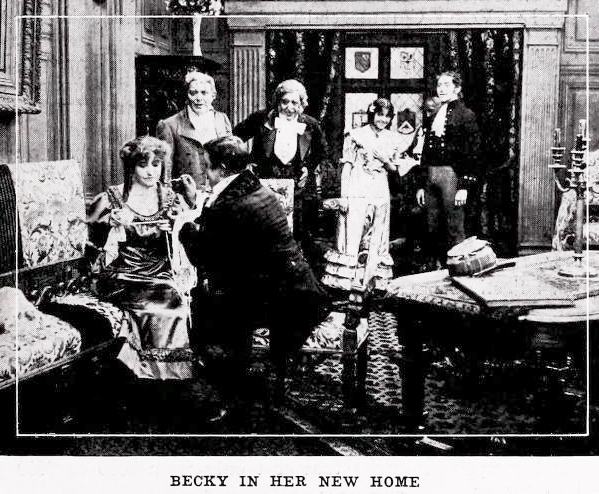
Minnie Maddern Fiske's portrayal of Becky Sharp is, in many respects, the beating heart of this silent epic. Fiske, a celebrated stage actress, brings a theatricality that translates remarkably well to the silent medium. Her Becky is not merely an opportunist; she is a survivor, a strategist, a woman whose intelligence and wit are her primary weapons against a society that would otherwise dismiss her. From her humble beginnings as an orphan, cast into the less-than-tender mercies of the Misses Pinkertons, Fiske's Becky exudes a fierce, almost predatory, intelligence. We see the calculations in her eyes, the subtle shifts in her demeanor as she navigates the treacherous waters of social interaction. When Amelia Sedley, portrayed with a delicate naiveté by Shirley Mason, extends an invitation to her home, it's less an act of pure kindness for Becky and more an opening, a door to be exploited.
The film excels in illustrating Becky's transformation from a perceived dependent to a proactive agent of her own fate. Her designs on Joseph Sedley, Amelia's self-satisfied brother, are rendered with a delightful blend of charm and cunning. It’s a masterclass in silent performance, where the flicker of an eyelid or the subtle curve of a smile must convey volumes. Fiske avoids reducing Becky to a one-dimensional villain; instead, she paints a portrait of a woman driven by circumstance, albeit one who embraces her more ruthless instincts with an almost admirable lack of apology. This nuanced approach allows the audience to understand, if not always condone, Becky's choices. In an era where female characters were often relegated to damsels or vamps, Becky stands as a complex, active protagonist, much like the strong female leads found in films such as Fanchon, the Cricket or Behind the Scenes, though Becky's moral compass points in a distinctly different direction.
The narrative’s genius lies not just in Becky's journey, but in how her presence acts as a catalyst for seismic shifts in the lives of those around her. The Sedley family's bankruptcy, a pivotal moment, is depicted with a pathos that underscores the fragility of social standing. Old Mr. Osborne, portrayed by Frank McGlynn Sr., embodies the rigid class prejudices of the era, swiftly breaking the engagement between his son George and the now-impoverished Amelia. George Osborne, played by Richard Tucker, is a character whose flaws are magnified by his vanity and susceptibility. His eventual marriage to Amelia, spurred by the conscientious Captain Dobbin (George A. Wright), feels less like a triumph of love and more like a reluctant adherence to honor, a theme that resonates with the more dramatic interpersonal struggles seen in films like The Secret Sin, where moral obligations clash with personal desires.
The film adeptly uses visual storytelling to convey these relational dynamics. The stark contrast between the Sedley family's initial comfort and their subsequent destitution is a silent but powerful commentary on the capricious nature of fortune. The quiet dignity of Amelia, even in her suffering, highlights Becky's more pragmatic, almost cynical, approach to life. It's a world where true sentiment often takes a backseat to social climbing and financial security, a truth that Becky understands implicitly from her earliest days. The interplay between these characters, often conveyed through subtle glances and exaggerated gestures, forms the emotional bedrock of the film, allowing the audience to trace the intricate web of relationships that Becky so skillfully manipulates.
Becky's arrival at Queen's Crawley marks a new, more expansive chapter in her life, a period where her ambitions truly take flight. Her interactions with the eccentric and avaricious Sir Pit Crawley, and her subsequent marriage to his son, Rawdon Crawley (played by Philip Quinn), are depicted with a keen eye for the absurdities of the upper classes. Their ensuing poverty, a constant shadow over their lives, forces Becky into ever more daring schemes. Her flirtation with the powerful Lord Steyne, a dangerous game played for financial gain and social leverage, is a highlight of Fiske's performance, showcasing Becky's audacity and her willingness to risk everything for advancement. This segment of the film, with its depiction of societal hypocrisy and the transactional nature of relationships, could draw thematic parallels with the darker undercurrents explored in films like Shadows of the Moulin Rouge, albeit in a more aristocratic setting.
The inclusion of the Battle of Waterloo, a grand historical backdrop, adds a layer of epic scope to the personal dramas unfolding. The chaos and tragedy of war, particularly the death of George Osborne on the battlefield, serve as a stark reminder of the larger forces at play beyond individual machinations. It’s a skillful juxtaposition of the micro and macro, showing how personal destinies are often irrevocably shaped by historical events. The film manages to weave these disparate threads together, maintaining a coherent narrative flow despite the inherent challenges of adapting such a dense source material into the silent format. The use of intertitles, while necessary, is generally well-judged, providing enough context without bogging down the visual storytelling. The production design, for its time, likely aimed for a certain period authenticity, helping to immerse the viewer in Thackeray's world of ballrooms and battlefields.
To truly appreciate 'Vanity Fair' (1915), one must engage with it on its own terms, as a product of early cinematic art. The performances, particularly Fiske's, are often broad by modern standards, yet they possess an undeniable power and clarity essential for conveying emotion without dialogue. The reliance on facial expressions, body language, and carefully choreographed movements becomes a language in itself, demanding a different kind of viewership. This film, like many of its contemporaries, asks the audience to participate more actively in the construction of meaning, filling in the gaps that sound would later provide. It’s a testament to the ingenuity of early filmmakers like Charles Sumner Williams that they could translate such a complex literary work into a visually engaging narrative, often with limited resources and an evolving cinematic grammar.
The film's exploration of ambition, class, and morality remains surprisingly pertinent. Becky Sharp, in her relentless pursuit of a better life, embodies a certain proto-feminist spirit, challenging the constraints placed upon women in her era. While her methods are often morally questionable, her drive is undeniably compelling. The film doesn't shy away from depicting the hypocrisy and superficiality of the society she inhabits, a critique that Thackeray himself so masterfully articulated. This enduring relevance is what elevates 'Vanity Fair' beyond a mere historical artifact, positioning it as a significant early example of how cinema could tackle profound social commentary.
Comparing it to other films of the period, one can see 'Vanity Fair' striving for a certain gravitas and sweep that was often reserved for historical epics like Bismarck or romantic dramas of the day. Its strength lies in its central performance and its willingness to delve into the less savory aspects of human nature. While the pacing might feel deliberate to a modern audience accustomed to rapid cuts and intricate soundscapes, there is a contemplative quality to silent film that allows for a deeper absorption of visual detail and character nuance. The film's ability to maintain narrative coherence across its various plot points, from the intimate struggles of the Sedleys to the grand scale of Waterloo, speaks volumes about its structural integrity.
The challenges of adapting a novel as rich and multifaceted as 'Vanity Fair' are immense, and Charles Sumner Williams, along with his team, made choices that reflect the cinematic language of 1915. The film necessarily streamlines much of Thackeray's intricate plotting and internal monologues, focusing instead on key dramatic incidents and the external manifestations of character. This approach, while perhaps sacrificing some of the novel's depth, ensures a narrative that is accessible and engaging for a silent film audience. The casting choices, particularly Fiske, demonstrate an understanding of how to translate stage presence into screen presence, a crucial skill in the early days of cinema.
In conclusion, 'Vanity Fair' (1915) is more than just a historical curiosity; it is a fascinating and often compelling early cinematic interpretation of a literary masterpiece. It showcases the expressive power of silent film, the enduring appeal of Thackeray's characters, and the timeless nature of his social critique. Minnie Maddern Fiske's Becky Sharp remains a captivating figure, a woman whose ambition, cunning, and resilience cut through the societal strictures of her time. For those interested in the evolution of film, the art of adaptation, or simply a compelling character study, this silent rendition of 'Vanity Fair' offers a rich and rewarding viewing experience. It reminds us that even without spoken words, the human drama of aspiration and downfall can be portrayed with profound impact, echoing the complex moral landscapes found in other character-driven dramas of the era like The Coward or The Bargain. It’s a vibrant piece of cinematic history that continues to provoke thought and conversation about the nature of ambition and the society that both fosters and constrains it.

IMDb —
1936
Community
Log in to comment.