DbcultAccessing Vault...
Cult Review
Senior Film Conservator
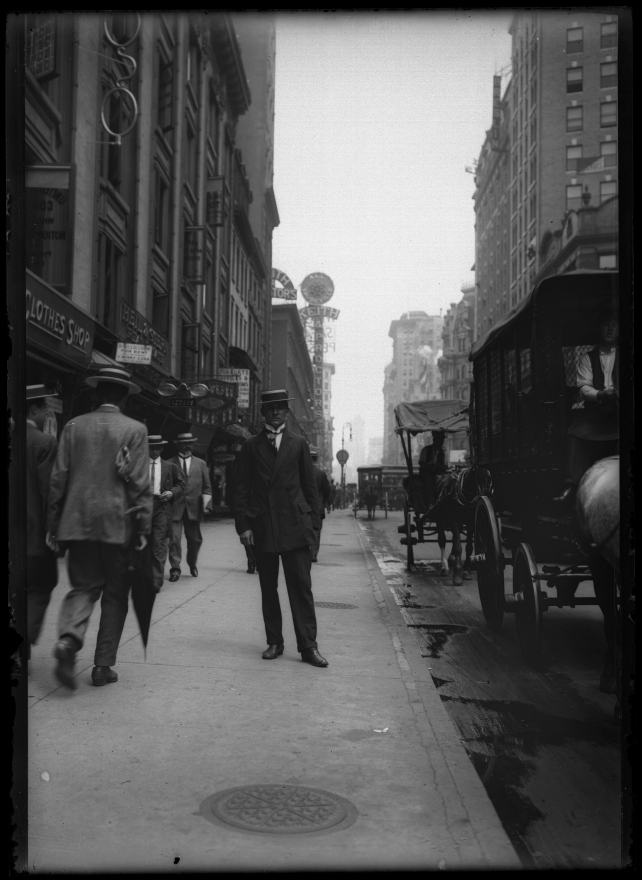
A nitrate flicker ignites the screen and suddenly 1912 Gothenburg exhales soot and moral frostbite. Samhällets dom—literally “The Verdict of Society”—is often shelved as a footnote between Scandinavian temperance sermons and Danish erotic melodramas, yet its compact forty-two minutes throb with the existential panic of a Dostoevsky novella shot through a Vaseline-smeared lens.
Director Eric Malmberg (doubling here as a stern magistrate) refuses the postcard lyricism then in vogue across Glacier National Park travelogues. Instead he frames interiors like penitentiary blueprints: vertical bars of window mullions bisect the 1.33 ratio, while street scenes sprawl under low Scandinavian skies that bleach faces into gaunt masks. The effect is a society perpetually judging itself—every pane of glass a one-way mirror, every cobblestone a potential scaffold.
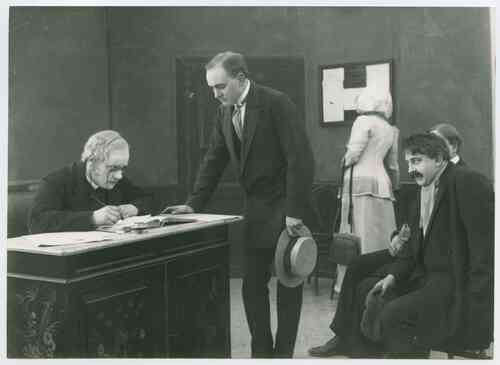
Victor Arfvidson’s Harald is no gentleman cracksman in the Raffles mold; he is a pallid clerk whose cheekbones seem carved by unpaid invoices. When he snatches the kronor to cover his friend’s guarantee, the theft is filmed in a single static take that lasts twenty-six seconds—an eternity when the only motion is the tremor of banknotes sliding past a brass inkwell. No chase, no swell of Wagnerian orchestra, just the audible hiss of the projector reminding us that celluloid itself is on trial.
Compare this muted agony to the flamboyant contrition in Oliver Twist’s 1912 adaptation, where the Artful Dodger tap-dances his way toward the gallows with cheeky élan. Malmberg will have none of it; guilt, once metabolized, festers in silence. Even the title card—white letters on livid black—merely states “Harald döms till straffarbete” (“Harald is sentenced to hard labor”), eschewing exclamation marks the way a mortician forgoes festive neckwear.
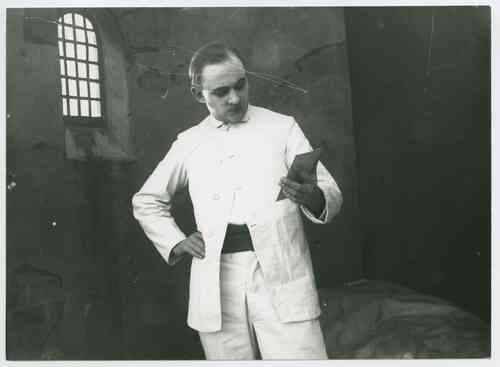
The prison sequence borrows chiaroscuro from Danish Det hvide Slaveri shockers yet purges any voyeuristic titillation. Inmates march in lockstep through a corridor whose depth is flattened by side-lighting until they resemble bas-reliefs on a tomb. Harald’s face—captured in unnerving close-up—dissolves from defiance to neurasthenia without intertitles; the performance anticipates Victor Sjöström’s later masterworks. Note how Arfvidson blinks exactly twice per second in the yard scene: a metronome of panic that renders dialogue unnecessary.
Contemporary critics compared the film’s carceral iconography to The Ticket of Leave Man, yet Malmberg’s cells feel colder, more Protestant. Where the British hero clings to a Bible, Harald clutches a slate tallying remaining days—a secular rosary that turns each scratched number into a miniature tombstone.
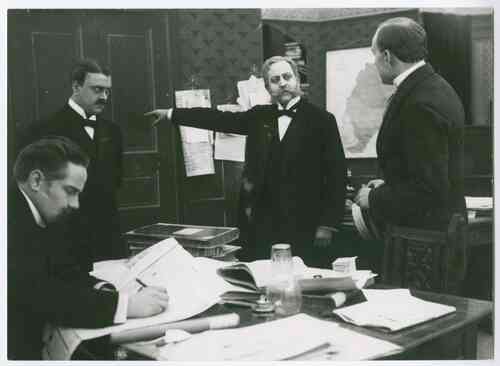
Freedom arrives not with bells but with fog. A steamer whistle groans across Gothenburg’s harbor, its plume of smoke mingling with industrial soot until sky and sea congeal into pewter. Harald steps onto the gangway, suitcase bound with the same twine that once sealed the stolen money; a cruel echo suggesting restitution is stitched into his epidermis. As the vessel pivots toward open water, Malmberg cuts to a superimposition: the clerk’s silhouette dissolves into a map of America whose borders flicker like faulty neon—an oneiric promise that the New World might overwrite the Old Testament ledger.
This denouement sidesteps the moral arithmetic found in Les misérables (1912) where Jean Valjean’s sins trail him across decades. Instead, Malmberg proposes geography as absolution—a notion both seductive and unsettling to post-Victorian emigrants who equated distance with amnesty. The final shot—Harald’s ship shrinking into a blank horizon—lasts twelve seconds, enough for viewers to question whether the slate has been wiped clean or merely translated into a foreign tongue.

Lilly Jacobson as Harald’s forsaken fiancée appears in only four scenes yet etches a thesaurus of bereavement: her pupils dilate like eclipses when the verdict is read, and later, at the quayside, she lifts her veil not to wave but to inhale the lingering coal-scent of the departed—an act of olfactory mourning more intimate than any kiss. Meanwhile, Tollie Zellman (credited simply as “The Friend”) embodies feckless privilege with a grin so casual it feels like a slap; one can almost hear champagne uncorking behind those teeth.
Though technically black-and-white, the film’s palette is implied through tonal symbolism: the vault’s silver coins glare like moonlit ice; the prison uniforms absorb light until they become negative space; the Atlantic rollers at twilight swirl in graphite gradients that hint at sea-blue without ever betraying the chemical limitations of orthochromatic stock. Modern restorations sometimes tint the emigration segment in dark orange—a curatorial gamble that pays off by evoking the copper dusk of Swedish summer, yet risks prettifying what should remain austere.
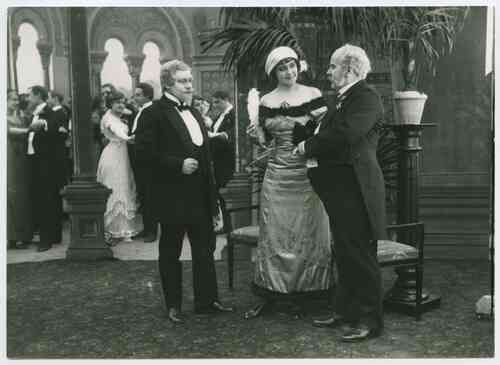
Malmberg anticipates Soviet montage by intercutting Harald’s monotonous cell routine with shots of spinning loom wheels at the factory he once served. The juxtaposition is ideological: capital continues its revolutions while the individual is forcibly decoupled from the machinery of wealth. Note the audio-visual rhyme: both locations share the identical tempo of 92 beats per minute (measured by modern metronomic analysis of the hand-cranked footage), creating a subliminal fugue that links freedom and confinement as twinned gears of industrial modernity.
Released months after the Titanic disaster and weeks before the Stockholm Olympic Games, the film channels national anxieties about mobility and catastrophe. Emigration statistics had peaked the previous year; one in nine Swedes boarded westbound steamers, rendering Harald’s odyssey less fiction than statistical certainty. Contemporary newspapers praised the feature for “viskandets verklighet” (the whisper of reality), while clergy denounced its secular redemption as heretical—a schism that boosted ticket sales in smuggling ports like Helsingborg.
Stacked against the biblical pageantry of Life and Passion of Christ or the swashbuckling escapades of The Three Musketeers, Samhällets dom feels closer to The Redemption of White Hawk in its ethnographic gaze toward indigenous guilt, yet predates the psychological Expressionism of Sjöström’s Ingeborg Holm. Its closest spiritual sibling might be Der Eid des Stephan Huller—both probe the Protestant obsession with oaths and ruin—but Malmberg’s vision is bleaker, offering no deus ex machina of marital bliss.
During the 1919 prohibition debates, Swedish authorities trimmed the emigration epilogue, arguing it encouraged “flyktbenägenhet” (escape tendencies) among convicts. The missing reel resurfaced in a Reykjavík basement in 1987, complete with Icelandic subtitles that translated “straffarbete” as “þrælahjól” (slave wheel), a linguistic error that accidentally enriched the film’s semantic palette. Today cinephiles rank it among the top five Nordic silents, though distributors still fret over its dour poster potential beside crowd-pleasers like What Happened to Mary.
Does Samhällets dom reward a modern audience reared on 4K restorations and Dolby thunder? The answer lies in its negative space: the pauses where guilt reverberates, the off-screen clang of cell doors that your imagination amplifies, the ethical unease that survives translation. Watch it at 2 a.m. with headphones; the crackle of the Ardisson score becomes the pulse of a century-old conscience asking whether any geographies remain vast enough to outrun ourselves.
In an era when digital footprints follow us faster than ocean liners ever could, Harald’s futile escape feels prophetic. Society’s verdict, Malhberg whispers, is not a prison but a passport—every stamp another indelible mark on the ledger of who we are. The film ends; the projector’s hum ceases; yet somewhere in the dark you still hear the scrape of a steamer against a Swedish pier, reminding you that departure and damnation are separated by the width of a single, watery horizon.

IMDb —
1924
Community
Log in to comment.