DbcultAccessing Vault...
Cult Review
Senior Film Conservator
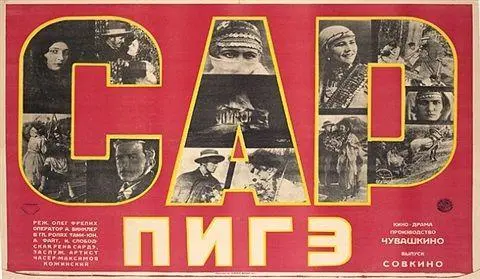
Should you watch Sar-Pige in the modern era? Short answer: Yes, but only if you view it as a historical artifact rather than a leisure-time entertainment. This film is for the dedicated cinephile and the cultural historian; it is absolutely not for someone looking for a fast-paced or lighthearted cinematic experience.
Sar-Pige stands as a foundational pillar of Chuvashkino, representing a rare moment where a specific ethnic identity was thrust into the spotlight of early Soviet cinema. It is a film that breathes with the heavy air of the past, capturing a world that was already disappearing when the cameras started rolling. While it lacks the technical polish of contemporary Hollywood exports like The Fighting Trail, it possesses a raw, unvarnished honesty that makes it far more compelling as a social document.
1) This film works because it captures a specific cultural texture—the Chuvash costumes, traditions, and landscapes—with an ethnographic precision that feels authentic rather than performative. 2) This film fails because its narrative structure is frequently interrupted by didactic title cards that prioritize political messaging over organic character growth. 3) You should watch it if you are interested in the evolution of Soviet silent cinema or the representation of minority ethnicities in early 20th-century film.
To understand Sar-Pige, one must understand the context of Chuvashkino. Under the direction of Ioakim Maksimov-Koshkinskiy, this was more than just movie-making; it was nation-building. The film acts as a mirror held up to a people who had long been marginalized. When we see the titular character navigating the treacherous social waters of her village, we aren't just watching a girl in trouble; we are watching the personification of a culture under siege. The specificity of the setting is its greatest strength. Unlike the generic urban settings of His Own Law, the rural expanse in Sar-Pige feels like a character itself—vast, indifferent, and beautiful.
The pacing is deliberate. Some might call it slow. I call it rhythmic. It mimics the cycles of rural life, where tragedy doesn't always strike with a bang, but rather erodes the spirit over time. There is a scene involving a community gathering that lingers long enough to let the viewer soak in the details of the fabric and the expressions of the non-professional extras. It’s these moments that elevate the film above mere propaganda.
Andrey Fayt delivers a performance that reminds us why he became a staple of Soviet cinema. He has a way of occupying space that feels inherently threatening. Even in silence, his presence creates a tension that the rest of the cast must navigate. Tatyana May, as Sar-Pige, offers a performance rooted in internal suffering. While the acting style of 1927 often leaned into the theatrical, May finds moments of quiet stillness that feel surprisingly modern. She doesn't need to flail to show her character's pain; it’s all in the set of her shoulders.
Compare this to the more overtly melodramatic performances in Ingeborg Holm. While both films deal with social injustice, Sar-Pige feels grittier, less interested in tugging at heartstrings and more interested in showing the cold machinery of oppression. The interactions between the local kulaks and the peasants are handled with a bluntness that is refreshing. There is no sugar-coating the dynamics of power here.
The visual language of Sar-Pige is one of high contrast. The cinematography utilizes natural light to great effect, often casting long, harsh shadows that mirror the moral ambiguity of the characters. There is a specific shot of the Volga river at dusk that is haunting in its simplicity. It serves as a reminder that while human empires rise and fall, the land remains indifferent. This philosophical undertone is what separates the film from more forgettable silent era works like The Chinese Musketeer.
However, the film is not without its technical limitations. The transitions can be jarring, and the framing occasionally feels static. But these flaws contribute to its charm. It feels handmade. It feels urgent. It is a film that was clearly made with limited resources but an abundance of conviction. The use of close-ups is particularly effective, focusing on weathered faces that tell more of a story than any dialogue could. It’s brutal. It’s honest.
Yes, Sar-Pige is worth watching for anyone who values the history of global cinema. It provides a window into a world and a cinematic movement that is often overlooked in favor of the more famous Moscow-based productions. It is a challenging watch, but a rewarding one for the patient viewer.
Pros:
Cons:
One of my more controversial takes on Sar-Pige is that it is actually more critical of the Soviet system than it appears on the surface. While it ostensibly attacks the Czarist past, the depiction of a rigid, unyielding bureaucracy feels like a veiled warning about the future. The way the villagers are treated by those in power—regardless of the political label—is hauntingly universal. It’s a cynical film, disguised as a revolutionary one. This layer of ambiguity makes it far more interesting than a standard morality play like Paap No Fej.
The film’s ending is particularly noteworthy. It doesn't offer a clean resolution. Instead, it leaves the viewer with a sense of lingering unease. This isn't the triumphant socialism of later years; it's the messy, painful reality of people trying to survive in the wreckage of an old world. It’s a bold choice for 1927. It works. But it’s flawed. The lack of a traditional 'happy ending' might frustrate some, but it lends the film a gravity that resonates long after the screen goes dark.
"Sar-Pige is a film that demands your attention not through spectacle, but through the sheer persistence of its vision. It is a ghost of a cinema that almost was."
Sar-Pige is a fascinating, if occasionally frustrating, piece of cinematic history. It succeeds as a cultural document and a showcase for early Soviet acting talent, even if its narrative gears grind slowly. It is a necessary watch for those looking to expand their horizons beyond the Western canon. It is a film of mud, sweat, and genuine soul. It’s not a masterpiece, but it is essential. If you can handle the silence, the rewards are plenty.
IMDb —
1929
Community
Log in to comment.