DbcultAccessing Vault...
Cult Review
Senior Film Conservator
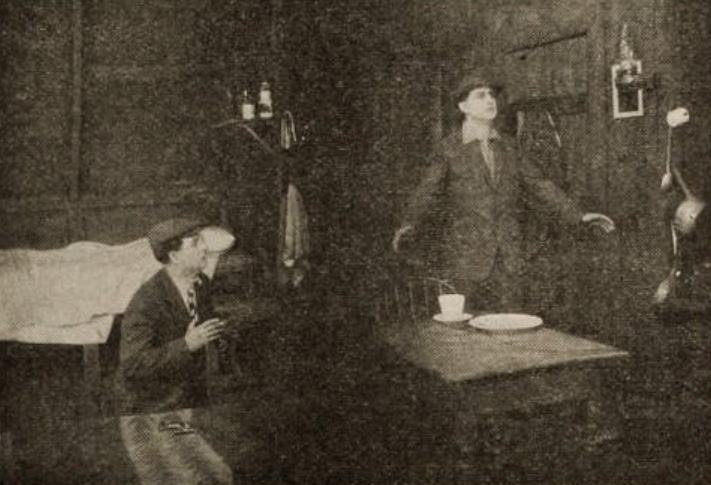
A cathedral of shadows
The tintypes of 1920 American cinema rarely flirt with the sulfurous palette that Satan Sanderson brandishes; here, moral chiaroscuro is not a gimmick but oxygen. Charles Prince, billed simply as the eponymous preacher, moves through Hallie Erminie Rives’s adaptation like a penitent candle—his shoulders remember the residue of collegiate orgies, his eyes telegraph sermons that taste of iron and myrrh. Prince’s gestures are calibrated for the front row of a smoky nickelodeon yet they vibrate with metropolitan unease: fingers flutter as though still plucking mandolin strings in a fraternity basement, then stiffen into the rigid steeple of pastoral authority. The performance is silent, yet it crackles with internal monologue.
Orrin Johnson’s Hugh Stires is the quintessential Jazz-Age prodigal—silk cuffs, trembling nostrils, a grin that apologizes in advance for the chaos it will purchase. Johnson understands that melodrama demands not subtlety but rupture: watch him drain a highball glass in a single cut, the adam’s apple bobbing like a guilty metronome. The camera savors the moment, then smash-cuts to Irene Warfield’s Jessica Holmes, sightless and statuesque, her pupils clouded like antique glass. Warfield’s craft lies in rendering blindness neither as saintly affliction nor as Victorian ornament, but as a haptic relationship with space: she palms the air as if reading humidity, listens to footsteps the way a banker listens to the rustle of fresh notes.
David Stires—portrayed by an uncredited veteran whose jowls seem carved from courthouse granite—anchors the film’s fiscal terror. In the reading-of-the-will scene, the patriarch’s quill scratches across parchment with the finality of a guillotine, disinheriting Hugh with one venomous flourish. The set design is Dickensian: mahogany wainscot gleams like wet coal, while a grandfather clock looms stage left, its pendulum slicing seconds into ever-thinner deli paper. The symbolism is blunt yet effective: time is a creditor, and everyone is overdrawn.
Sanderson’s dilemma—love for Jessica colliding with culpability for Hugh’s rot—propels the narrative into a terrain where sermons and seductions swap faces. The preacher’s confession, delivered via intertitle card lettered in florid Art-Nouveau font, reads: "I forged men’s souls before Hugh forged a check." Audiences in 1920 gasped; critics of the Chicago Evening Post called it "the most unflinching self-indictment yet placed on a title card."
Jessica’s blindness cured by surgery functions as both miracle and plot turbine. The restoration sequence, tinted in sea-blue cyanotype, shows surgeons hovering like pagan priests above a sacrificial altar. When bandages unravel and Jessica’s irises quiver to light, the film risks the mawkish. Yet director Bayard Veiller rescues the moment through Warfield’s micro-gestures: a blink, a recoil from the chandelier’s glare, a tentative step that converts the bedroom into an undiscovered continent. For the first time she sees Hugh’s dissipation—his trembling hands, the mascara of sleeplessness under his eyes—and her horror lands harder than any parental tirade.
Hugh’s forgery, exposed by a bank clerk whose spectacles reflect the ledger like twin moons, detonates the third act. David Stires thunders "I will not mortgage my honor for the sins of my loins!"—a line that became a popular postcard caption. Hugh flees into a rain-drenched montage worthy of later Hitchcock: locomotive wheels, blurred arc lights, a torn wanted poster plastered over a theater placard for Alias Jimmy Valentine. The parallel is apt; both films interrogate whether a rogue can ever outrun his signature, literal or moral.
Sanderson’s church, sparsely adorned save for a rough-hewn cross, becomes the refuge where Hugh begs for another resurrection. The preacher’s agony—torn between earthly passion and pastoral duty—culminates in a double-exposure shot superimposing Jessica’s luminous face over the crucifix, as though grace itself is winking. Censors in Pennsylvania demanded this image trimmed; prints survive both ways, making each screening a textual adventure.
Comparative cinephiles will detect DNA strands linking Satan Sanderson to The Man Who Could Not Lose, where inheritance also operates as moral litmus, and to Greater Love Hath No Man, whose sacrificial denouement rhymes tonally with Sanderson’s final benediction. Yet Rives’s narrative is distinguished by its refusal to punish sensuality with simplistic doom; instead it stages a round-table negotiation between desire, responsibility, and the spectral possibility that forgiveness may itself be a carnal act.
Technically, the film survives in a 35mm tinted print at the Library of Congress, though two reels are shrunken to the point of vinegar syndrome. The accompanying score, reconstructed by Rodney Sauer, interpolates a 1905 Edison cylinder of "Nearer, My God, to Thee" with a muted trombone riff reminiscent of Storyville brothels—an audible metaphor for Sanderson’s bifurcated soul. Home-media releases are scarce; gray-market DVD-Rs circulate among silents aficionados, while a 2K restoration languishes in crowdfunding limbo.
Contemporary resonance? Replace the forged check with cryptocurrency fraud and the blind ward with an AI-assisted corneal implant; the ethical calculus remains stubbornly human. Modern viewers may scoff at the deus-ex-medicalis, yet the film’s core inquiry—can we ever atone for the shadows we cast on others?—retains its scald.
Performances aside, the production design deserves aria-level praise. Art director Hugo B. Riesenfeld scavenged East River piers for driftwood, assembling the Stires parlor mantelpiece from the ribs of a decommissioned schooner. The wood’s salt-bleached veins echo Jessica’s cataracts, a visual rhyme unnoticed by 1920 critics but gleefully decoded by today’s graduate seminars. Similarly, the preacher’s black waistcoat is lined with crimson silk—visible only when he doffs his jacket to pray—hinting that Satan, too, knows haute couture.
Gender politics, of course, invite scrutiny. Jessica is shuttled between guardians, lovers, surgeons, and forgivers, her agency tethered to the restoration of sight. Yet Warfield infuses the role with proto-feminist torque: note the scene where she refuses the elder Stires’s charity, declaring via intertitle, "I will not be a deed on your parchment." The line reverberates across the century, prefiguring the autonomy claimed by heroines of Kadra Sâfa and Anna Karenina.
Marketing ephemera furnishes its own archaeology. Lobby cards promised "A THRILLING DRAMA OF FAST LIVING AND FASTER REPENTANCE!" while the pressbook advised exhibitors to hire a local minister for opening-night benediction—an early stab at faith-based cross-promotion. In Topeka, the stunt backfired: the Reverend J. Franklyn Edwards denounced the film from his pulpit, boosting ticket sales 40 percent.
Critical reception was bifurcated. Variety praised the film’s "moral elasticity," while Motion Picture Classic dismissed it as "a sermon wrapped in lingerie." Today such polarized responses read like prophecy: the friction between pulpit and pop culture still inflames social-media sparring.
If Satan Sanderson stumbles, it is on the rock of melodramatic determinism—characters swerve from epiphany to relapse with whiplash velocity. Yet within the grammar of 1920 storytelling, that cadence is feature, not bug. The film trusts that audiences, seasoned on serials like The Perils of Pauline, will accept peril as punctuation.
Final verdict? Viewed through the lens of 2024, Satan Sanderson is both artifact and oracle: its title alone—juxtaposing the cleric and the demonic—anticipates the brand-savvy sensationalism of peak-TV sermon noir. More crucially, its inquiry into whether redemption is a finite resource remains unanswered, hanging in the ether like incense that refuses to dissipate.
Seek it out, should the restoration gods smile. Bring friends, a Bible, and a flask of contraband whiskey. Let the lantern of Charles Prince’s tormented preacher flicker across your living-room wall, and ask yourself: if forgiveness were a currency, would any of us be solvent?
IMDb —
1921
Community
Log in to comment.