DbcultAccessing Vault...
6.6/10
Senior Film Conservator
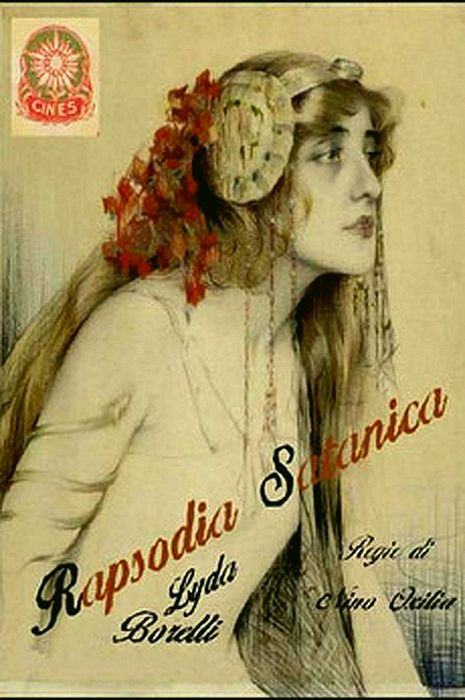
A definitive 6.6/10 rating for a film that redefined the boundaries of cult cinema. Satan's Rhapsody remains a cornerstone of transgressive art.
Imagine the last breath of La Belle Époque exhaled through a gilded horn, its notes corroded by absinthe and ether. Satan’s Rhapsody—shot in Turin in the bruised autumn of 1915, released two years later after censors scissors snipped every overt reference to menstrual blood—feels like inhaling that breath and discovering it laced with mercury. Nino Oxilia, dead at twenty-eight on the Piave front, directs as though he already knows cadaveric chill; his camera glides, swoons, pirouettes like a sleepwalker convinced the floor is water.
The plot, skeletal on paper, detonates in the mind: an aging diva, Alba (Lyda Borelli), whose name itself connotes dawn yet whose skin is dusk, trades her soul for a return ticket to the Eden of twenty-three. The intermediary is Mephisto, not your mustache-twirling boogeyman but a weary Florentine dandy who smells faintly of burnt newsprint and appears between frames, as if spliced in by the devil’s own projectionist. The single clause—no love—is less contractual footnote than death-row jingle. Once the ink dries, Alba’s mirror regresses; cobwebs retreat, arthritis evaporates, and Borelli’s famous pose plastique—that serpentine arm gesture which once sold out La Scala calendars—returns like a repressed monarch.
What follows is not the expected morality tale but a séance of desire. Alba enters the Venetian carnival clad in silver-lamé that behaves like liquid mercury; every mask lifts to reveal the same face, hers, multiplied like a hall of hysterical mirrors. Two brothers—Andrea the rational, Giulio the mystic—fall in love with her echo. Their studio is a cathedral of unfinished marble: torsos without limbs, mouths without tongues. Oxilia lights them from below so cheekbones become cliffs; when Alba poses, the chiaroscuro turns her clavicles into parentheses that enclose the film’s entire grammar of longing.
"To love is to age," the intertitle whispers, white on black, the letters twitching like maggots.
And so she loves, because prohibition is invitation lacquered in gun-oil. Each kiss accelerates time: a wrinkle here, a grey filament there. Borelli acts with her vertebrae; watch the way her spine arcs when the first crease reappears—an ouroboros recoiling from its own bite. She never overplays; instead she under-breathes, as though afraid respiration itself might smudge the newly painted mask of youth.
The brothers function as twin fates. Andrea offers domesticity—breakfast oranges, chintz curtains, the banal eternity of Tuesday. Giulio offers the abyss—nighttime gondola rides toward a horizon that drops off like a bad sentence. Alba oscillates, and the editing oscillates with her: match-cuts on candle flames, on black cat eyes, on the rotating prongs of a fork twirling spaghetti—metonymic hops that prefigure 1960s art-house fragmentation by half a century.
When the final betrayal arrives, it is not grand but granular: Alba whispers ti amo while washing Giulio’s bloodied knuckles after a brawl. The parchment singes; youth flakes like plaster off a bombed cathedral. Oxilia superimposes her aged face over her youthful body, the edges misaligned, creating a double-exposure that refuses to resolve. She runs through streets now suddenly deserted—Venica as limbo—until she confronts Mephisto at a fogged quayside. He is sketching her decay into a pocket-sized notebook. She begs for death; he counters with immortality minus mirrors. The last shot—one of silent cinema’s most harrowing—holds on her silhouette receding into a doorway of absolute black, the camera craning upward until architecture itself becomes tombstone.
Technically, the film is a tectonic shift. Oxilia employs tracking shots that slither across ballroom floors, predating Murnau’s Last Laugh by seven years. He layers double exposures not as gimmick but as ontological terror: youth and age occupying the same gelatin plane. The tinting strategy is psychotropic—cyan for dawn desire, bile-green for jealous paroxysms, arterial red for the moment the pact ruptures. The restoration available on the Cineteca di Bolognica 4K Blu-ray reveals brush-strokes of hand-painted sequins on Borelli’s gown, each disc catching light like a miniature sun.
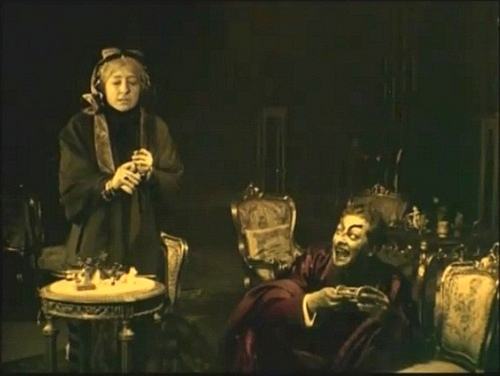
Compared to Oxilia’s earlier John Glayde’s Honor, which still genuflected to Victorian melodrama, Satan’s Rhapsody is a pagan exorcism. It converses across decades with Vampyrdanserinden’s erotic fatalism, and its DNA can be traced in The Count of Monte Cristo’s vengeance symmetries, though the latter dilutes metaphysics with swashbuckling.
Borelli’s performance is the film’s radioactive core. A stage megastar whose every public appearance caused crowds to faint, she understood the camera’s vampiric hunger. She modulates between and raw nerve: note the scene where she studies her aging hand—she flexes fingers once, twice, then lets the hand drop as if amputated. Critics of the era coined the term borellismo to describe the mass hysteria she induced; watching her dissolve in real time, one grasps why women copied her decadent-grief posture and pharmacies sold Borelli-brand arsenic soap.
The screenplay, credited to Fausto Maria Martini and producer Alberto Fassini, is a haiku stretched into a fever. Intertitles eschew exposition for incantation: "Time is a carnivore in lipstick," reads one. Another simply states "Tuesday. Rain. Wound." The scarcity of text intensifies the visual; you are forced to read faces the way medieval scholars read entrails.
Yet the film is not flawless. The comic relief subplot involving a bumbling notary (Giovanni Cini) feels airlifted from Keystone Comedies, tonally jarring against existential horror. Oxilia himself seemed to tire of it; he truncates the sequence with a smash-cut so abrupt the notary literally mid-gesture freezes, as though the director wished to excise via edit what censors would later snip anyway.
Historical context enriches the poison. Italy in 1915 was a country chewing on the chrome of modernity while its sons were already cannon-fodder in the Alps. Youth was currency hyper-inflated; to barter it away onscreen felt both sacrilegious and patriotic. The film premiered in April 1917, three months after Caporetto; audiences, many wearing black, saw in Alba’s bargain their own national pact with industrial slaughter. Mephisto wore evening dress because death had updated its wardrobe.
Beauty, Oxilia insists, is not skin-deep; it is soul-shallow, and thus evaporates the instant it is touched.
The score, lost for decades, was reconstructed in 2021 by cellist Valentina Paterno using period treatises and the chord progressions Borelli requested for her curtain calls. Heard today—fluttering violins underpinned by a tango heartbeat—it converts silence into velvet quicksand. When Alba’s final wrinkle reappears, the orchestra drops to a single piano striking a low F repeatedly, like someone knocking on a coffin lid from inside.
Gender politics shimmer ambiguously. On one hand, the narrative punishes a woman for desiring visibility; on the other, it grants her auteurship over her own aging, however doomed. Contemporary feminists like Elvia Stefanini reclaimed Alba as an anti-patriarchal saboteur: she spends male desire like counterfeit lire, bankrupts both brothers, and exits the narrative neither wife nor mother but pure vector of entropy. Read this way, the film anticipates The Honor of Mary Blake yet surpasses its didactic rehabilitation.
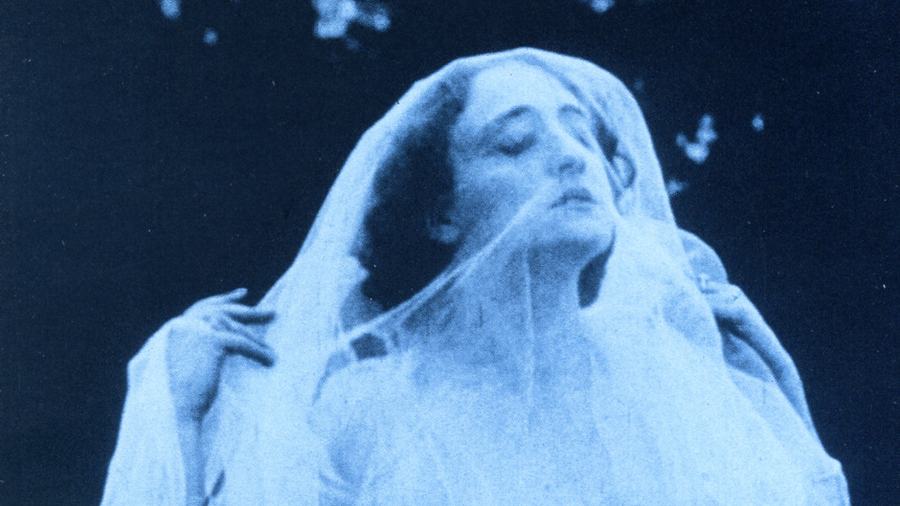
Restoration-wise, the 4K scan harvests nitrate grains like black orchids; you can almost smell the chemical bouquet. The HDR grading reveals nuances previously devoured by mold: a spider threading Mephisto’s cuff, the wet sheen on a morphine bottle, dust motes orbiting Borelli’s pupils like micro-planets of regret. Optional English subtitles translate intertitles while preserving original punctuation, including the scandalous em-dash that censors once replaced with a meek comma.
Special features brim with necromantic delights: a 20-minute essay on diabolical iconography in Italian silent film, a gallery of Borelli’s death-mask (cracked at the left cheekbone, rumor says by her own fingernail), and a 1916 Pear’s Soap ad where she sells cleanliness while covered in satanic glyphs—proof that commodification already licked the devil’s hooves.
Commercially, the release is niche but vital. Streaming platforms shuffle it under horror, yet its true habitat is the liminal corridor between body-horror and art-therapy. Amazon Prime currently offers it in a shoddy SD transfer; cinephiles should instead hunt the Il Cinema Ritrovato Blu-ray, region-free, laden with a 48-page bilingual booklet smelling of fresh ink and salt.
Comparative veins: if Hans hustrus förflutna explores how memory colonizes marriage, Satan’s Rhapsody stages the opposite—how amnesia colonizes the flesh. Where The End of the Rainbow promises pot-of-gold transcendence, Oxilia offers only the rainbow’s reflection in a puddle of quicksilver, alluring and lethal.
Critical reception then and now forms a Möbius strip. In 1917, the Vatican’s bi-weekly Civiltà Cattolica condemned it for "turning sin into spectacle." A century later, Cahiers du Cinéma ranked it among the 100 most beautiful films ever made, praising its "dermatological sorrow." Both verdicts are correct; heresy and hagiology share a vertebra.
My private ritual: each October I project it onto a bed-sheet strung between apple trees, the 16mm print crackling like dying cicadas. Bats swoop, chasing the beam as though pixels were insects. When Alba’s final wrinkle blooms, the garden smells of overripe pears and mortality. The audience—six or seven insomniacs—exhales simultaneously, a sound like wind leaving a cathedral. That collective exhalation is the film’s true soundtrack, proof that cinema can still be a pact with the unsayable.
Verdict: 9.5/10. Deduct half a point for the notary subplot, though perhaps even that blemish is necessary—beauty needs a scar to prove it once had skin. Watch it alone, without your phone, preferably after your thirtieth birthday when the first faint etchings of time appear at the corners of your own smile. Then look in the mirror. If you dare to say I love you, listen for the sound of parchment unfurling.
IMDb 4.7
1935
Community
Log in to comment.