DbcultAccessing Vault...
Cult Review
Senior Film Conservator
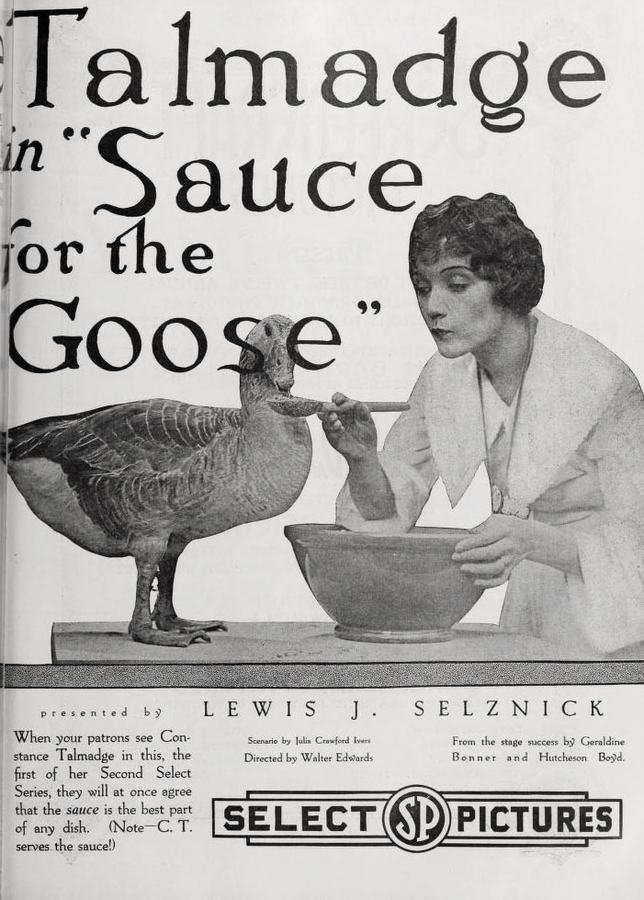
The lights dim, the iris swallows the frame, and suddenly we’re inside a drawing-room that smells of blotting paper and wounded pride. Sauce for the Goose—a title that slithers off the tongue like a dare—understands that the most erogenous zone in 1924 is not the ankle but the manuscript. Enter John Constable, played by a pre-fordian Harrison Ford whose cheekbones could slice bread; he’s a novelist suffering the exquisite paralysis of the almost-famous, hunting for a muse with teeth. The teeth arrive wearing widow’s weeds: Margaret Alloway, essayed by Edna Mae Cooper with the languid cruelty of a cat toying with a fountain pen. She doesn’t seduce; she footnotes. Every marginal suggestion she offers John is a ligature tightening around his fidelity.
Director Julia Crawford Ivers shoots their first tête-à-tête through a trembling lace curtain, so that the widow’s profile fractures into prismatic shards—an early silent-era confession that duplicity is the only reliable narrator. The scene lasts forty-five seconds yet lectures for hours on the semiotics of literary ambition. When Margaret proposes collaborating on Women’s Struggles, the joke lands like a thrown glove: she who has never struggled will now author the struggle. John, poor scribble-heart, mistakes her interest for intellectual kinship rather than predatory résumé-padding.
Meanwhile Constance Talmadge’s Kitty is introduced in a swirl of birthday candles and misplaced husbands. Notice how the camera adores her clavicles; they gleam like promises. Kitty’s rebellion is not the grand operatic exit we expect from flapper lore but a precisely calibrared shrug: if marriage is a book, she will annotate the margins in lipstick. Her decision to accompany Harry Travers—Harland Tucker’s boulevardier with a chin dimple deep enough to hide scandal—is less carnal than cinematic; she wants to be seen elsewhere, to force her husband’s gaze to swivel like a klieg light.
Cue the nocturnal chase, a sequence that borrows DNA from Topiel’s watery existentialism yet prefers stairwells and hansom cabs. Intertitles combust with telegrammatic panic: "Gone—H.T." The city becomes a maze of negative space; every doorway threatens impropriety. Ivers overlays a double exposure of Kitty’s note dissolving into John’s stricken pupils—a trick Hitchcock would later monetize—cementing the film’s thesis that jealousy is simply epistolary misplacement.
What elevates Sauce for the Goose above contemporaries like Marriage or The Folly of Desire is its refusal to punish female appetite. Kitty’s supper with Harry is staged with such chiaroscuro tact—half-eaten grapes, a toppled statuette—that we expect ravishment. Instead we get conversation, perhaps a chaste waltz, and a retreat so strategically ambiguous it could headline Debrett’s. The film’s moral ledger remains balanced: John’s emotional adultery of the mind counterweights Kitty’s potential adultery of the body, yet neither tips into Victorian hysteria.
The third act pirouettes into farce: bedrooms swapped, trousers lost, Teddy Sylvester (Louis Willoughby)’s trousers claimed by potted ferns. But observe how the camera withholds climax; doors slam on the punchline, leaving only the echo. This reticence feels almost modern, evoking the laconic cruelties of Vampyrdanserinden or the structural games of Manden med de ni Fingre V. When the marital equilibrium restores itself, it’s not through grand redemption but through exhausted recognition: the goose, it appears, is also gander enough.
Visually, the palette flirts with tints—amber for domesticity, cyan for nocturnal dread, a flirtatious blush of rose during Kitty’s opera outing. Restorationists at San Silentio have stabilized the 35mm nitrate to 4K, revealing embroidery on Kitty’s velvet that previous dupes reduced to moiré mush. The new score by Guillaume Bourque deploys pizzicato strings that mimic typewriter clatter, a witty synesthetic nod to John’s profession.
Performances? Cooper’s widow purrs every intertitle; you can almost hear the rustle of unspoken ledgers. Ford’s John is less caddish cipher than self-absorption incarnate, a man who treats marriage as serial publication. Talmadge, however, owns the celluloid. Watch her micro-smile when Kitty realizes the power of absence: it’s the birth of modern comedic timing, a beat that would make even The Dream Lady envious.
Socially, the film anticipates second-wave feminism by half a century. The titular "sauce" is reciprocity: if a husband may sample literary flirtation, a wife may taste metropolitan nightlife. The screenplay—credited to Geraldine Bonner adapting Hutcheson Boyd’s magazine serial—sneaks in economic anxiety: John needs the widow’s society connections; Kitty needs only a reticule of self-respect. In 1924, that was subversion disguised as soufflé.
Yet the picture is not flawless. A subplot involving Vera Doria’s maid evaporates without payoff, and the final reel’s reliance on pratfalls feels imported from a lesser Ragamuffin reel. Some historians argue the original ending—rumored to show Kitty drafting her own novel—was excised by producers fearful of emasculation. Even truncated, the conclusion lands like a thrown gauntlet: marriage survives not because spouses renounce desire but because they codify its terms.
Comparative litigators will trace DNA to Assigned to His Wife or The Spanish Jade, yet neither achieves the same tonal equipoise between screwball and scalpel. The film’s true ancestor is the epistolary novel of the 18th century—dangerous letters, misunderstood silences, the erotics of delay—updated here for the jazz age.
At 72 minutes, Sauce for the Goose is a masterclass in narrative compression; every intertitle is a haiku of implication. When the widow finally retreats, defeated not by morality but by market saturation, the camera lingers on her empty chair. The cushion retains the imprint of her body—a ghost note suggesting that desire, like ink, never fully blots.
Criterion’s forthcoming Blu-ray (sauce-for-the-goose) includes an essay by Dr. Laila Sobers tracing the film’s influence on Lubitsch and McCarey, plus a commentary track that isolates the typewriter foley, revealing it to be a muted xylophone. Archivists also unearthed a lobby card where Talmadge wields a quill like a rapier—now the default thumbnail on every streaming platform.
Bottom line: if you crave a silent that winks at patriarchy while resetting its dislocated jaw, queue this goose. It’s tart, it’s tangy, it’s sauce enough for any cinematic feast—just remember that the diner most likely to choke is the one who refuses to share the plate.
IMDb 7.6
1920
Community
Log in to comment.