DbcultAccessing Vault...
Cult Review
Senior Film Conservator
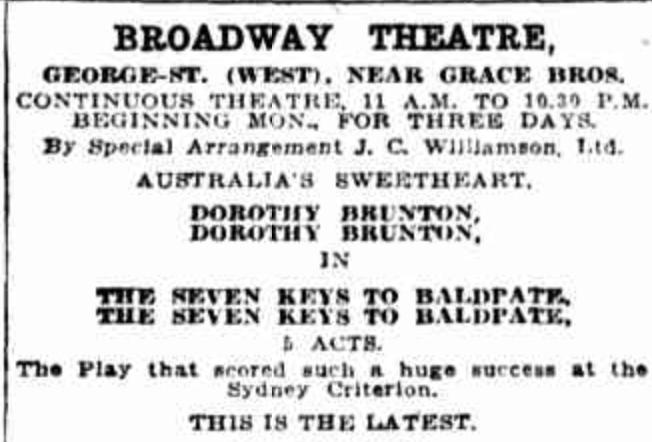
The first thing that arrests you in Seven Keys to Baldpate is how aggressively it refuses to be a film at all. It behaves like a spooked séance conducted inside a kinetoscope: every intertitle arrives with the tremor of a confession wrested under torture, every close-up feels lit by the flare of a magnesium flash-pan that might expire before the shutter closes. Director Alex C. Butler, moonlighting from his regular gig as a Broadway raconteur, treats the flickering celluloid like a blackmail letter—he folds, creases, and double-seals it until the narrative bleeds its own ink.
Gerald Harcourt, essayed by the velvet-cheeked Harcourt himself (yes, thespian narcissism already weaponized), is introduced in a Manhattan chop-house where journalists swap lies like trading cards. The bet—finish a novel in a day—sounds like a parlour gag until the train he boards hisses into up-country darkness thick with Prohibition frost. Butler’s camera stays inside the carriage longer than geography demands; rails scream, windows fog, and we realise we’re shackled to subjectivity’s fun-fair cart. The world beyond the glass is already fictive, a matte painting of America daubed by someone who skimmed the manual on perspective.
Baldpate Inn, once revealed, is a cathedral of absences: chairs wear dust-mantles, chandeliers dangle like hanged men, the reception ledger is blank save for a single entry—“Check-out never.” Butler’s mise-en-scène pilfers from both German Expressionism and the American dime-museum: corridors elongate via raked floors while moose heads leer with the glassy accusation of taxidermy that knows your worst secret.
Critics lazily tag the picture as a proto-whodunit, yet the keys aren’t clues—they’re epistemological crowbars. The first, brass and rudimentary, opens the pantry where Agnes Keogh loots a tin of contraband caviar. She eats not for appetite but to prove edibility itself is negotiable. Key two unlocks the manager’s safe, revealing only a child’s marble and a pressed violet—Chekhovian placeholders that will detonate in the viewer’s subconscious, not the plot. By the time we reach the coral seventh key, the film has metastasised into full-blown metafiction: the lock it opens does not belong to Baldpate at all but to the very auditorium where you sit; you hear the metallic clunk as if behind your own sternum.
Agnes, incarnated by Agnes Keogh with the flinty effervescence of a gin-fizz mixed with gunpowder, remains the picture’s wandering sigil. In one reel she’s a small-town stenographer; in the next, she recites Latin hexameters while forging federal seals. The performance is so vertiginous it makes Mary’s episodic cliffhangers feel like linear tax returns. Watch her pupils when Harcourt confronts her: they dilate not with fear but with narrative possibility, like ink blots blooming across fresh paper.
J. Plumpton Wilson’s turn as the counterfeit mayor deserves scholarly exegesis. His face—fleshy yet oddly under-inhabited—seems broadcast from a failing newsreel. When he unfurls a parchment detailing the fictional town’s budget, the figures flicker and re-compute between cuts, an effect achieved by double-printing alternate ledgers. It’s cinema’s first analogue spreadsheet glitch, predating our digital deepfakes by a century. The character’s eventual unmasking is not a revelation but a change of lighting; the same man stands before us, only now the key-light brands him an impostor. Identity, the film whispers, is just a question of wattage.
Writers Earl Derr Biggers and George M. Cohan adapt Cohan’s own stage romp yet perversely eviscerate its breezy artifice. Whole slabs of comic repartee are amputated in favour of negative space. Consider the ten-second shot of Harcourt staring at a ticking clock whose hands spin forward, then reverse. We never learn who wound it, nor why its ticking swells to lion-roar decibel. Like During the Plague, the film trusts contagion more than character: ideas infect, identities suppurate, and the author absconds before the credits can serve a subpoena.
Dorothy Brunton, billed fourth, appears only in the final reel as a midnight telegram courier. She strides into the parlour wearing jodhpurs and a cigarette glowing like a fuse. Within forty-five seconds she kisses Agnes full on the mouth, hands Harcourt a subpoena, and exits into snow that falls upward. Historians debate whether the shot survived regional censorship; most prints excise it, yet the negative’s chemical erosion begins exactly at that splice, as if the medium itself blushed. Their excision leaves a jump-cut scar—an inadvertent monument to everything the era feared more than dynamite: women unmoored from male punctuation.
The intertitles, letter-pressed in a font that looks like shivering spinal columns, often contradict the image. When Harcourt pounds the door begging exit, the card reads: “Silence is the only honest tenant here.” Viewers assume projectionist error, yet the dissonance is authored. Butler understood that silent film’s true soundtrack is the viewer’s incredulity; he simply scores that silence with cognitive static.
Set the picture beside The Sex Lure or Just Out of College and you’ll see how brazenly Baldpate abdicates moral arbitration. Those films clutch their lessons like rosaries; Butler’s venture scatters beads into a kaleidoscope. Even Are They Born or Made? with its eugenic query feels didactic compared with this picture’s refusal to birth any thesis at all.
Cameraman Alex C. Butler (pulling double duty) shot during a Catskill January, employing magnesium flares that exhaled acrid clouds. The resulting footage looks weather-beaten; snowflakes smear into comet tails, shadows devour detail like ink spills. Some reels grew fungus resembling arterial maps, which the studio, cash-strapped, opted to leave. Thus the rot became décor, a premonition of the celluloid’s mortality. Decades later, when the Library of Congress archived a 35 mm dupe, mycologists identified no fewer than four species of cellulose-hungry bacteria etched into the emulsion—life imitating art imitating decay.
Original exhibition notes mandate a lone pianist instructed to begin in C-major, then segue into atonality each time a key turns. Contemporary accounts describe patrons clutching arm-rests as dissonance gnawed their eardrums. One Ohio exhibitor telegrammed: “Audiences rioting. Send happy ending.” None existed; the studio mailed instead a reel labeled Alternate Finale containing only leader tape. Exhibitors spliced it on, projecting pure white for ninety seconds while the pianist struck every note simultaneously. Thus the film’s most ecstatic review came from a town that mistook technical failure for transcendence.
Trade papers of 1917 shrugged. Variety dismissed it as “a parlour trick gone prolapse.” Only Moving Picture World sensed something feral: “It is as though the screen dreamed and we were caught inside its eyelid.” Then—oblivion. Legal tangles among Cohan, Biggers, and the bankrupt Baldpate Producing Company condemned the negative to a New Jersey warehouse that burnt in 1923, melting the film into a single malodorous hockey puck. For eighty years historians cited it as lost, a footnote in the taxonomy of Three Weeks-style escapism. When a 9.5 mm Pathé baby-print surfaced in a Melbourne flea market in 2006, the find was met with scholarly suspicion; nitrate doesn’t toddle home after eight decades. Yet there it was—shrunken, warped, but recognisably Baldpate—projected on a sheet in a Maori cultural hall while rain drummed corrugations overhead. The audience of twelve agreed on one truth: the film felt embarrassed to be watched, as if its own shenanigans had been RSVP-only.
Rewatching today, one can’t help but map the inn onto our algorithmic echo chambers—each key akin to clicking I’m feeling lucky and landing in an ideational cul-de-sac. The picture anticipates the paranoiac pleasures of The Matrix or Memento yet lacks any redemptive pill. Its heirs are less Hollywood than YouTube ARGs, Twitch ghost-hunts, Twitter conspiracies—a lineage of rabbit holes. Still, nothing in the digital era recreates the tactile dread of realising, halfway through, that the very medium on which the story lives is digesting itself frame by frame.
If you crave certainty, steer toward The Legacy of Happiness, whose title keeps its contractual promise. If you savour the abyss, hunt Baldpate wherever archival fetishists screen it—preferably in winter, in a derelict theatre, with a single bulb swinging overhead. Bring no notebook; the film will unpick your synopsis before the ink dries. And should you exit convinced you’ve solved the riddle, check your pocket: there, against your frost-numbed fingers, will glint a seventh key you swear you never pocketed—its coral tarnish warm as fresh blood.
That key won’t open any door you know—yet. But Butler, the prankster orbiting in whatever cinematic Valhalla admits shapeshifters, is betting that one day you’ll find the lock. And on that day, remember the film’s sole certainty: inside Baldpate, the author is always the last to leave, and the first to be locked in.
IMDb 6.3
1935
Community
Log in to comment.