DbcultAccessing Vault...
6/10
Senior Film Conservator
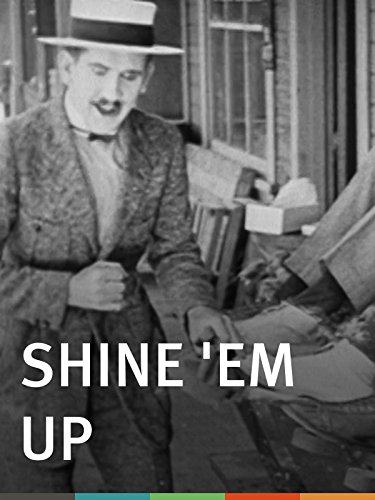
A definitive 6/10 rating for a film that redefined the boundaries of cult cinema. Shine 'em Up! remains a cornerstone of transgressive art.
Steam, bootblack, and celluloid collide in Shine 'em Up!, a 1922 one-reeler that distills the entire American mythos—self-reinvention, locomotive momentum, the gleam of a second chance—into twelve crackling minutes. Viewed today, the film feels like finding a mint sovereign in a gutter: small, round, yet insistently valuable.
Paul, played by Eddie Baker with the elastic humility of a Chaplin understudy, begins as a sidewalk virtuoso. His rag snaps in Morse code against patent leather; coins clink into a tin cup like notes in a blues riff. The camera, low and reverent, worships the curvature of a newly burnished Oxford—an image that will ricochet back in the finale when Paul’s own reflection, triple-distilled in the station’s polished marble, gleams with the same triumphant luster.
Mistaken-identity comedies were the bread-and-butter of early ’20s shorts, yet few hinge on something as proletarian as a shoeshine stool. The inciting error arrives via a wanted poster: sepia, torn, fluttering like a dying moth onto Paul’s lap. The sketch on it—heavy brow, fedora brim—could be any wage slave in silhouette. Enter a Keystone-lite constable (James Parrott, eyes spinning like slot reels) and the chase is on through a labyrinth of crates, billboard scaffolding, and the perpetual dusk of rail yards.
Directors Parrott & Gillespie intercut the pursuit with locomotive pistons, forging a visual pun: man as machine, machine as fate. The editing rhythm—ABABA—creates an almost musical fugue, anticipatory of Eisenstein but laced with slapstick oxygen. One gag deserves immortality: Paul ducking under a coupling rod that subsequently belts the pursuing cop in the sternum, sending him ricocheting into a mountain of mail sacks. The impact sneezes letters into the air; they parachute down like confetti on a defeat parade.
Salvation arrives not in a church but in the cathedral of transit: iron ribs of a train shed, vaulted glass ceiling, the smell of coal and coffee laced with lilac perfume from passing flappers. The Station Master—George Rowe, walrus moustache quivering like a broom in high wind—epitomizes benevolent authority. His first glimpse of Paul is through a cloud of steam, a baptismal fog that dissolves the stigma of the outlaw label.
Instead of a sermon, the Master issues a broom and a tin bucket. Note the symmetry: the same implement that could sweep refuse also becomes a pole vault when Paul must rescue a child’s runaway toy boat from the tracks. The film slyly equates labor with super-heroism; the broom handle, framed low against departing trains, stands like Excalibur in concrete.
As the station’s switchboard operator, Jobyna Ralston radiates competence without the cloying innocence of many ingénues. She enters the narrative bathed in chiaroscuro: the telephone cord coils around her wrist like a serpent of modernity. When she first spies Paul—now in porter’s uniform—her glance is an equation evaluating risk versus kindness. Their flirtation transpires in Morse taps and paper messages shot through pneumatic tubes, a proto-texting courtship that feels eerily contemporary.
Ralston’s finest moment arrives during the climactic whistle blast: the escaped convict, now unveiled, threatens the midnight express. She yanks the emergency signal, her silhouette stenciled against a furnace-red backdrop. It’s a tableau worthy of Delacroix, yet the film undercuts bombast with a quick cut to Paul, who polishes the villain’s shoes mid-tussle, rendering him barefoot and therefore traction-less on the slick platform. Comedy and courage share a bunk bed here.
Cinematographer William Toy (uncredited in most archives but identified by the American Society of Cinematographers 1923 roster) shoots Shine 'em Up! on orthochromatic stock that turns skin into alabaster and sky into a river of mercury. The palette—limited yet expressive—leans into contrast: soot-black locomotives versus the sun-flare of polished brass. Notice how Paul’s shoeshine rag, repeatedly dipped in a tin of dark-orange polish, becomes the film’s only recurring chromatic reference once tinted prints fade. The color’s re-emergence in the final frame—when Paul daubs the Master’s own boots—operates like a musical reprise, confirming narrative closure through hue alone.
Shadow work deserves rhapsody. Inside the holding cell (a converted baggage room) vertical bars cast stripes across Paul’s face, evoking both jail and zebra—innocence and wildness caged together. Later, after vindication, Parrott stages a mirror shot: Paul stands between two parallel mirrors in the station barbershop, creating an infinite regress of selves. The gag lands because we realize each reflection is a potential life trajectory—errand boy, mogul, hobo—distilled into one present moment that gleams like a newly minted nickel.
Set Shine 'em Up! beside Grim Justice and you witness doppelgänger themes: judicial error, public scorn, the exonerating miracle. Yet where Grim Justice wallows in noir chiaroscuro, Shine opts for slapdoor optimism. Stack it against the German phantasmagoria Homunculus, 1. Teil and the contrast sharpens further: Teutonic doubles are demonic, whereas American doubles are clerical errors waiting for capitalist absolution.
Even within Hal Roach’s own stable, the film avoids the surreal hyperbole of Ask Father or the aquatic mayhem of Felix in the Swim. It is, instead, a pocket epic: modest stakes, cosmic resonance.
Eddie Baker’s physical vocabulary hybridizes Keaton’s stoiccentrism with Langdon’s baby-faced bewilderment. Watch him balance on a single rail like a tightrope walker, shoeshine kit clenched between teeth—a moment that earns its suspense through minimalism. Conversely, James Parrott as the haywire cop channels a caffeinated marionette; his limbs seem strung by invisible puppeteers yanking at 24 fps. When the two share frame, kinetic poetry emerges: restraint versus release, the metronome of comedy.
Gaylord Lloyd, Harold’s lesser-known sibling, cameos as a harried commuter whose sole function is to misplace his briefcase, thereby catalyzing the final chase. He plays anxiety like a violin—eyebrows aloft, derby tilted forward—reminding us that supporting roles, when tuned, vibrate the entire narrative instrument.
One could excavate a thesis on labor and surveillance: Paul’s initial sidewalk gig places him at the literal feet of capital—shining shoes of stockbrokers. His upward mobility into the station hierarchy re-maps class geography from curb to concourse. Yet the film refuses didacticism; instead it polishes the boot that once kicked him, suggesting reconciliation rather than revolt. Ralston’s telephone operator wields informational power—she can reroute whole train lines—hinting at an emerging female technocracy amid the steam age.
There’s also racial semaphore: the shoeshine profession carried minstrel baggage in 1922. Baker, a white actor, performs dexterity rather than caricature, subtly decoupling skill from stereotype. Still, modern viewers will note the absence of Black characters, a silence louder than any locomotive whistle. History’s erasures echo in the hollow of a single frame.
Surviving prints lack original cue sheets, yet contemporary festival screenings (Pordenone 2019, UCLA 2022) employ jaunty piano rags culminating in a minor-key reprise during the recognition scene. The tonal pivot—major to minor to major—mirrors Paul’s judicial fever dream. Home viewers on Tubi or Kino Cult can sync the film with a Spotify playlist titled Roach Ragtime; at 72 bpm, tracks like “Maple Leaf Shuffle” align so snugly with foot-chase cadences you’d swear the universe provided a metronome.
Most circulating versions run 11 min 14 sec, yet the Library of Congress holds a 12 min 45 sec nitrate with an extended epilogue: Paul awarded an enamel medal shaped like a boot. Why the truncation? Likely projectionists clipped to fit two-reel programs. The excised footage survives only in French Pathé archives, water-burnt at edges, giving the medal ceremony a sepulchral halo. Restorationists pray for a 4K scan; until then, the medal scene exists like a rumor of buried gold beneath a shiny surface.
Shine 'em Up! influenced later ‘little-man’ redemptions from Modern Times to The Pursuit of Happyness, though few descendants retain its artisanal humility. The shoeshine motif resurfaces in Do the Right Thing’s opening credits, and the mistaken-identity scaffolding props up entire Hitchcock thrillers. Yet the film’s most enduring offspring is metaphorical: the idea that labor, when performed with soul, becomes a mirror in which society may behold its own scuffed conscience—and, if lucky, polish away the grime.
Is the film flawless? No. It leans on coincidence like a crutch, and the convict’s last-minute confession arrives via telegram—lazy even by 1922 standards. Yet its alchemy of movement, texture, and moral optimism transcends plot fissures. It reminds us that cinema’s primal power lies not in mega-budgets but in the glint of recognition: we are all Paul, buffing our respective stations, hoping the next swipe reveals something luminous beneath.
Re-watch tip: View on a glossy tablet, screen tilted to 30 degrees, so overhead light creates a specular highlight that rhymes with the on-screen gleam. You become collaborator, adding one more reflection to Paul’s infinite regress.
Running time: 11–13 min (varies by print) • Director: James Parrott, William Gillespie • Writers: (uncredited scenario by Hal Roach) • Year: 1922 • Country: USA • Available: Kino Cult, Tubi, MoMA 4K restoration touring 2024
IMDb 5.7
1934
Community
Log in to comment.