DbcultAccessing Vault...
Cult Review
Senior Film Conservator
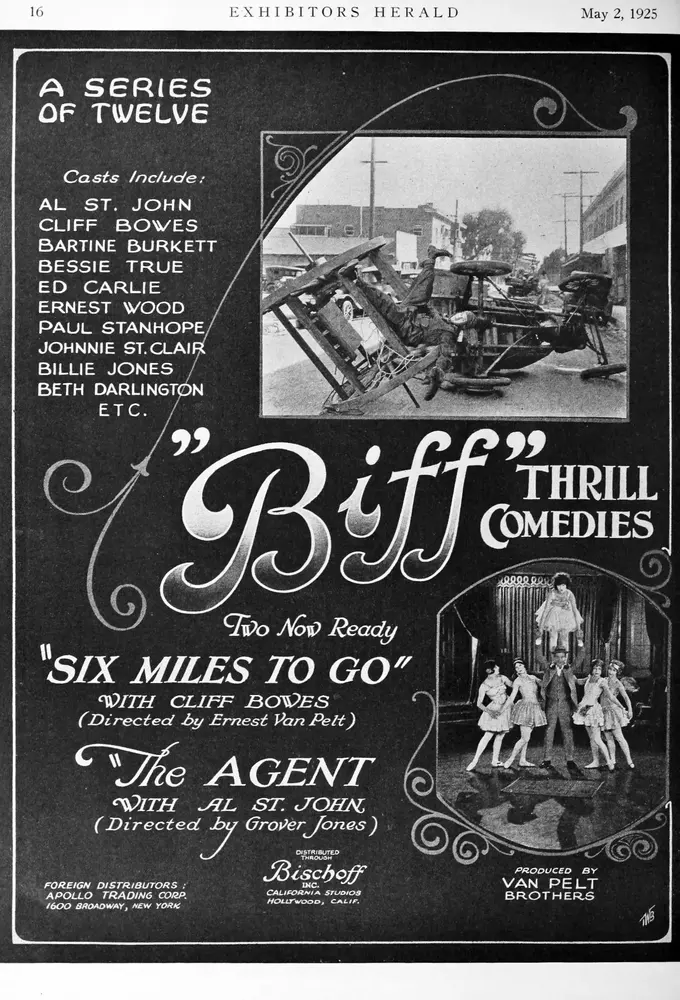
Is Six Miles to Go worth watching today? Short answer: yes, but only if you appreciate the raw, unpolished mechanics of early physical comedy. This isn't a film for those seeking narrative depth or emotional resonance; it is a film for the student of the 'gag,' the viewer who finds beauty in a perfectly timed pratfall and the sheer physical toll of 1920s stunt work.
This film is for the silent cinema completionist and the history buff who wants to see how the 'middle class' of Hollywood comedy operated outside the shadows of Chaplin or Keaton. It is NOT for the casual viewer who finds silent film pacing tedious or those who require a complex plot to stay engaged. It is a sprint, disguised as a journey, and it demands you meet it on its own frantic terms.
1) This film works because it understands the inherent comedy of escalating frustration, turning a simple commute into a cosmic battle against physics.
2) This film fails because it lacks the structural variety found in superior shorts of the era, occasionally feeling like a repetitive loop of similar gags.
3) You should watch it if you want to see a masterclass in high-energy, low-budget physical performance that modern CGI-heavy comedies could never replicate.
Yes, Six Miles to Go is worth watching for its historical value and the sheer athleticism of Cliff Bowes. While it lacks the poetic soul of a Keaton feature, it offers a visceral, sweaty look at the labor of comedy. It provides a direct window into the 1920s short-form industry where volume and energy were king. If you can appreciate the evolution of the stunt, this film is a necessary piece of the puzzle.
Cliff Bowes was never going to be the 'Great Stone Face,' and he lacked the balletic precision of Chaplin. Instead, Bowes specialized in a brand of comedy that felt dangerously close to actual bodily harm. In Six Miles to Go, his performance is defined by a specific type of kinetic anxiety. You don't just watch him fall; you feel the impact. There is a scene early on involving a botched attempt to board a moving vehicle that highlights this perfectly. Unlike the choreographed dances of his peers, Bowes looks like a man who is genuinely losing a fight with a car.
His collaboration with Virginia Vance is equally vital. Vance often played the role of the catalyst—the reason for the journey or the prize at the end. In this film, her presence provides the necessary stakes to justify Bowes' increasingly insane behavior. While many shorts of this era, such as Pardon Me, relied on domestic misunderstandings, Six Miles to Go pushes the conflict into the open air, making the world itself the antagonist. The chemistry here isn't romantic in the traditional sense; it’s a shared commitment to the frantic pace of the production.
What separates this film from something like The Golf Bug is the singular focus on the 'journey' motif. The title isn't just a suggestion; it’s a countdown. As a critic, I find the film's commitment to this linear progression fascinating. Each mile represents a new tier of slapstick escalation. By mile three, the gags move from simple trips to complex interactions with the environment. This is where the cinematography of the 1920s really shines—or struggles. The use of deep focus in the outdoor shots allows the audience to see the next disaster approaching from the background, a technique that creates a wonderful sense of dread.
However, the film’s biggest flaw is its lack of a 'breather.' In a more sophisticated work like Kohlhiesel's Daughters, the comedy is interspersed with character beats. Here, it is relentless. It is exhausting. There are moments where the repetition of Bowes falling over an object feels less like a joke and more like a glitch in the film reel. It works. But it’s flawed. The pacing is so aggressive that the individual gags don't always have room to breathe before the next one begins.
When we look at the broader context of 1919-1925 cinema, Six Miles to Go sits in a strange middle ground. It lacks the melodrama of The Avalanche or the social weight of Birthright. It is pure, distilled entertainment. Yet, there is something oddly gritty about it. The locations aren't polished studio lots; they are the dusty, unpaved roads of early California. This gives the film a 'guerrilla' feel that makes the comedy feel more immediate.
Comparing it to The Canvas Kisser, another Bowes vehicle, you can see a clear evolution in his screen persona. In Six Miles to Go, he is more of a victim of circumstance than an active participant in his own demise. This 'man against the world' trope is a staple of the genre, but Bowes infuses it with a unique sense of panic that makes him more relatable than the more 'heroic' comedy stars of the day. He is the everyman who just wants to get from point A to point B without being hit by a ladder.
One cannot review a silent short without discussing the 'cranking' speed. Like many comedies of the time, Six Miles to Go was likely shot at a slower frame rate to make the action appear faster when projected. This 'undercranking' is what gives Bowes his superhuman speed. While some critics find this a cheap trick, I argue it is an essential part of the film's language. It transforms a simple walk into a frantic scurry, heightening the comedy through mechanical intervention.
The framing is surprisingly sophisticated for a low-budget short. There is a specific use of the 'X-axis'—characters moving directly toward or away from the camera—that creates a sense of scale. When Bowes is seen as a tiny speck in the distance, slowly growing larger as he runs toward the lens, the film captures the true scale of his 'six-mile' struggle. It’s a simple visual gag, but it’s executed with a level of precision that suggests the director (often uncredited or working under a house name) had a keen eye for spatial comedy.
Pros:
Cons:
Six Miles to Go is a fascinating relic. It doesn't possess the timeless elegance of the 'Big Three' (Chaplin, Keaton, Lloyd), but it has a grit and an energy that is entirely its own. It is a film about the struggle of existence, told through the lens of a man tripping over a bucket. While it may not be a 'masterpiece' in the traditional sense, it is a vital, breathing example of the comedy of the common man. It is a loud, sweaty, and ultimately triumphant display of early cinema’s power to turn pain into laughter. It is exhausting, yes, but that exhaustion is the point. If you want to understand where the modern action-comedy was born, you have to walk these six miles.
IMDb —
1921
Community
Log in to comment.