DbcultAccessing Vault...
Cult Review
Senior Film Conservator
In the pantheon of early silent comedy, few films capture the sheer, sweating palm-inducing dread of social climbing quite like Small Change. While many contemporary shorts favored the broad, kinetic violence of the Keystone school, this piece opts for a more localized, psychological brand of slapstick. It is a film that breathes the same air as the domestic anxieties found in The Old Nest, yet filters that sentiment through the lens of a frantic, youthful optimism that is perpetually on the verge of collapse.
The premise is deceptively simple: a young man of limited means takes his girl to an ultra-expensive café. However, the execution is anything but basic. William Eugene, an actor whose physicality often feels like a precursor to the more refined movements of the 1920s leading men, imbues his character with a palpable sense of 'imposter syndrome' long before the term was coined. He isn't just trying to buy dinner; he is trying to buy a version of himself that belongs in such a gilded environment. This performative wealth is a recurring theme in the era, often explored with more gravity in films like Gates of Brass, but here, it is played for the highest stakes of embarrassment.
The café itself is a character. The set design emphasizes the height of the ceilings and the judgmental distance of the waitstaff, making the protagonist feel small, even before he looks at the prices. It is a visual manifestation of the class divide. We see a similar exploration of domestic economy in Hooverizing, though Small Change trades the patriotic duty of frugality for the desperate vanity of the lovestruck.
Eugene’s performance is a marvel of micro-expressions. Watch the way his eyes dart toward the right-hand column of the menu—the column where the numbers live. His performance avoids the caricatured 'tramp' tropes, leaning instead into a middle-class aspiration that feels painfully relatable. He is the Everyman who wants to be the Exceptional Man for just one evening. This yearning for a different life, a different social standing, mirrors the thematic weight of Aus eines Mannes Mädchenjahren, albeit in a vastly different narrative context.
Virginia Vance provides the necessary counterweight to Eugene’s frantic energy. She is the picture of blissful ignorance—or perhaps, more interestingly, a woman who chooses to ignore the cracks in the façade to preserve the magic of the evening. Her performance isn't just about being the 'best girl'; she represents the prize that the protagonist is so terrified of losing. Her presence elevates the stakes; if this were just a solo meal, it would be a tragedy of hunger, but with her there, it becomes a tragedy of reputation. Her screen presence reminds one of the delicate balances found in Aloha Oe, where the female lead often serves as the emotional compass for the male protagonist's journey.
Then there is Pal the Dog. In the history of cinema, the 'wonder dog' has often been used as a cheap emotional hook, but in Small Change, Pal is a comedic precision tool. He represents the untamed reality that threatens to shatter the high-society illusion. Every time the protagonist nearly succeeds in looking like a gentleman, Pal intervenes with a burst of canine honesty. The dog is the bridge between the high-brow aspirations of the café and the low-brow reality of the street. This use of an animal to bridge social gaps is a technique we see utilized for different emotional effects in Set Free.
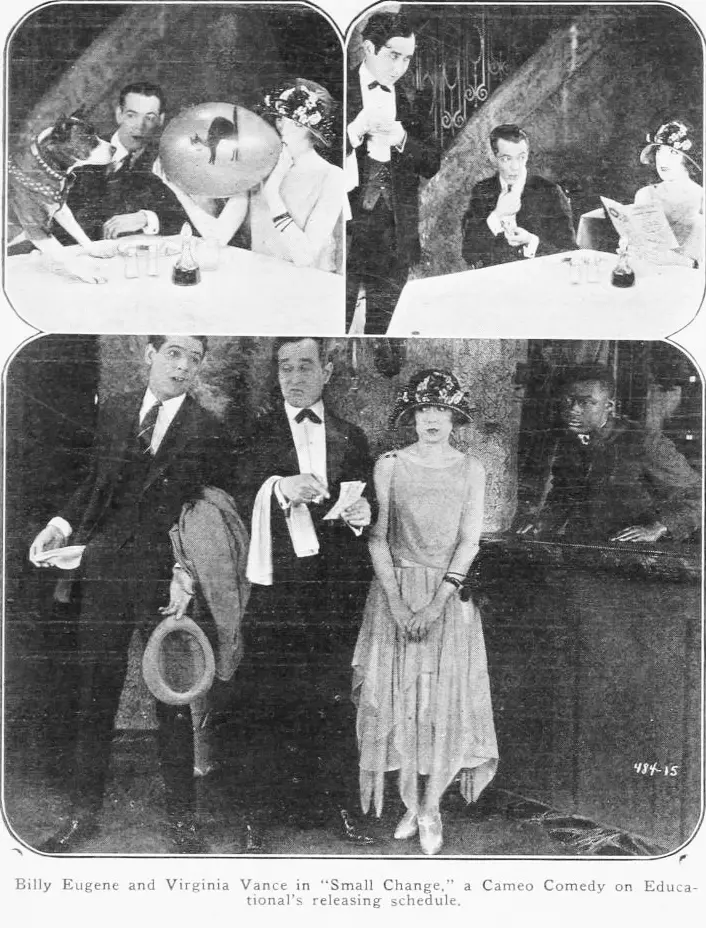
The cinematography in Small Change utilizes sharp contrasts. The lighting in the café is bright, almost clinical, leaving no shadow for our hero to hide his mounting dread. Compare this to the nocturnal shadows of Die rote Nacht or the atmospheric density of Les heures - Épisode 4: Le soir, la nuit. In Small Change, the light is an enemy. It reflects off the silverware and the monocles of the other patrons, creating a shimmering barrier that the protagonist cannot penetrate. The film understands that to a poor man, a bright room is the most dangerous place on earth.
The pacing of the film is relentless. It builds like a symphony of errors. We see the influence of early slapstick, but there is a narrative cohesion here that suggests the filmmakers were looking toward the feature-length structures of the future, much like the ambitious storytelling seen in Flying Colors. The 'small change' of the title refers not just to the coins in his pocket, but to the incremental shifts in his dignity as the night progresses.
Is there a lesson in Small Change? Unlike the heavy-handed moralizing of Thou Shalt Not or the punitive justice of The Pillory, this film offers a more cynical, yet ultimately more humanistic, conclusion. It suggests that the social structures we navigate are inherently absurd. The protagonist’s failure is not a lack of character, but a lack of capital—a distinction that many films of 1917 were beginning to explore with increasing nuance. The 'hoodoo' of bad luck that follows him is not a supernatural curse, as one might find in Hoodooed, but a purely economic one.
The final sequence, where the bill finally arrives, is a masterclass in tension. It carries the same weight as the life-altering decisions in Sacrifice, but instead of blood or honor, the currency is social standing. When the protagonist realizes he is short, the film doesn't descend into a simple chase. It lingers on the moment of realization, the 'oh' that we can almost hear through the silent frame. It is a moment of pure, unadulterated human vulnerability.
In the broader context of 1917 cinema, Small Change sits comfortably alongside the works of Lloyd and Chaplin, yet it retains a unique flavor. It lacks the overt sentimentality of En Søns Kærlighed and the athletic bombast of Little Johnny Jones. Instead, it occupies a middle ground of 'anxious comedy.' It is a film for anyone who has ever looked at a menu and felt a pang of existential dread. It reminds us that the smallest coins can carry the heaviest weight, and that in the theater of high society, we are all just one bill away from being found out.
The brilliance of Small Change lies in its refusal to offer an easy escape. It forces its characters—and its audience—to sit in the discomfort of their own aspirations. It is a timeless piece of social satire that remains as sharp today as it was over a century ago. Whether you are a fan of William Eugene's particular brand of twitchy charm or Pal the Dog's scene-stealing antics, there is something profoundly universal about this little film with a big heart and an even bigger bill.
IMDb —
1924
Community
Log in to comment.