DbcultAccessing Vault...
Cult Review
Senior Film Conservator
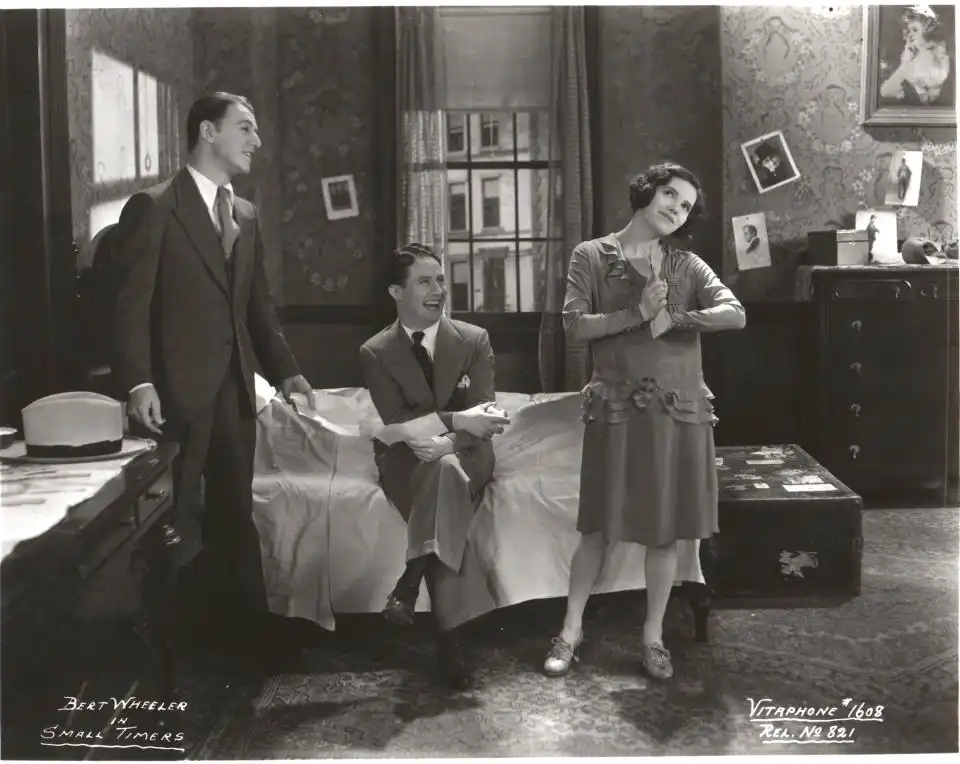
If you have ten minutes to spare and a soft spot for the sound of crackly, popping film audio, you might actually like this. Small Timers is a 1932 short that feels like someone just pointed a camera at a stage and told everyone to act like their lives depended on it.
It is definitely worth watching if you are a fan of Bert Wheeler or the history of stage comedy. If you hate loud, screechy voices and jokes that were already old when your grandparents were kids, you will probably want to skip it.
Bert Wheeler is here without his usual comedy partner, Robert Woolsey. It feels a bit strange, like seeing a one-legged table trying to stand up straight. He’s working with his real-life wife, Bernice Wheeler, and they are playing—surprise, surprise—a husband and wife team trying to get a break.
The whole thing happens in this one room that is supposed to be a theatrical agent's office. It looks incredibly cheap, like they just moved two chairs and a desk into a hallway and called it a set. There is a guy playing the agent named Al Clair, and he mostly just sits there looking like he wants to go home and take a nap.
Bert does this cry-laughing routine that was his trademark. He starts sobbing about nothing, then switches to a high-pitched giggle in about half a second. It is impressive the first time, but by the third time, I was kind of checking my watch.
The energy is just so high, it’s almost exhausting to watch from a couch in the future. It reminds me of the frantic pace in South o' the North Pole. Everything is shouted instead of spoken. This was 1932, and the microphones they used back then were not exactly subtle.
Bernice is okay, but she mostly just feeds Bert his lines so he can do his funny faces. She has this look in her eyes sometimes that makes me think she’s wondering if the check cleared. They have this stiff, practiced chemistry that feels very 'show business' and not very 'real life.'
One thing I noticed was the background noise. Since this was an early talkie, you can hear this constant hiss underneath every word. It makes the silence between the jokes feel very heavy and awkward. Sometimes a joke would land, and the silence afterwards lasted about two seconds too long.
The musical number in the middle is a bit of a disaster for the ears. The piano sounds like it’s being played in a different building. When Bert and Bernice start singing together, the audio levels peak so hard it sounds like a radio being dropped in a bathtub. I actually had to turn my volume down because the high notes were piercing.
There is a specific gag about a thin man that made me chuckle despite myself. He said the guy was so thin he had to stand in the same place twice to make a shadow. It’s a total dad joke, but Bert delivers it with such earnest desperation that you can't help but like him a little bit.
I noticed a smudge on the top left corner of the frame for most of the office scene. It looks like a thumbprint or a bit of dust that got stuck in the gate. It kept drawing my eye away from the actors, which probably says something about the plot's ability to hold my attention. It’s not as polished as something like Half a Hero.
The agent, played by Al Clair, has this great moment where he just stares at the camera while Bert is dancing. He looks completely soul-crushed. I don't know if it was part of the script or if he was just genuinely tired of the routine. It’s the most relatable moment in the whole movie.
The costumes are actually pretty sharp. Bert has this suit with very wide lapels that looks like it weighs about twenty pounds. Bernice has a hat that seems to be defying gravity. I spent a good minute wondering how it stayed on her head while she was spinning around.
The set decoration is basically non-existent. There’s a door in the back that looks like it’s made of balsa wood. When someone closes it, the whole wall shakes slightly. It gives the movie a very homemade feeling that you don’t get with modern stuff.
It’s a bit like watching The Praise Agent in terms of that weird, transitionary period of filmmaking. They were still figuring out how to tell stories with sound without making it feel like a recorded play. They didn't quite figure it out here, but they tried.
There is no real ending to the story. They finish their act, the agent says something, and it just fades to black. No big emotional payoff or resolution. It just stops, like the cameraman ran out of crank and decided to go to lunch.
I think the charm of Small Timers is just how hard it’s trying. It’s a group of people who really wanted to make you laugh for nine minutes. Even when the jokes are bad and the sound is crunchy, that effort is still visible. It’s not a masterpiece like The Last Chance, but it’s a fun little time capsule.
If you like seeing old-school vaudeville before it completely disappeared, this is a neat find. Just don't expect anything groundbreaking. It’s just Bert Wheeler being loud and his wife being patient. Sometimes that’s enough for a Tuesday afternoon.
I’m still thinking about that door shaking. It’s those little mistakes that make these old movies feel more human to me. You can see the strings, and that makes the whole thing feel more honest. Even if the jokes are 90 years old and a bit dusty.
IMDb —
1920
Community
Log in to comment.