DbcultAccessing Vault...
Cult Review
Senior Film Conservator
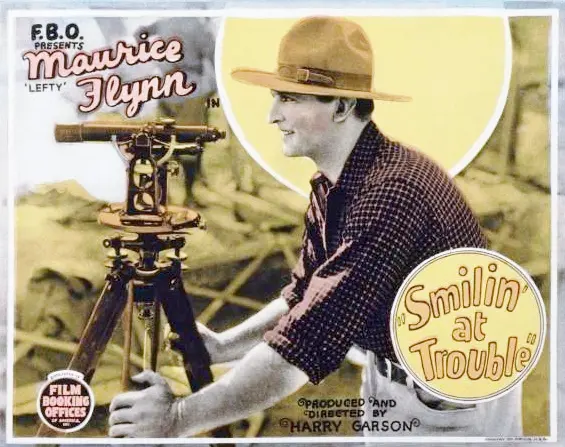
The 1925 cinematic landscape was often characterized by a fascination with the burgeoning industrial might of the United States, and Smilin' at Trouble emerges as a quintessential specimen of this era. It is a work that deftly intertwines the grit of civil engineering with the gossamer threads of high-society aspiration. Maurice 'Lefty' Flynn, portraying the stalwart Jerry Foster, provides a performance that is as much about physical presence as it is about the silent internal conflict of a man caught between his duty to the earth and his duty to his heart. The film opens not with a whisper, but with the metaphorical roar of progress, as Michael Arnold’s dam project becomes the stage for a grand human drama.
At its core, the film utilizes the construction of the dam as a sprawling metaphor for character integrity. While Jerry Foster represents the reinforced concrete of morality, the antagonist Lafayette Van Renselaer is the 'inferior cement' that Jerry eventually uncovers in the dam’s foundations. The narrative structure mirrors the slow curing of a massive structure, building pressure until the inevitable crack occurs. Unlike the more whimsical explorations of marriage seen in Pick Out Your Husband, this film treats the union of Alice and Lafayette as a transactional necessity of the nouveau riche, a theme explored with varying degrees of cynicism in other contemporary works like Black Oxen.
The casting of Lee Shumway as the bullying foreman Swazey provides a visceral counterpoint to Flynn’s stoic heroism. Swazey is the personification of industrial rot, a man who prioritizes short-term gain over the structural safety of the community. This conflict between the visionary engineer and the corrupt labor force echoes the socio-economic tensions found in The Italian, though transposed from the urban tenements to the expansive, dusty vistas of the American West. The cinematography captures the scale of the dam with a reverence that borders on the religious, making the eventual destruction all the more terrifying.
Kathleen Myers, as Alice, delivers a performance that transcends the typical 'damsel' tropes of the mid-twenties. Her struggle is one of perception; she is trapped in a panopticon of societal expectations and romantic misinformation. Her belief that Jerry is enamored with Kathleen O'Toole (played with a poignant vulnerability by Helen Lynch) is the catalyst for much of the film’s emotional turmoil. This trope of the misunderstood romance is handled with far more gravity here than in the lighthearted Caught in the Act, as the stakes are tied to a literal life-and-death struggle against the elements.
The writers—Barry Barringer, Gertrude Orr, and Rob Wagner—crafted a screenplay that avoids the pitfalls of simplistic hero-worship. Instead, they present a world where even the 'good' man, Jerry, is susceptible to the machinations of those more socially adept than himself. The character of Lafayette Van Renselaer is particularly fascinating in his spinelessness. He is a man of the 'old world'—or at least a facade of it—trying to survive in a new world defined by sweat and steel. His demise in the flood is not merely a plot convenience but a symbolic washing away of the archaic and the artificial, much like the cleansing of secrets in The Unholy Three.
Technically, Smilin' at Trouble is a marvel of its time. The flood sequence, which serves as the film’s kinetic climax, utilizes practical effects that still command respect in the digital age. The sheer volume of water unleashed upon the screen serves as a reminder of nature’s indifference to human social climbing. While Always in the Way dealt with the obstacles of the heart, this film presents an obstacle of overwhelming physical force. The editing during the reservoir breach is frantic, capturing the chaotic energy of a world literally coming apart at the seams.
The fight between Jerry and Swazey is choreographed with a raw, unpolished intensity that avoids the theatricality often found in silent film brawls. It feels like a clash of ideologies: the man who builds versus the man who exploits. This scene establishes Jerry as a figure of immense physical capability, a necessary trait for a hero who must later navigate the churning waters to rescue Alice. The contrast between this grit and the refined settings of the Van Renselaer social circle is stark, emphasizing the film's underlying critique of the aristocracy.
Ray Ripley and Joe O'Brien provide solid support, grounding the film in a reality that feels lived-in. The presence of Ray Turner adds a layer of character diversity that, while reflective of the era's limitations, contributes to the sense of a bustling, multi-faceted construction site. The film’s focus on the 'engineer as hero' is a recurring motif in American cinema of this period, representing a nation building its identity through infrastructure. One might compare the moral weight of Jerry’s decisions to the heavy ethical burdens carried by characters in The Black Stork, though the context here is significantly more grounded in industrial realism.
The direction avoids the static nature of many stage-to-screen adaptations of the time. The camera moves with a purpose, often lingering on the textures of the construction site—the dust, the tools, the pouring of the cement. This tactile quality makes the revelation of the 'inferior cement' feel like a personal betrayal to the audience. We have seen the work; we have felt the heat of the West; and thus, we share Jerry’s outrage. This level of immersion is something that even more high-profile historical dramas like Dorothy Vernon of Haddon Hall sometimes struggled to achieve amidst their opulent costuming.
As the flood waters recede in the final act, the film leaves us with a landscape transformed. The social pretenses of Michael Arnold have been washed away along with the villainous Lafayette. What remains is the core of human connection, stripped of the 'fashionable' trappings that Arnold so desperately sought. The resolution of the love triangle is handled with a satisfying, if somewhat predictable, efficiency. Alice’s realization of Jerry’s true character is not just a romantic victory but a moral one. She chooses the man of substance over the man of status.
The film’s title, Smilin' at Trouble, suggests a levity that the actual content frequently defies. There is a darkness here, found in the betrayal of Kathleen O'Toole and the murderous rampage of Swazey. It is a film that recognizes that progress has a cost, and that the 'trouble' we smile at is often a mask for a much deeper struggle for survival. In this way, it shares a certain psychological DNA with the more somber European imports like Gefangene Seele, though it maintains a distinctly American optimism in its conclusion.
Ultimately, the film stands as a testament to the power of silent storytelling to convey complex engineering concepts alongside intimate human emotions. The writers managed to weave a tale that is as much about the strength of a dam as it is about the strength of a man’s word. For modern viewers, the film offers a fascinating glimpse into a past where the construction of a reservoir was an event of titanic proportions, capable of making or breaking the lives of everyone in its shadow. It lacks the surrealism of The Wildcat but gains a rugged authenticity that serves it well.
The interplay of light and shadow in the evening scenes, particularly those involving Kathleen O'Toole’s heartbreak, showcases a sophisticated understanding of mood. The film doesn't just tell us she is sad; it surrounds her with a darkness that Lafayette’s bright, false world cannot penetrate. This visual storytelling is what elevates the movie above standard melodrama. It is a work that understands that sometimes, the greatest floods are those that occur within the human heart, and the strongest dams are those built on a foundation of truth. Like the protagonist in The Courageous Coward, Jerry Foster proves that true bravery is found in standing one's ground when the world—and the water—tries to sweep you away.
In the pantheon of 1920s cinema, Smilin' at Trouble may not have the avant-garde reputation of some of its peers, but its mastery of narrative tension and its impressive scale make it a vital piece of film history. It captures a moment in time when the American dream was being poured in concrete, and the cost of social climbing was often paid in the currency of one's own integrity. It is a film that rewards the patient viewer with a crescendo of action and a resolution that feels earned rather than gifted. For those interested in the intersection of industrial history and cinematic art, this is an essential viewing experience that continues to resonate long after the final frame has faded to black.
IMDb —
1920
Community
Log in to comment.