DbcultAccessing Vault...
Cult Review
Senior Film Conservator
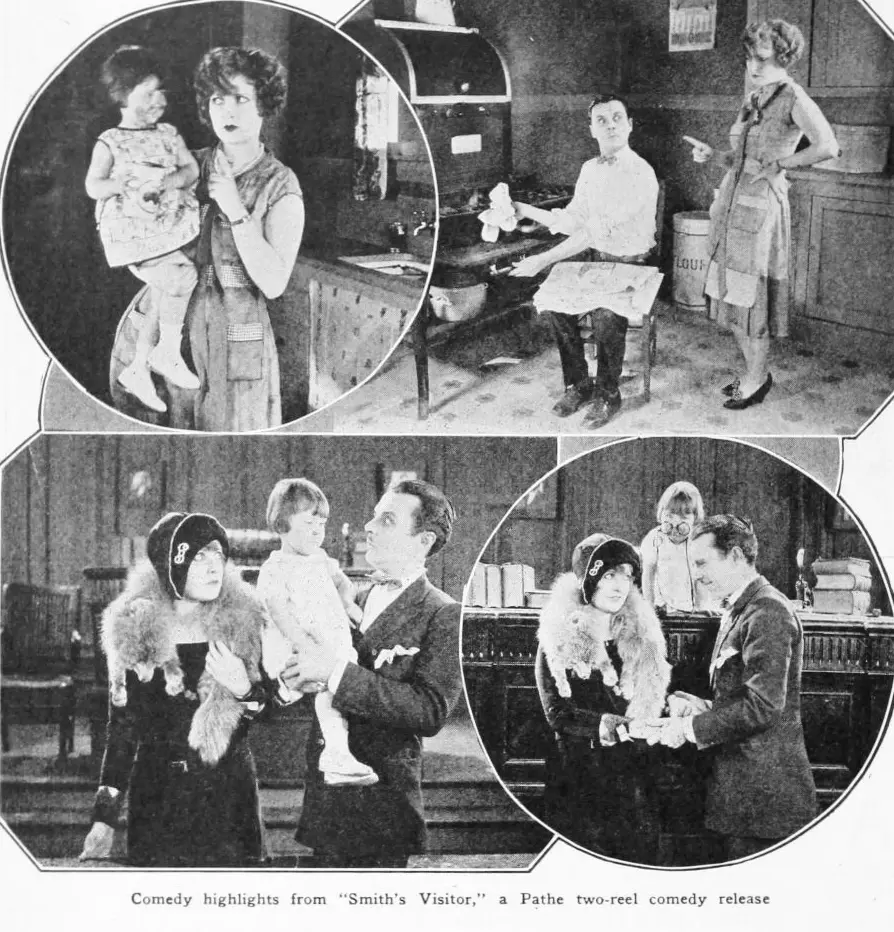
Is Smith's Visitor worth watching today? Short answer: yes, but with significant caveats that demand a specific palate. This early silent comedy is a delightful, if slight, diversion for those deeply invested in cinema history and the evolution of comedic timing, yet it offers little for audiences seeking modern narrative sophistication or deeply resonant character arcs.
It's a curious artifact, a window into a bygone era of storytelling where spectacle and broad strokes often superseded subtlety. This film works because of its charming simplicity and the surprisingly effective physical comedy that transcends the silent era's limitations. It operates on a single, escalating misunderstanding, which, while predictable, is executed with a certain earnestness.
This film fails because its plot, while foundational for future farces, is exceedingly thin, relying almost entirely on a single, prolonged misunderstanding that strains credulity even for its time. The emotional stakes, though central to the premise, never quite land with the necessary weight to elevate it beyond simple amusement. You should watch it if you appreciate the foundational elements of slapstick, are a scholar of early film, or simply enjoy the quaint innocence of 1920s cinema.
"Smith's Visitor" serves as a fascinating, if minor, entry into the burgeoning genre of marital farce prevalent in early cinema. Its premise, built entirely on the flimsiest of misinterpretations, reflects a societal preoccupation with domestic discord, often played for laughs rather than genuine drama. Here, the sanctity of marriage is threatened not by grand betrayals, but by the innocent babbling of an infant and the accidental overlap of romantic song titles.
The film's central conflict — Mrs. Smith's misplaced jealousy – is a common trope, yet its execution here feels uniquely rooted in the constraints and opportunities of silent filmmaking. Dialogue, or the lack thereof, forces the narrative to rely on exaggerated expressions and physical comedy, turning what could be a simple conversation into a series of visually driven misunderstandings.
It’s a daring choice, really, to hinge an entire plot on such flimsy evidence. The film asks its audience to suspend disbelief to an almost absurd degree, accepting that a wife would initiate divorce proceedings based on a baby's 'antics' and overheard song snippets. Yet, within its era, this kind of exaggerated setup was par for the course, paving the way for more sophisticated farces in later decades.
What's striking is how this film, despite its comedic intent, inadvertently highlights the fragility of trust within a relationship. The mere suggestion of infidelity, however absurd the 'evidence', is enough to shatter domestic peace. This underlying current, though not deeply explored, adds an unexpected layer to the otherwise lighthearted proceedings.
Comparing it to other domestic comedies of the era, such as Edgar's Jonah Day, one can observe a shared reliance on situational humor and character-driven gags. However, "Smith's Visitor" perhaps leans more heavily on the sheer audacity of its central misunderstanding, stretching it to its comedic limits.
The direction in "Smith's Visitor," attributed to a collective of writers including Randall Faye and Tay Garnett, demonstrates a clear understanding of silent film mechanics. The camera is largely static, typical of the era, but its placement is often effective in framing the physical comedy and the reactions of the characters. Close-ups, though sparse, are utilized to emphasize key moments of dawning suspicion or comedic exasperation.
One particular strength lies in the staging of the 'overheard' conversations. The film cleverly uses spatial separation, placing Mrs. Smith just out of sight but within earshot, allowing her to piece together a completely erroneous narrative. This visual construction of misunderstanding is fundamental to the film's comedic engine, a testament to the ingenuity required when dialogue is absent.
The film's visual storytelling relies heavily on physical gags and the expressive faces of its cast. Director(s) manage to extract humor from the simplest actions: the way a baby might innocently pull at clothing, or a husband's well-meaning but ill-timed remark. There's a particular scene where the baby's interaction with a prop becomes the catalyst for Mrs. Smith's suspicion, a moment that relies entirely on visual interpretation.
Cinematography, while not groundbreaking, is functional. The lighting is straightforward, serving to illuminate the set and characters without much stylistic flourish. This simplicity, however, allows the performances and the escalating absurdity of the plot to take center stage. There are no grand sweeping shots or complex camera movements; the focus remains squarely on the domestic drama unfolding in a confined space.
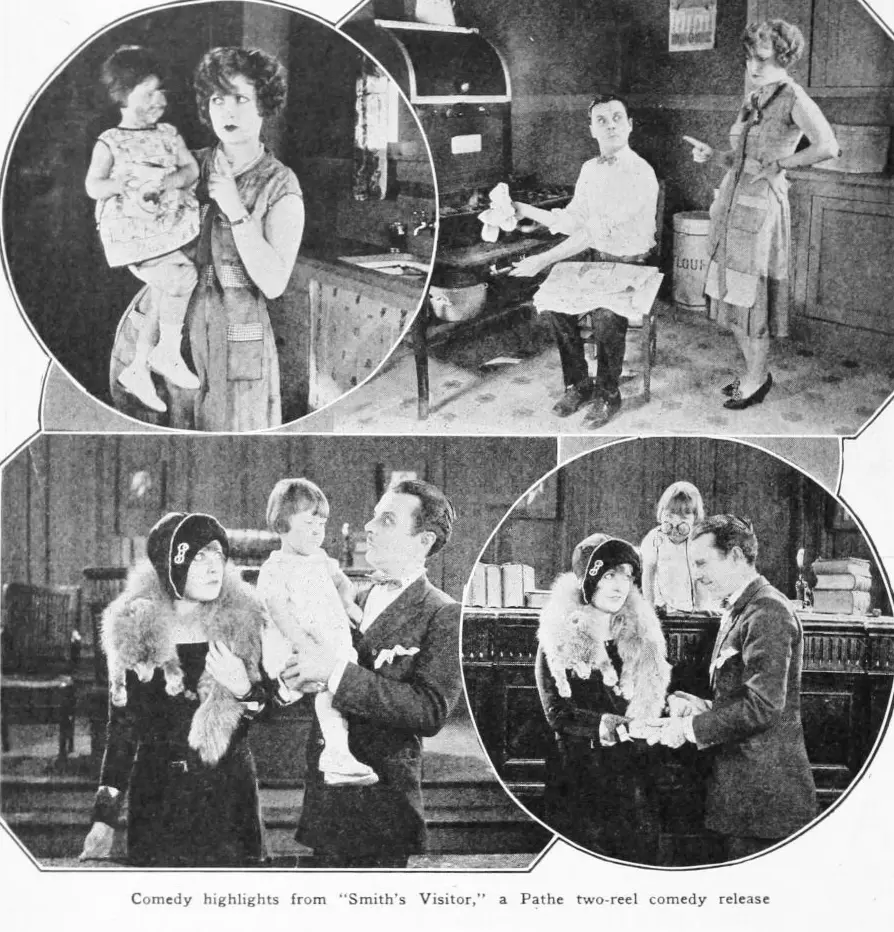
It is in these subtle visual cues that the film truly shines, demonstrating how silent cinema could convey complex emotional states and comedic timing without a single spoken word. The directors understood the power of implication, allowing the audience to fill in the blanks, often to humorous effect. This approach, while basic, is surprisingly effective in sustaining the central joke for the film's duration.
The cast of "Smith's Visitor" delivers performances that are, by necessity, broad and expressive, yet surprisingly nuanced for the era. Dave Morris as Mr. Smith embodies the bewildered husband with a palpable sense of innocent frustration. His facial contortions and body language eloquently convey his bewilderment at his wife's sudden shift in demeanor, without resorting to caricature. He's the everyman caught in a comedic maelstrom of his own wife's making.
Janet Royce, as Mrs. Smith, is the true engine of the film's conflict. Her portrayal of a woman consumed by unfounded jealousy is a masterclass in silent screen acting. Her eyes narrow, her lips purse, and her entire posture stiffens with suspicion. It's a performance that, while exaggerated, feels genuinely driven by emotion, making her eventual decision to pursue a divorce feel, in the context of the film, almost understandable.
However, the real standout — and an unconventional observation — is the performance of Mary Ann Jackson, the baby. Far from being a mere prop, Jackson’s innocent antics are central to the plot's mechanics. Her playful interactions, misinterpreted by Mrs. Smith, are genuinely charming and surprisingly effective as plot devices. It’s rare for a baby’s actions to carry such narrative weight, and Jackson pulls it off with effortless, naturalistic charm. This is not just a child in a scene; this is a tiny, unwitting catalyst.
The supporting cast, including Leo Sulky and Irving Bacon, provides solid comedic relief, reacting to the escalating domestic chaos with appropriate levels of confusion and amusement. Their roles are smaller, but they contribute to the overall atmosphere of lighthearted absurdity. Omar the Dog also makes an appearance, adding to the domestic charm, though his contributions are more background than plot-driving.
What these performances highlight is the unique skill set required for silent acting. It's not just about mugging for the camera; it's about conveying complex emotions and intentions through gesture, posture, and facial expression alone. The cast of "Smith's Visitor" manages this with commendable success, making a rather thin plot feel engaging through sheer expressive force. It works. But it’s flawed.
The pacing of "Smith's Visitor" is characteristic of many early silent comedies: it’s deliberate, allowing scenes to unfold gradually, building humor through repetition and escalation. This isn't a film that rushes its jokes; it savors them, letting the audience fully grasp the misunderstanding before advancing to the next stage of Mrs. Smith's growing indignation.
The initial scenes establish a comfortable domesticity, which makes the subsequent descent into marital discord all the more humorous. The film takes its time introducing the elements that will later become points of contention: the baby’s innocent play, the visitor’s presence, and the seemingly innocuous conversations about song titles. This slow burn allows the audience to become fully invested in the comedic setup.
The tone remains consistently lighthearted, even as the plot veers towards the dramatic prospect of divorce. The film never truly allows the audience to believe that the marriage is in genuine peril, maintaining a comedic distance throughout. This prevents the farce from becoming too heavy or emotionally taxing, ensuring it remains an enjoyable, if predictable, romp.
However, this deliberate pacing can also be perceived as a weakness by modern audiences accustomed to faster cuts and quicker joke delivery. There are moments where the film feels stretched, where the single joke of misunderstanding is perhaps milked for a little too long. This is a common challenge for silent films, where the absence of spoken dialogue often necessitated longer takes to convey information.
Despite this, the film’s consistent tone of gentle absurdity is maintained throughout, a credit to the writers and directors. It never wavers from its comedic intent, ensuring that even the most serious moments are ultimately played for laughs. This unwavering commitment to its lighthearted premise is one of its quiet strengths, offering a consistent viewing experience that, for its time, was probably quite satisfying.
Yes, "Smith's Visitor" is worth watching today, but primarily for specific audiences. It's a valuable historical document. It offers insight into early silent film comedy. It showcases the foundational elements of visual storytelling. It's best appreciated by film scholars. It's also for those curious about the evolution of cinematic humor. It's not for viewers seeking complex plots or modern pacing. Its charm lies in its simplicity and historical context.
"Smith's Visitor" is not a lost masterpiece, nor does it aim to be. It is, however, a delightful and historically significant piece of early silent comedy that offers genuine charm and a few hearty laughs. Its reliance on broad physical humor and a straightforward misunderstanding is a hallmark of its era, and while it may test the patience of some modern viewers, it rewards those willing to engage with its unique cinematic language. It’s a film that, despite its simplicity, holds a mirror to the timeless comedic potential of human miscommunication. While it might not redefine your understanding of cinema, it will undoubtedly offer a pleasant, if fleeting, escape into a gentler, funnier past. It's a solid, if not spectacular, watch for the right audience.
IMDb 7.2
1925
Community
Log in to comment.