DbcultAccessing Vault...
Cult Review
Senior Film Conservator
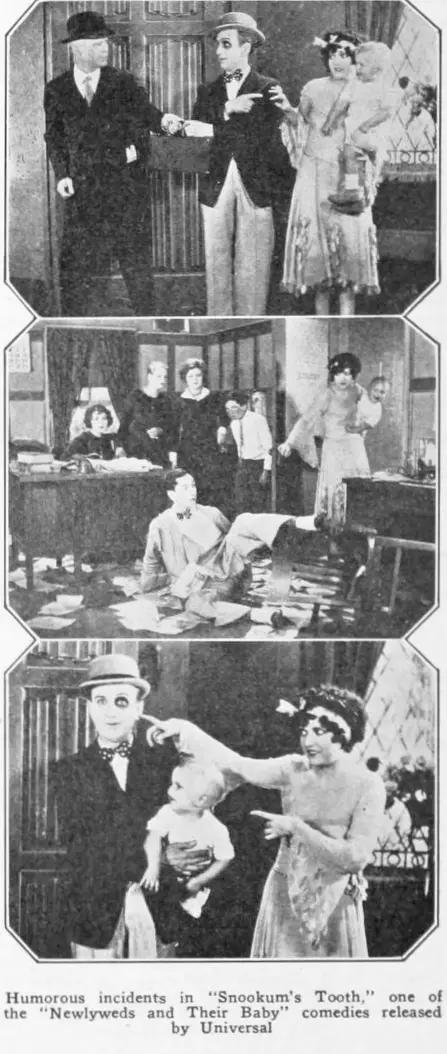
Is Snookums' Tooth a hidden masterpiece of the silent era? Short answer: No, it is a screeching relic that functions better as a historical curiosity than a piece of genuine entertainment. This film is specifically for silent film completionists and those obsessed with the evolution of comic strip adaptations; it is absolutely not for the casual viewer who lacks the patience for the repetitive, high-pitched energy of early domestic slapstick.
The film exists as a fascinating, if often irritating, window into the 1920s' obsession with the 'child as king' dynamic. While other films of the era like The Woman in His House dealt with domesticity through a lens of melodrama, Snookums' Tooth leans into the absurd. It is a loud film for a silent one. You can practically hear the screaming of the toddler through the intertitles.
1) This film works because it captures the frantic, unpolished energy of late-1920s short-form comedy before the industry fully transitioned to talkies.
2) This film fails because the central character is designed to be an irritant, and the joke wears thin within the first five minutes, leaving the audience exhausted long before the climax.
3) You should watch it if you are researching the career of George McManus or want to see the primitive origins of the modern family sitcom.
Sunny Jim McKeen was the 'it' child of the late silent era, and in Snookums' Tooth, he is given free rein to be as demanding as possible. The film doesn't ask him to act so much as it asks him to exist as a catalyst for parental panic. The way Lovey and Dovey (played with a specific brand of over-the-top desperation by Ethlyne Clair and Ed Dooley) react to his every move is where the comedy is supposed to live. However, for a modern audience, the 'humor' of a child getting everything he wants feels less like a joke and more like a cautionary tale about bad parenting.
Take the scene where Snookums demands a specific toy during his birthday party. The camera stays static, but the movement within the frame is frantic. The parents collide, the guests are pushed aside, and the result is a messy, uncoordinated ballet of domestic failure. It lacks the precision of a Buster Keaton sequence, but it has a raw, amateurish charm that is hard to find in more polished studio productions like The Isle of Lost Ships.
Writer George McManus was a titan of the comic strip world, and his influence is visible in every frame. The framing is flat, often mimicking the panels of a newspaper strip. This gives the film a 'lived-in' cartoonish quality. Characters enter and exit the frame with the suddenness of a page turn. While this works for a three-panel gag, it feels disjointed in a film that attempts to build tension through a kidnapping plot. The transition from the domestic space to the 'chase' space is jarring, lacking the fluid geography we see in films like High and Dry.
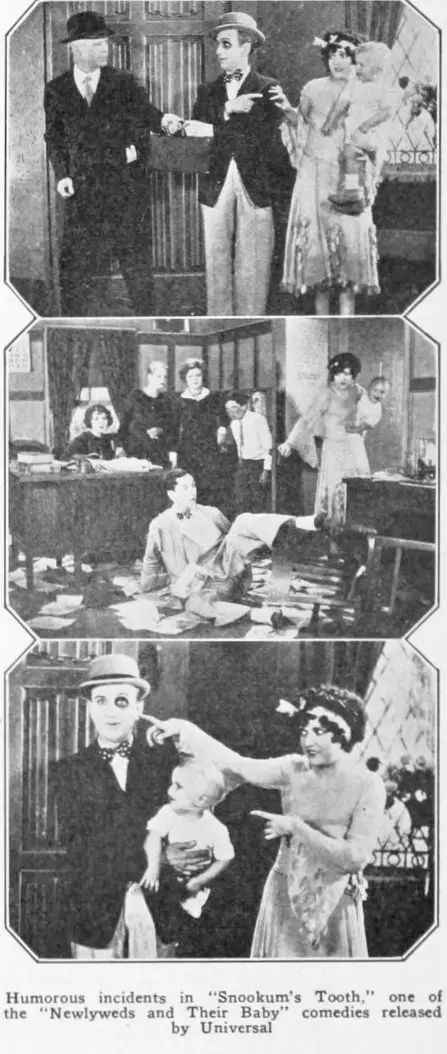
The film's reliance on the 'Newlyweds and Their Baby' source material means that it doesn't bother with character development. You are expected to know who Lovey and Dovey are. If you don't, they come across as two-dimensional caricatures with no internal life. This is a common pitfall of early adaptations. It feels like a sequel to a movie that doesn't exist, similar to how Breaking Into Society relied on pre-existing social tropes to do the heavy lifting for its narrative.
The pacing of Snookums' Tooth is its greatest enemy. The first half drags through repetitive gags about the birthday party, while the second half is a blur of poorly edited chase sequences. The cinematography is utilitarian at best. There is no attempt at the atmospheric lighting found in The Beckoning Trail or the epic scope of The River's End. Instead, we get bright, flat lighting that exposes the cheapness of the sets.
However, there is one moment during the chase where the film almost finds its footing. As Lovey runs through the streets, the camera captures a glimpse of 1928 urban life that feels accidental and authentic. For a few seconds, the artifice of the 'Snookums' universe drops away, and we see real people in the background reacting to the filming. It’s a moment of unintentional documentary that is far more interesting than the scripted comedy.
This is a difficult question to answer with a simple yes. If you are looking for a laugh-out-loud comedy, the answer is a resounding no. The humor is dated, the 'brat' archetype is grating, and the production values are minimal. It is a film of its time, but not in a way that transcends that time. Unlike the work of Harold Lloyd, which still feels kinetic and dangerous, Snookums' Tooth feels like a dusty museum piece that has lost its luster.
However, if you are a student of film history, there is value here. It shows how early studios attempted to monetize popular print media. It demonstrates the 'Star System' as applied to infants. It also provides a contrast to the more sophisticated comedies of the era, such as Feet of Mud. It is a failure, but an educational one. It works. But it’s flawed. Deeply.
The film offers a rare look at Sunny Jim McKeen, one of the most popular child stars of the silent era. His screen presence is undeniably unique, even if the material is beneath him. Additionally, the George McManus connection makes it a vital piece of the puzzle for those studying the intersection of comics and cinema.
The plot is paper-thin and relies on a misunderstanding that is resolved in a way that feels unearned. The editing is choppy, and the domestic scenes feel claustrophobic. The film lacks the heart found in other family-oriented films of the time, feeling more like a product than a piece of art.
The kidnapping plot in Snookums' Tooth is triggered by a visual misunderstanding during the baby's first birthday party. Lovey sees a guest carrying a bundle that resembles Snookums and immediately assumes the worst. This leads to a frantic chase through the city. The plot is resolved when it is revealed that Snookums was never actually in danger, highlighting the theme of parental over-protectiveness.
Snookums' Tooth is a relic that has not aged gracefully. While it offers some insight into the 1920s domestic psyche and the power of the comic strip as a source for Hollywood, it fails to deliver a cohesive or particularly funny narrative. It is a manic, disorganized short that relies too heavily on the novelty of its child star. Skip it unless you are writing a thesis on George McManus or the history of child actors in silent film. There are better examples of the era's comedy, and your time is better spent elsewhere.
IMDb 5.4
1935
Community
Log in to comment.