DbcultAccessing Vault...
Cult Review
Senior Film Conservator
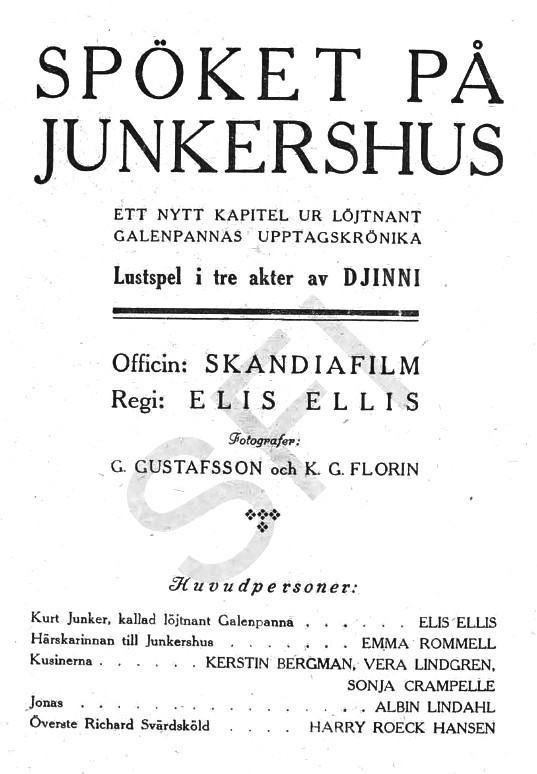
Stepping back into the hallowed halls of early Swedish cinema, one encounters a fascinating tapestry of narratives that often weave together psychological depth with a distinct sense of place. Among these, Spöket på Junkershus (The Ghost of Junkershus), a work penned by Hedvig Svedenborg and Elis Ellis, who also directed, emerges not merely as a relic of its era but as a compelling study of human confinement and the insidious nature of domestic ennui. This silent film, rich in its visual storytelling, invites us to a world where the spectral presence is less about supernatural apparitions and more about the haunting shadows of unfulfilled lives and societal expectations.
The very title, ‘The Ghost of Junkershus,’ tantalizes with the promise of gothic thrills, yet the true specter within this film is far more profound and pervasive than any sheet-clad phantom. It is the ghost of wasted youth, the haunting echo of stifled aspirations, and the oppressive weight of societal decorum. The narrative centers on three sisters – Marie-Louise, Louise-Marie, and Madelaine – who reside with their aunt, the matriarch of the titular Junkershus. Their existence is painted with broad strokes of profound boredom, a monotonous cycle of days that drain their spirits and leave them yearning for something, anything, beyond the manor’s formidable walls. Their plight is exacerbated by the intermittent, yet always unwelcome, incursions of their cousin, Jonas, a character depicted as hypocritical and generally disagreeable, whose presence only serves to underscore the suffocating atmosphere of their lives.
Junkershus itself is more than just a backdrop; it is a principal player in this quiet drama. The architectural grandeur, captured through the lens of a silent film era cinematographer, paradoxically emphasizes the emotional constriction experienced by its inhabitants. One can almost feel the dust motes dancing in the shafts of light, symbolizing the stagnant air of their existence. The long corridors, the imposing drawing rooms, the meticulously maintained gardens – all serve as golden cages for the sisters. This sense of spatial confinement mirrors their emotional and intellectual imprisonment. Unlike the overt menace of a truly haunted house, Junkershus presents a more insidious threat: the slow erosion of spirit through sheer lack of stimulation. This psychological intensity, conveyed through visual cues and the actors' nuanced expressions, is a hallmark of the period's cinematic artistry.
The film’s portrayal of the manor’s interior design and exterior façade contributes significantly to its thematic depth. Every ornate detail, every shadowy corner, seems to whisper tales of bygone eras, yet offers no solace to the present inhabitants. It stands as a monument to ancestral pride, but also to generational burdens. The very opulence becomes a visual metaphor for the weight of expectation and the lack of personal agency afforded to the women within its walls. This contrasts sharply with the broader world that Jonas, the cousin, is free to wander. The disparity in freedom between the sexes, even within the confines of a privileged life, is subtly but powerfully underscored by the contrast between the sisters’ static existence and Jonas’s peripatetic habits.
Marie-Louise, Louise-Marie, and Madelaine are not merely characters; they are embodiments of a particular societal ailment prevalent among women of a certain class in that era: a profound, debilitating boredom. Their days, we infer, are filled with polite conversation, needlework, perhaps a turn at the piano – activities that, while culturally sanctioned, offer little genuine intellectual or emotional engagement. The film, through its visual narrative, allows us to glimpse their internal struggles, their unspoken frustrations. The subtle shifts in their gazes, the slight drooping of a shoulder, the sighs that would be unheard but are keenly felt through their body language, all convey a deep-seated weariness. This collective portrayal of female disquiet resonates with other films exploring the constraints on women, though often in more overt melodramatic forms. One might consider the psychological intensity found in a film like The Second Mrs. Tanqueray, which, while dealing with different social dilemmas, similarly probes the internal lives of women grappling with societal expectations and personal desires.
The genius of silent cinema lies in its ability to communicate complex emotional states without dialogue. Here, the actresses (Sonja Crampelle, Emma Rommel, and Kerstin Bergman, presumably among the sisters) must rely entirely on their physicality and facial expressions. Their performances, even in the absence of spoken words, manage to convey a spectrum of feelings from resignation to fleeting moments of hope, quickly extinguished by the relentless sameness of their environment. This is a testament to the skill of the performers and the direction of Elis Ellis, who understood how to harness the power of visual storytelling to articulate internal landscapes. The very repetition of their names, Marie-Louise and Louise-Marie, subtly hints at a lack of distinct individuality, a blurring of personal identity under the weight of their shared, uninspired existence.
Enter Jonas, portrayed by Albin Lindahl, a character whose very existence seems designed to amplify the sisters' discontent. Described as hypocritical and sad, Jonas embodies a particular type of social parasite – one who benefits from the system while contributing little but discomfort. His 'wandering around in society' suggests a superficial engagement with the world, a man more concerned with appearances than substance. For the sisters, Jonas is not just an annoying relative; he is a living embodiment of the societal flaws that trap them. His hypocrisy likely stems from a desire to maintain his social standing or to exert control, even if subtly, over the women of Junkershus. His presence injects a dose of low-level antagonism into the already stagnant atmosphere, stirring resentment without offering any dramatic resolution.
The character of Jonas serves a crucial thematic purpose. He is the external irritant that highlights the internal decay. His 'sadness' could be interpreted as a form of self-awareness, a quiet acknowledgment of his own moral failings, or simply the melancholic disposition of a man trapped by his own pretense. Regardless, his interactions with the sisters, however brief, are pivotal in establishing the oppressive social dynamics at play. He represents the kind of male authority, however weak or flawed, that still holds sway over the lives of the women, dictating the terms of their confinement. This portrayal of a morally ambiguous male figure, whose negative influence is felt acutely by the female protagonists, finds echoes in other period dramas that explore domestic power imbalances, such as The Hidden Hand, where unseen forces or manipulative individuals often dictate the fates of more vulnerable characters.
The most intriguing aspect of Spöket på Junkershus lies in its interpretation of the 'ghost.' While the title might lead one to expect a supernatural horror, the film, in typical art-house fashion, likely uses the 'ghost' as a potent metaphor. The specter haunting Junkershus is not a rattling chain or a spectral form, but the pervasive sense of unlived lives, of potential suffocated by convention. It is the ghost of dreams deferred, of passions extinguished, of individuality suppressed. This metaphorical 'ghost' is far more terrifying because it is an internal haunting, a spiritual decay that can’t be banished by exorcism but only through radical change or awakening.
However, the possibility of a more literal 'ghost' or a mystery element cannot be entirely dismissed, especially given the narrative conventions of the era. Perhaps the 'ghost' refers to a hidden secret within the manor, a past transgression, or a clandestine affair that continues to exert its influence. Such an interpretation would align the film with traditional mystery narratives, where the uncovering of a hidden truth provides the dramatic impetus. Yet, the emphasis on the sisters' boredom and Jonas's hypocrisy suggests a more psychological and sociological reading. The 'ghost' could simply be the invisible yet palpable presence of their collective unhappiness, a silent scream trapped within the manor’s walls. This duality allows the film to operate on multiple levels, engaging both the viewer's desire for mystery and their capacity for empathetic introspection.
Elis Ellis, serving as both writer and director, demonstrates a keen understanding of silent film aesthetics. The visual grammar of the era, relying heavily on expressive acting, carefully composed shots, and intertitles, is employed with finesse. Ellis’s direction likely focuses on long takes to allow the emotional weight of a scene to build, and close-ups to capture the subtle nuances of an actor's face. The pacing, characteristic of silent films, would have been deliberate, allowing the audience to absorb the atmosphere and the unspoken tensions. The use of lighting and shadow would have been crucial in conveying mood, with the interiors of Junkershus perhaps bathed in a perpetual twilight, reflecting the somber spirits of its inhabitants.
The cast, including Sonja Crampelle, Emma Rommel, Elis Ellis himself, Harry Roeck Hansen, Kerstin Bergman, Vera Lindgren, and Frans Oskar Öberg, would have been tasked with conveying complex emotions through highly stylized yet deeply felt performances. Albin Lindahl, as Jonas, would have needed to project hypocrisy and inner sadness through gestures and posture, perhaps a perpetual sneer or a downward cast gaze. The sisters, in contrast, would have embodied resignation through their languid movements and expressions of quiet despair. The absence of dialogue elevates the importance of every glance, every movement, transforming the actors into living sculptures of emotion. This demands a mastery of physical expression, a craft that distinguished many silent film stars. The subtle interplay between characters, the unspoken resentments and yearnings, would have been communicated through a ballet of gestures and expressions, a testament to the power of non-verbal communication in storytelling.
The collaborative effort of Hedvig Svedenborg and Elis Ellis in crafting the screenplay is noteworthy. Their partnership likely brought together different perspectives, enriching the narrative with both emotional depth and structural integrity. Svedenborg's contribution might have infused the story with a particular sensitivity to the female experience, articulating the nuances of the sisters' boredom and their unspoken desires. Ellis, with his directorial eye, would have translated these textual ideas into compelling visual sequences, ensuring that the emotional core of the story was conveyed effectively through the medium of silent film. Their combined vision seems to have leaned towards a critique of societal norms, particularly those that restrict individual freedom and foster hypocrisy.
The fact that Ellis also acted in the film suggests a deep personal investment in the project, allowing for a seamless integration of the narrative vision with its execution. This multi-hyphenate role was not uncommon in early cinema, often leading to a singular, unified artistic voice. The screenplay, even without direct dialogue, must have been meticulously structured, outlining emotional beats, character motivations, and key visual moments. It’s a testament to their storytelling prowess that such a seemingly simple premise – three bored sisters and an annoying cousin – can be imbued with such rich thematic resonance and psychological complexity, offering a subtle yet potent critique of the societal expectations that often lead to internal 'hauntings.'
While Spöket på Junkershus may not be as widely known as some of its more dramatic contemporaries, its artistic merits and thematic depth make it a valuable piece of cinematic history. It stands as an exemplar of how silent films, far from being simplistic, could tackle complex psychological states and offer incisive social commentary. The film’s exploration of ennui, hypocrisy, and confinement remains strikingly relevant, echoing the struggles of individuals caught between personal desire and societal dictate, a theme that transcends eras and cultural boundaries.
The 'ghost' of Junkershus, whether literal or metaphorical, continues to whisper its tale of quiet desperation and the subtle ways in which lives can be haunted by circumstance. For those interested in the rich tapestry of early European cinema, particularly the nuanced storytelling that emerged from Sweden, this film offers a compelling glimpse into a world where silence spoke volumes. It reminds us that sometimes, the most terrifying specters are not those that go bump in the night, but those that reside within the human heart, slowly eroding joy and purpose, leaving behind only the ghost of what could have been. It's a poignant reminder that the human condition, with its inherent struggles against stagnation and superficiality, has been a fertile ground for artistic exploration since the dawn of cinema. Its understated power lies in its ability to evoke empathy for characters trapped in circumstances that, despite their privileged veneer, are deeply unfulfilling, making it a timeless commentary on the search for meaning in an indifferent world.
IMDb —
1916
Community
Log in to comment.