DbcultAccessing Vault...
Cult Review
Senior Film Conservator
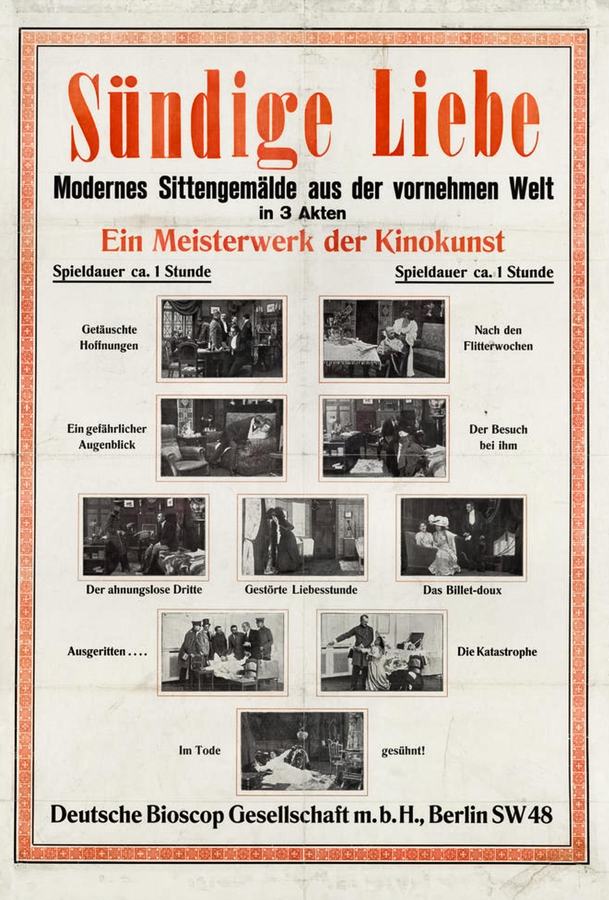
The year 1911 stands as a monumental threshold in the evolution of the moving image. It was an era where the medium was shedding its 'cinema of attractions' skin—those brief, ephemeral glimpses of reality seen in works like Saída dos Operários do Arsenal da Marinha—and donning the heavy, velvet robes of narrative complexity. Within this transformative zeitgeist, Sündige Liebe (Sinful Love) emerges not merely as a relic of German production but as a sophisticated inquiry into the human condition, framed by the nascent yet powerful visual language of silent melodrama.
To witness Paul Bildt in this early stage of his career is to observe the blueprints of German Expressionism being drawn in real-time. While the world was still captivated by the physical prowess of athletes in films like Jeffries-Johnson World's Championship Boxing Contest, Bildt was pioneering a different kind of combat: the internal struggle of the bourgeois man against his own shadow. His performance in Sündige Liebe is a masterclass in micro-expression. Long before the close-up was codified as the primary tool of intimacy, Bildt used his entire physiognomy to convey a sense of impending doom. Every tilt of the head, every hesitant gesture toward Ilse Oeser, speaks of a man aware that he is stepping off a precipice.
The chemistry between Bildt and Oeser is palpable, even through the flickering, sepia-toned veil of a century-old negative. Oeser, often unfairly relegated to the role of the 'temptress' in contemporary synopses, imbues her character with a tragic agency. She is not merely a siren; she is a reflection of the protagonist's repressed vitality. Their interactions are filmed with a surprising degree of spatial awareness, utilizing the depth of the frame in a way that rivals the sophisticated staging found in Den hvide Slavehandels sidste Offer or the later works of the Danish masters.
Technically, Sündige Liebe represents a significant leap from the static, stage-bound productions of the previous decade. While films like The Life and Passion of Jesus Christ relied on iconic, well-known imagery to guide the viewer, Sündige Liebe must build its emotional resonance from the ground up. The cinematography employs a proto-expressionistic use of light and shadow. The domestic spaces, initially bright and airy, begin to feel increasingly cavernous and oppressive as the weight of the 'sin' grows. The shadows are no longer just absences of light; they are active participants in the narrative, creeping across the floorboards like the moral rot the film seeks to expose.
One cannot discuss the visual impact of this film without comparing it to the sheer scale of international productions from the same period. While Defense of Sevastopol aimed for the epic and the nationalistic, Sündige Liebe turns its lens inward, finding an equal amount of drama in the quiet closing of a door or the burning of a letter. This intimacy is what allows the film to transcend its 1911 origins. It feels less like a historical document and more like a fever dream of a lost social order.
The thematic core of the film is the irreconcilable conflict between the individual and the collective. In this regard, it shares a spiritual kinship with Anna Karenina (1911), yet it approaches the subject with a distinctly Teutonic severity. Hugo Flink’s character serves as the personification of the law—not necessarily the legal code, but the unwritten social contracts that bound the German middle class. Flink plays the role with a chilling composure, his presence a constant reminder that for every moment of 'sinful' bliss, a price must be paid in the currency of reputation and soul.
The film’s title itself, Sündige Liebe, serves as both a warning and a provocation. For a 1911 audience, the word 'sinful' carried a religious and social weight that is difficult to replicate today. However, the film subverts this by making the 'sin' feel more like a tragic inevitability than a malicious act of rebellion. It suggests that in a society as rigid as the one depicted, any genuine expression of passion is, by definition, an act of transgression. This perspective aligns the film with other provocative works of the era, such as A Victim of the Mormons, which utilized sensationalist themes to explore deeper anxieties about modernity and the changing roles of women and men.
To truly appreciate Sündige Liebe, one must look at what else was flickering on the screens of the world's nickelodeons and grand cinemas. The market was flooded with 'reproductions' of events, like Reproduction of the Corbett and Fitzsimmons Fight, which focused on the spectacle of the body. In contrast, Sündige Liebe represents the 'cinema of the mind.' It is a film that asks the viewer to contemplate the consequences of action rather than just the action itself. It is a precursor to the great chamber dramas (Kammerspielfilm) that would dominate German cinema in the 1920s.
Even when compared to literary adaptations of the time, such as Jane Eyre or Hamlet, Sündige Liebe feels more modern because it is not beholden to a pre-existing text. It speaks the language of the camera first. The pacing is deliberate, allowing the tension to accumulate until the final, inevitable collapse. It lacks the frantic energy of The Story of the Kelly Gang, opting instead for a gravitational pull that draws the characters toward their doom with a slow, agonizing grace.
Why does Sündige Liebe still resonate? Perhaps because the 'sin' it depicts—the choice between personal happiness and social acceptance—remains one of the fundamental dilemmas of human existence. While the specific social mores of 1911 Germany have vanished, the psychological architecture of the film remains intact. Paul Bildt’s performance, in particular, bridges the gap between the centuries. He doesn't just play a character; he embodies a state of being—the state of being caught between two worlds.
In the broader history of cinema, this film serves as a vital link in the chain. It takes the moralistic fervor of early religious epics like Life of Christ and transplants it into the secular, gritty reality of the modern city. It replaces the divine judgment of the heavens with the cold, judgmental eyes of one's neighbors. It is a film that understands that the greatest tragedies do not happen on battlefields or in the ring of a The Joe Gans-Battling Nelson Fight, but in the quiet corners of a drawing room, where a single glance can destroy a life.
Final Verdict: Sündige Liebe is an essential viewing for any serious student of film history. It is a haunting, beautifully crafted piece of art that proves that even in 1911, cinema was capable of profound emotional depth and complex social critique. It stands alongside other 1911 landmarks like Dante's Inferno as a testament to the limitless potential of the silent frame. If you can find a print of this rare gem, do not hesitate. It is a window into a world of shadows, secrets, and the enduring power of a love that dares to be sinful.
IMDb —
1923
Community
Log in to comment.