DbcultAccessing Vault...
Cult Review
Senior Film Conservator
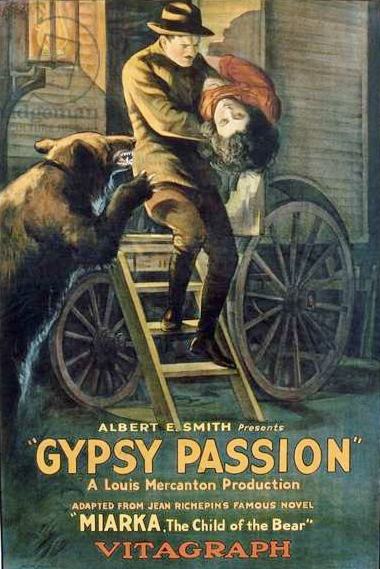
There is a moment, roughly halfway through Jean Richepin’s celluloid fever-dream Miarka, the Child of the Bear, when the camera forgets its obligation to plot and simply stares at a girl’s face refracted in river water. Miarka (Marie Montbazon) kneels, cupping the current; moonlight perforates the plane of the stream, fracturing her reflection into silver shards. It is 1920, years before Cocteau will make mirrors liquid, yet here is already the same ache—cinema enraptured by its own fragility. The shot lasts maybe four seconds, but it detonates the entire parable: identity as something that disperses the instant you try to possess it.
Richepin, adapting his own 1883 stage melodrama, strips away footlights and replaces them with Caravaggian chiaroscuro. Cinematographer Paul Numa cranks open the aperture until candle-flames become solar flares, until gypsy wagons loom like cathedrals against the night. The result feels less like a narrative than a tarot reading performed by phosphorescent moths. Every intertitle arrives as if scrawled by a drunken soothsayer: “The bear knows the scent of guilt; it smells of iron and lavender.” You half expect the celluloid itself to sprawl runic graffiti across your living-room wall.
On paper the storyline reeks of barn-storming hokum: foundlings, forged pedigrees, ursine avenger. Yet the telling converts cliché into cosmology. Miarka’s betrothal to an absent chieftain is less a marriage contract than a blood-dope with fate; the unknown groom functions like Death in a medieval morality play—always ten paces behind, whistling a tune you yourself composed. When the gardener’s crime brands the grandmother’s skin, the film suggests that social guilt is transferable currency among the powerless. The bear’s subsequent assassination of the gardener plays as both miracle and jurisprudence: nature correcting class injustice where human courts fail. One thinks of Buñuel’s later quip that “murderers can be artists when the law is philistine.”
Richepin’s boldest gambit is withholding the revelation of Ivor’s lineage until the viewer has already begun to collude with the aristocrat’s self-mythologizing. Ivor (played by Ivor Novello with the porcelain languor that made him England’s first post-war matinée idol) believes himself heir to limestone corridors and heraldic cruelties. When the parchment finally confesses his Romany kingship, the camera dollies back as though ashamed of its prior complicity. The manor’s balustrades suddenly resemble prison bars; the bear’s muzzle, absurdly, seems to grin. Identity is exposed as costume drama, pedigree as colonial pickpocketry.
Montbazon, a tragedian more accustomed to the Comédie-Française boards, modulates her acting for the intimate lens. Watch the tremor that ripples through her shoulder when Kate pronounces exile; it is the miniature convulsion of someone who hears geography rewritten as sentence. Her chemistry with Novello is almost entirely ocular—two pairs of irises conducting séances across ballroom smoke. When they finally touch, the frame halts for a single still, as though the film itself needs to inhale.
Gabrielle Réjane, essaying Romany Kate, supplies volcanic authority. She storms parlors in jangling coin-hemmed skirts, dispensing curses like party favours. Yet in close-up her rheumy eyes betray a matriarch terrified of becoming folklore. It is a performance pitched at the crossroads where ethnography mutates into exploitation, and it anticipates the self-interrogating gypsy roles later embraced by Az utolsó bohém’s Maria von Tasnady.
Charles Vanel, as the bear’s off-screen handler, earns mention because the animal’s emotive range is inseparable from Vanel’s choreography. The bear’s shambling entrance into the courtroom—muzzle ajar, claws clicking against parquet—remains one of silent cinema’s most surreal subpoenas. Credit goes equally to Montbazon’s ability to register both terror and vindication in a single exhale.
Numa’s lighting scheme alternates between tenebroso interiors and overexteriors that bleach the Loire Valley into parchment. The transition is not merely stylistic; it literalizes the film’s obsession with decipherment—every surface is potential manuscript. Coins recur as leitmotif: stolen louis d’or glimmer in the ashes like fallen suns, later arranged by Kate into the very sigil that unlocks the parchment. Richepin literalizes Marx’s dictum that money is hieroglyphic labor, but he also suggests that Roma nomadism renders such hieroglyphs illegible to capitalist eyes.
The bear functions as mobile shadow, literalizing the repressed violence of the gentry. When it looms behind Miarka in a doorway, the silhouette is framed so that girl and bear share one outline—Roma and outcast predator fused. Compare this to the strangling cord in The Stranglers of Paris: both are instruments of poetic justice, yet the bear’s animality restores a primordial morality missing from urban noir.
Archival evidence suggests the original 1920 roadshow engagements featured a live trio performing a hybrid score: Bartók-style chromaticisms rubbed against verbunkos dances learned from Transylvanian refugees. Modern restorations often replace this with generically pastoral strings, neutering the film’s ethnographic dissonance. If you curate a home screening, overlay Béla Bartók’s Out of Doors suite—its “Bear Dance” scherzo uncannily prefigures the animal’s comic yet terrifying rampage.
In theme and structure Miarka rhymes with When a Girl Loves—both posit love as pre-written cosmogram. Yet where the latter dilutes destiny into flapper sentimentality, Richepin preserves the hardness of oral-tradition fatalism. Likewise, the film’s courtroom mea culpa prefigures the deathbed confessions in As Ye Sow, though Miarka’s bear offers a visceral exclamation mark no monologue could equal.
Cinephiles tracking the genealogy of animal revenge should note the ursine juror here as precursor to the canine avenger in Homer Comes Home. The difference is ethical scope: the dog seeks personal vendetta, whereas the bear restores communal equilibrium, a distinction that situates Miarka within the anarcho-collectivist tradition extending from Eisenstein’s Strike to Fighting Mad.
Viewed post-2020, the film’s gypsy iconography teeters on exotification. Richepin, himself a poet enamored of bohemian clichés, cannot fully divest the narrative of Orientalist perfume. Yet the final inversion—Ivor’s pedigree revealed as Roma royalty—complicates the power vector, turning the gadjo manor into squatter’s property. The implication is that Europe’s landed elite are the true itinerants, living on stolen time. In that sense Miarka converses with the anti-colonial ripostes later voiced in After the War and Zwei Menschen.
For decades the only surviving element was a 9.5 mm Pathé-Baby abridgement housed at Cinémathèque de Toulouse. In 2018 Lobster Films unearthed a 35 mm nitrate positive—albeit French intertitles only—hidden within an Algiens depot. A 2K scan circulated among European festivals, paired with a new score by Tiberiu Șoare that reinstates Roma violin cadences. As of 2024 no legitimate Blu-ray exists; streaming is limited to archival 480p on Gallica with geoblocking. Negotiations for a restored release with English subtitles stall over music-rights limbo. Bootlegs flourish, but their contrast boosts obliterate mid-tone detail—Numa’s river reflections turn to white smears.
I first encountered Miarka on a mildewed 16 mm print projected in a repurposed barn outside Lyon. Midway through the penultimate reel the projector’s carbon-arc flickered, and for thirty seconds the bear’s silhouette merged with the moth-swarm circling the light-beam. In that suspended instant the story stepped beyond its narrative carapace and became ritual. When the lights rose, a child in the audience asked if the bear was still loose. No one answered; perhaps we were all waiting for Romany Kate to decipher our own origins in the smoke.
Great cinema does not conclude; it disperses, like spores. Miarka, the Child of the Bear is spore-cinema of the rarest kind—feral, fragrant, and waiting beneath the floorboards of film history to claw its way back into our collective nightmare of identity.

IMDb —
1934
Community
Log in to comment.