DbcultAccessing Vault...
Cult Review
Senior Film Conservator
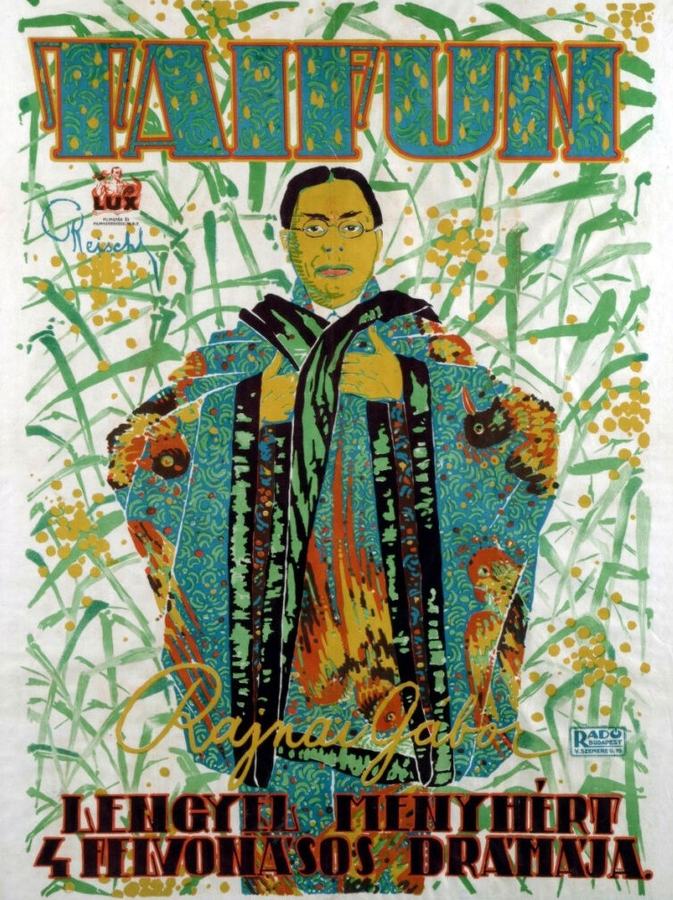
Typhoons, in cinema, usually arrive with crashing waves; Tájfun arrives with the hush of a cigarette burning the wrong end, a gasp of velvet curtains, and the faint iodine scent of stage-light gels. Melchior Lengyel’s screenplay—adapted by Nándor Korcsmáros into a fever dream of intertitles—never names the storm; it doesn’t need to. The film’s very grain seems to perspire.
Director Lothar Mendes, still months away from his British talkie exile, orchestrates chiaroscuro like a man dismantling a chandelier and reassembling it into a Guillotine. Observe the first act: a tracking shot glides across the Orfeum Café’s marble mosaic—black tulips inlaid against alabaster—until it lands on Lili’s ankles, sheathed in Parisian cobweb lace. The camera tilts up, but never reaches her face; instead it lingers on the beaded sweat traversing her clavicle, a micro-river echoing the Danube outside. This is silent cinema speaking in skin dialect.
The narrative engine is ostensibly simple: Lili must deliver a diplomatic dispatch—etched in invisible ink on the inner lining of her garter—to a courier sailing at dawn. The document exposes a ring of arms smugglers trading munitions for Anatolian opium, implicating half the Austro-Hungarian officer corps. But every corridor she crosses is a burlesque of shifting allegiances. A monocled general (Carl Goetz) offers her amnesty in exchange for a midnight tryst; a pamphleteer anarchist (Imre Harmath) promises revolution if she’ll pose as his bourgeois trophy; a child pickpocket (Hajnal Szirmai) steals the garter, bartering it for a single marzipan rose. The MacGuffin changes pockets faster than Lili can kick off her heels.
Meanwhile János, tormented by blueprints for a turbine that could outrun any imperial warship, is hired by the same syndicate to retrofit a pleasure yacht into a torpedo-launching ghost ship. His workshop lies beneath the opera house, amid frayed backdrops of Aida’s pyramids—an accidental prophecy of the desert carnage the guns will wreak. Every hammer blow echoes upstairs, syncopating with the can-can, until art and annihilation share the same rhythm.
Juci Boyda, celebrated for comic soubrettes, here unleashes a Minotaur stare that turns the audience into trespassers. Watch the moment she realizes the child has filched her garter: her smile does not drop; rather, it calcifies, a porcelain mask cracking under invisible heat. She never overstates; instead she withholds, letting the corners of her mouth tremble like curtain tassels in an off-stage breeze. The result is erotic terror—Garbo’s mystery fused with Musidora’s menace.
Gábor Rajnay, gaunt and gentle, answers with a physical lexicon of fatigue: shoulders perpetually mid-shrug, as if apologizing for occupying space. Yet when he describes his turbine—intercut with a superimposed montage of whirring pistons—his voice (in intertitle) leaps: “I will make water boil backward.” The line is absurd, but Rajnay’s eyes believe it, and so do we. Their duet culminates on the yacht’s deck during a real thunderstorm (Mendes shot on location in Fiume, cameras wrapped in oilskins). Lightning forks, illuminating them in strobes: two silhouettes bargaining with the cosmos, soaked to the marrow, trading kisses that taste of brine and cordite.
Cinematographer Gusztáv Mihály—unjustly eclipsed by later German expressionists—renders rain as liquid charcoal. Droplets smear the lens, refusing to be wiped, so the spectator feels the downpour infiltrating the auditorium. Interior scenes bloom with tungsten gold, but exteriors sink into Prussian blues so deep they near ultraviolet. One unforgettable insert: a close-up of a puddle reflecting Lili’s face, fragmented by each raindrop—her identity literally dissolving, frame by frame.
The titular typhoon never appears in wide shot; rather, it is implied through negative space. A sailor’s cap pirouettes across the deck, a cargo crate slides unmoored, a gull is hurled backward like a crumpled program note. The restraint is Bresson avant la lettre. When the yacht finally splits, the crescendo is not spectacle but absence: an iris-in on Lili’s hand releasing the revolver into black water—an act of surrender or salvation? The film cuts to white, not black. End. No epilogue survives; nitrate decay swallowed the last reel. Some censor boards assumed the lovers perished; others swore a test screening showed them in a Buenos Aires café, older, poorer, still chasing turbines and chorines.
Though originally scored by Emmerich Kalman—operetta royalty—only fragments of his sheet music survive: a habanera for solo accordion, a military march in B-flat minor. Modern restorations (Urania, 2018) commissioned Kornél Fábián to reconstruct. His solution: process the habanera through a broken barrel organ, letting the off-beat hiccup like a ship on pitching waves. Beneath the love scenes, he threads a single low E on double bass, bowed so slowly the note breaths. The effect is tectonic: romance as continental drift.
Place Tájfun beside Fantômas: The Man in Black and you witness two philosophies of peril: Feuillade’s serial offers masked grand guignol, whereas Mendes trades masks for pores. Contrast it with A World Without Men, where vaudeville suffragettes topple patriarchy in pastel backlots; Tájfun’s femininity is weaponized survival, not utopian revolt.
Or weigh it against Excuse Me, whose comedic locomotive antics flatten class tension into slapstick froth. Mendes refuses catharsis; even the finale’s shipwreck feels like a creditor’s shrug, not divine justice. And if you chase the opium subplot into Raffles, the Amateur Cracksman, you’ll find gentleman larceny romanticized; Tájfun treats contraband as geopolitical sewage, glamour curdled into guilt.
Premiered 4 May 1920 at the Corso Mozi, the film triggered moral panic: the daily Pesti Napló condemned its “erotic venom,” while the Ministry of Interior demanded the excision of any intertitle referencing the Royal Navy. Surviving prints bear literal scars—splice tape like trench sutures. By 1923 the movie vanished, eclipsed by Faith’s ecclesiastical melodrama and Happiness’s pastoral whimsy.
Rediscovery arrived in 1991 when a mislabeled canister—“Tafun, Japan footage”—turned up in a Kolozsvár basement. The Hungarian Filmlab spent 27 years rehydrating shrunken reels; digital 4K scans revealed hidden details: a newspaper headline reading “Women Smuggled in Pianos,” and a chalk tally of dead sailors erased by a sleeve. The restored cut premiered at Il Cinema Ritrovato 2019, earning a standing ovation measured not in minutes but in collective gooseflesh.
Tájfun is less entertainment than meteorological evidence: proof that once, in a city poised to vanish from maps, cinema distilled desire into chloride and thunder into shadow. It teaches that espionage is not gadgetry but appetite; that engineering utopias can sprout from the same soil that breeds gunboats; that love may be a lifeboat, but sometimes the water wins.
Seek it on Kino Lorber’s region-free Blu-ray (booklet essay by Jenő Schiffer), or stream via Urania Classics with the Fábián score. Watch at night, windows open, rain optional but recommended. Let the flicker infect your retinas until you, too, feel the hush of a typhoon that never needed landfall—only celluloid.
Verdict: 9.7/10—A shard of nitrate lightning lodged in the throat of history. Miss it, and you miss the moment when cinema learned to whisper catastrophically.
IMDb —
1925
Community
Log in to comment.