DbcultAccessing Vault...
Cult Review
Senior Film Conservator
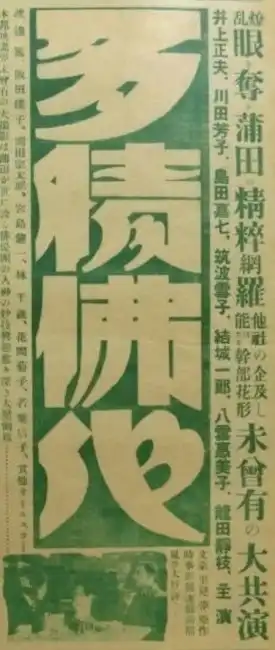
You should only watch this if you actually like silent films or if you are trying to see everything from the 1920s. If you hate reading title cards and slow pacing, you will probably turn this off after ten minutes.
It is a bit of a relic. But for the right person, it feels like a nice, quiet afternoon.
The story isn't anything ground-breaking. It is mostly about people being stuck in their own heads and dealing with social pressure.
Ken'ichi Miyajima has this very specific way of standing still. He looks like he is carrying the weight of the world on his shoulders just by how he holds his coat.
There is a scene where the characters are just sitting and drinking tea. It goes on for a long time.
I found myself looking at the background more than the actors. The sets have this fragile quality to them that you don't see anymore.
The writing by Ton Satomi and Tokusaburō Murakami feels a bit theatrical. You can tell they were still figuring out how to make movies feel like real life and not just a filmed play.
Sometimes the emotions feel a bit too big. Like, someone gets a piece of bad news and they react like the world is literally ending right there in the living room.
It reminds me a little of the heavy vibes in A Wall Street Tragedy, but with more Japanese 1920s flair. Both movies really want you to feel the misery of the characters.
Ichirō Yūki is also pretty good here. He has a very expressive face that works well for the silent format.
The lighting is actually better than I expected. There are these shadows in the corner of the rooms that make everything feel a bit spooky even when it isn't supposed to be.
One reaction shot of Yoshiko Kawada lingers for way too long. I think the editor might have fallen asleep or they just really liked her face.
It gets a bit repetitive in the second half. You feel like they are having the same argument over and over again without saying words.
The print I saw was a bit grainy, which actually added to the mood. It felt like watching a ghost story from a hundred years ago. 👻
I noticed a small mistake in one scene where a prop on the table moves between shots. It’s funny how those little things still happen even back then.
If you have seen Vendémiaire, you know how these long silent epics can feel. Tajo busshin isn't as grand as that, but it has its own small-scale charm.
The ending doesn't really give you a clean answer. It just kind of stops, which I actually liked more than a fake happy ending.
Is it a masterpiece? Probably not. But it is a real movie made by people who clearly cared about the characters.
It's worth a look if you want to see what Japanese cinema looked like before it became a global powerhouse. Just bring some coffee so you don't nod off during the long walking scenes. ☕
IMDb —
1917
Community
Log in to comment.