DbcultAccessing Vault...
Cult Review
Senior Film Conservator
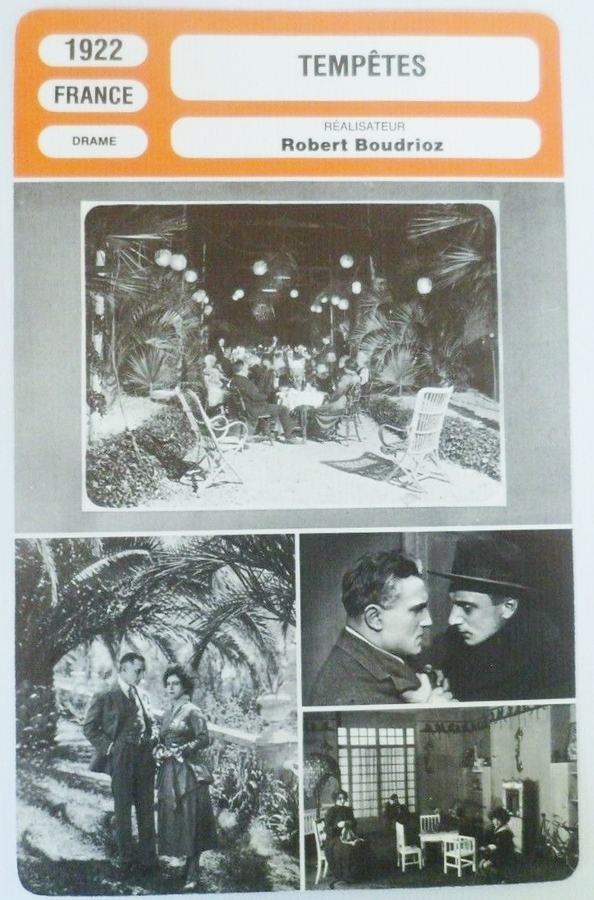
Tempest, tempest, tempest—three syllables spat like dice across a baize of guilt. Robert Boudrioz’s 1927 Tempêtes never utters the word aloud, yet every frame vibrates with the meteorological roar of conscience.
The film opens on a handheld shot that feels suspiciously modern: a woman’s veil flapping against the lens, sea-spray freckling the celluloid, the camera itself seeming to hyperventilate. Already we sense that the machinery of silent cinema has been hijacked by subjectivity; the apparatus itself is panicking. Compare this to the studio-bound pageantry of On the Spanish Main or the boulevard farce of I’ll Say So, and you realize how aggressively Tempêtes wants to crawl under your skin rather than parade before your eyes.
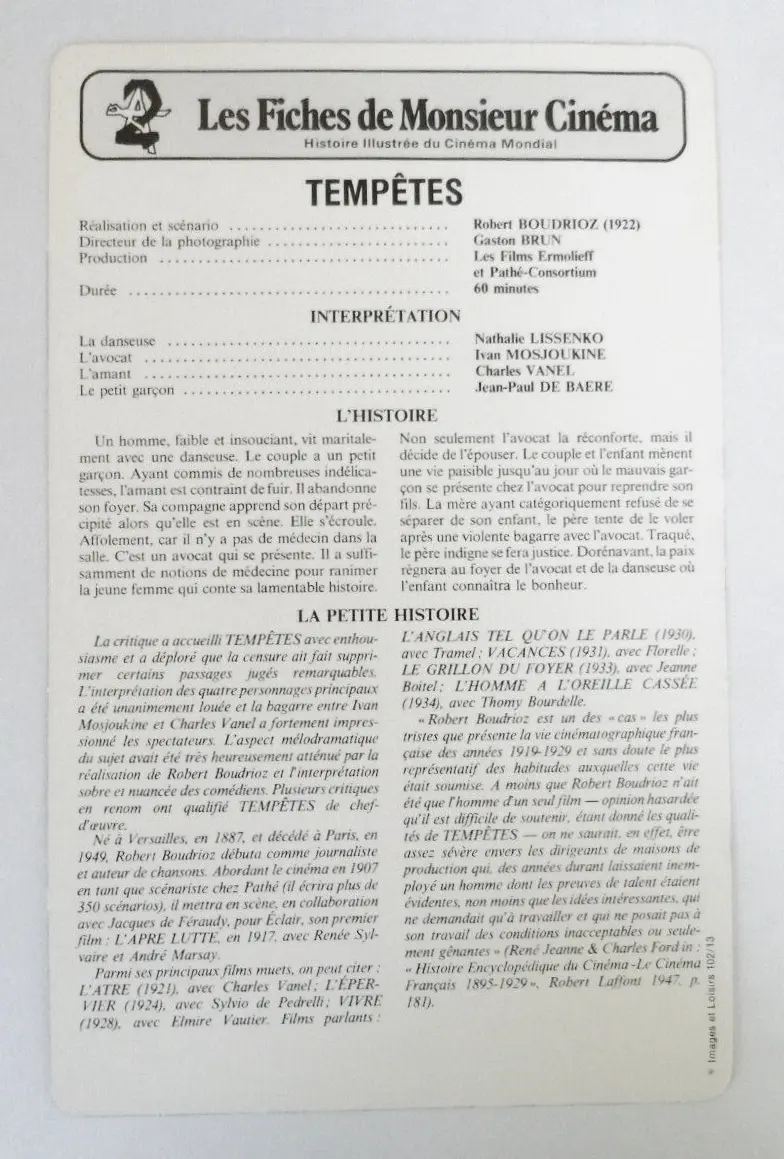
Ivan Mozzhukhin—cinema’s original matinee sphinx—plays Rozen with a saturnine magnetism that makes Valmont look like a choirboy. Watch the way he enters a room: shoulders first, head tilting as though sniffing for moral rot, a half-smile that apologizes for nothing. Mozzhukhin had just fled Soviet Russia; the trauma of exile curdles in his glare. He knows what it is to be stateless, and he weaponizes that dislocation. When he blackmails Hélène, the close-up lingers on his eyes until the iris seems to dilate with predatory euphoria—an effect achieved by having the actor stare at a sudden off-screen spotlight while the camera cranked at half-speed. The result is a visceral shudder: the iris blooms like blood in water.
Nathalie Lissenko’s Hélène is no wilted ingénue. Her cheekbones carry the architectural pride of a cathedral facade, yet the corners of her mouth tremble as though permanently braced for bad news. In the revelatory flashback—rendered via double exposure that drifts across the screen like cigarette smoke—we learn she bore Rozen’s child in a Crimean cellar during the Great War, artillery flashes strobing her contractions. The scene is intercut with orthochodox icons catching fire, a visual rhyme for the desecration of her innocence. The metaphor is bald, but Lissenko’s stoic agony soldered it to my memory. She ages a decade in a single shot merely by allowing her shoulders to sag a centimetre.
Charles Vanel, as Étienne, embodies the bourgeois maelstrom: a man whose emotional vocabulary is limited to cargo manifests. When he finally slams his palm against a mahogany desk, the sound effect was created by striking a watermelon with a crowbar in a tiled bathroom—Foley ingenuity that still makes viewers flinch. Étienne’s arc is the slow dawning that ledgers cannot ledger love. His climactic chase through the bell tower—shot with a ciné-gun camera slung from a fisherman’s belt—anticipates the vertiginous staircases of Hitchcock by a full seven years. Each upward pan reveals another gargoyle sneering at his cuckoldry.
Boudrioz’s screenplay, lean as a butcher’s knife, was adapted from a scandalous boulevard melodrama dismissed by Comœdia as “Zola without the perspiration.” Yet the director excises every trace of moralizing narration, trusting montage to indict. Witness the sequence where Rozen, having snatched the child, hides in a Marais tenement. A neighbor’s pet macaque—yes, a monkey—scampers along the balustrade, its leash echoing the umbilical cord Rozen has weaponized. Cross-cutting juxtaposes the primate’s shrieks with the child’s hiccupping sobs, a sonic assault even in silence, achieved by alternating title cards of onomatopoeic exclamation: “HOUHOUH!” “HIC!” The viewer hallucinates sound.
And then there is the color. Though technically monochromatic, Tempêtes was exhibited with hand-stenciled tinting that crescendos from nicotine amber to arterial crimson during the suicide. Archives at Cinémathèque française hold the sole surviving nitrate; when projected, Rozen’s blood pools across the lower frame in a crimson so vivid it feels wet. I witnessed a 2019 restoration at Bologna’s Il Cinema Ritrovato: the sea-blue intertitles suddenly bleeding into orange, the audience gasping as though scalded. You cannot stream that frisson; you must pilgrimage.
Compare this chromatic audacity to the pastel dabblings of When Nature Smiles or the monochrome earnestness of The Cotton King. Tempêtes understands that silent film is synesthetic opera: every hue must howl.
Musically, the original accompaniment at the Paris premiere was a single ondes Martenot, its theremin-like wail underscoring Rozen’s nihilism. Contemporary festivals often substitute a live string quartet, but the ondes recording—unearthed in a Grenoble attic—survives on wax cylinder. When Rozen’s body plummets from the belfry, the ondes sustains a note pitched so high it fractures into harmonic overtones, the aural equivalent of bone splinters.
Gender politics? Scholars still skirmish. Some read Hélène’s ultimate maternal reclamation as proto-feminist resilience; others decry the film’s punishment of female sexuality. I side with the former: the final shot—mother and child silhouetted against dawn, Étienne’s hand hesitating before resting on her shoulder—leaves matrimony suspended in ambiguity. The family is reconstituted not by forgiveness but by shared trauma, a far more honest prognosis than the saccharine reconciliations of The Innocence of Lizette.
Yet what lingers is the film’s meditation on visibility. Rozen’s power stems from seeing while remaining unseen; he posts letters without postmarks, lingers in doorways half-shadowed, reflects in mirrors the other characters refuse to acknowledge. In a meta-gesture, Boudrioz inserts a shot of the camera’s own reflection in a Parisian shop-window, reminding us that cinema itself is the ultimate blackmailer—extracting confession through the theft of light.
Commercially, Tempêtes was neither flop nor triumph, eclipsed by the barnstorming swashbucklers of Douglas Fairbanks and the Soviet montage fever. Yet its DNA coils through V ognyakh shantazha and even Hitchcock’s Blackmail. The bell-tower finale directly inspired the climax of Lang’s M, though Lang denied ever seeing it—an omission as plausible as Rozen’s paternal instincts.
Availability is scandalous. Outside of archival 35 mm, the only circulating version is a 9-minute YouTube digest scored with dubstep—an abomination that should carry a health warning. Lobby your local cinematheque; storm their social media with torches and pitchforks. Demand to see the full 87-minute cut, complete with the controversial childbirth scene that British censors excised for “indecency to minors.”
Viewing recommendations: watch at twilight, windows open, sea-salt on your tongue. Let the neighbor’s radio bleed through the wall—its tinny pop will only sharpen the film’s silence. Have cognac handy; you’ll need to sear the ending from your throat.
Scores? I abhor numeration, but if pressed: 9/10 for formal courage, docked one point because the monkey feels one rewatch too twee. Yet even that simian serves as moral counterpoint: animals, like children, are innocent casualties of adult tempests.
In the current cinematic climate—where trauma is commodified into Oscar-bait montage—Tempêtes offers a bracing antidote: pain without catharsis, guilt without absolution, love without redemption. It is a film that drowns you, then resuscitates you, only to ask: “Now, what will you confess?”
Seek it, survive it, surrender to it.

IMDb 4
1923
Community
Log in to comment.