DbcultAccessing Vault...
Cult Review
Senior Film Conservator
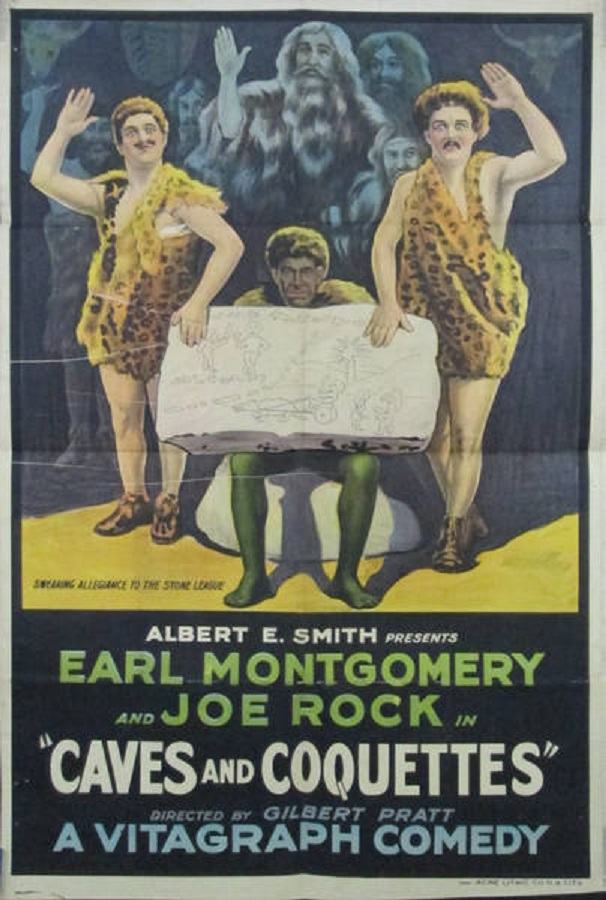
To engage with Caves and Coquettes is to step into a time capsule where the ink was still wet on the blueprints of cinematic comedy. Produced in an era when the medium was shedding its nickelodeon skin to embrace more complex narrative structures, this film represents a fascinating intersection of physical prowess and burgeoning social satire. The collaborative genius of Joe Rock and Earl Montgomery—men who were as comfortable behind the typewriter as they were in front of the lens—yields a work that is both primitive in its execution and surprisingly sophisticated in its thematic underpinnings. Unlike the grand theatricality of Hamlet (1917), which sought to legitimize cinema through literary prestige, this short film finds its soul in the dirt, the grime, and the glorious absurdity of the human body in motion.
The casting of Eddie Baker and Frank Alexander provides the foundational tension of the piece. Alexander, often the 'heavy' in every sense of the word, offers a gravitational pull that grounds the more mercurial movements of his co-stars. His physicality is not merely for show; it is a comedic weapon, a rhythmic counterpoint to the frantic energy of the 'coquettes' who populate the film's lighter moments. This is not the refined, almost ethereal drama found in The Beautiful Lie; this is a comedy of collisions, where the impact of man against earth—or man against man—serves as the primary dialectic.
One cannot overlook the writing. Rock and Montgomery were architects of the 'gag' in its purest form. In Caves and Coquettes, the writing doesn't just dictate dialogue—which, in the silent era, was a secondary concern—but rather dictates the geometry of the space. The 'caves' of the title aren't just settings; they are claustrophobic arenas where the characters' dignity goes to die. Contrast this with the sprawling, almost operatic scope of The Life and Adventures of John Vane, the Australian Bushranger, and you see the power of the short-form comedy to distill human experience into a concentrated burst of kinetic energy.
The film dances on the edge of the surreal. There is a sense that the logic of the 'coquettes'—the socialites, the objects of desire, the agents of civilization—is constantly being undermined by the 'caves'—the primal, the unrefined, the chaotic. This thematic duality is a recurring motif in the era's output, yet here it feels particularly pointed. It lacks the melodrama of La verdad, opting instead for a relentless pace that leaves the viewer breathless. The writers understood that in a world recovering from the Great War, the sight of a man tripping over his own shadow in a cavern was not just funny; it was a necessary catharsis.
Technically, the film utilizes the limited lighting of its day to create a chiaroscuro effect that is surprisingly atmospheric. While it doesn't lean into the horror elements seen in The Eyes of the Mummy, there is a certain eerie quality to the subterranean sequences. The shadows are deep, and the highlights on the actors' faces—often exaggerated by the heavy makeup of the time—create a mask-like effect that harks back to the Commedia dell'arte. This visual style elevates the slapstick, giving it a weight that modern 'gross-out' comedies often lack.
"Caves and Coquettes is a masterclass in the economy of movement. Every fall is a sentence, every double-take a paragraph in the grand novel of silent absurdity."
The transition between the cave environments and the more 'civilized' social settings is handled with a jarring, almost dream-like editing style. It mirrors the psychological state of the characters—one moment they are kings of their primitive domain, the next they are bumbling intruders in a world of tea and lace. This tonal shift is reminiscent of the social friction explored in The Brazen Beauty or the deceptive appearances in The Little Liar. However, where those films might linger on the moral implications, Caves and Coquettes simply pushes the characters into the next disaster.
Is there a deeper meaning to the 'coquettes'? In the context of 1920, the 'New Woman' was emerging as a powerful cultural force. The flirtatious, independent women in this film aren't just props; they are the catalysts for the men's undoing. They represent a world that the 'cavemen'—the old guard of masculinity—cannot quite grasp. This dynamic is a bit more playful than the romantic entanglements in The Love Net or the formal arrangements in His Official Fiancée, but the underlying anxiety is the same. The men are outmatched, not by strength, but by a shifting social landscape they are ill-equipped to navigate.
The performance of Joe Rock himself deserves special mention. As a performer, Rock possessed a rubber-faced elasticity that made every reaction shot a highlight. He doesn't just act; he reacts to the very air around him. This hyper-awareness is what makes the comedy work. In The Good Ship Rock 'n' Rye, we see similar flashes of this brilliance, but here, paired with Montgomery's structural discipline, it reaches a fever pitch. It is a far cry from the somber, brooding atmospheres of Het geheim van het slot arco, proving that the silent era was as much about laughter as it was about mystery.
Looking back from a century's distance, Caves and Coquettes feels like a vital bridge. It connects the raw, unpolished antics of the early 1910s with the sophisticated feature-length comedies of the mid-20s. It shares the DNA of the 'fish out of water' story found in The Boomerang, yet it maintains a uniquely chaotic flavor. Even when compared to international efforts like the Polish Studenci, the American slapstick tradition represented here feels distinctly aggressive and optimistic.
The film's climax—a whirlwind of physical errors and social faux pas—serves as a reminder that comedy is often the best way to process the 'tidal waves' of change (to borrow a metaphor from The Tidal Wave). While some might dismiss it as a mere relic, a more nuanced viewing reveals a sophisticated understanding of human folly. The 'caves' are our base desires, the 'coquettes' are our aspirations, and the comedy is the messy, hilarious bridge between the two.
While it may lack the libertine excesses of The Libertine, Caves and Coquettes succeeds through sheer force of will and comedic timing. It is a testament to the era of Joe Rock and Earl Montgomery—a time when cinema was unafraid to be loud, even when it was silent. For the modern cinephile, it is an essential piece of the puzzle, a reminder that before there were blockbusters, there were men in caves, women in parlors, and a camera rolling to capture the glorious collision of the two.
IMDb —
1918
Community
Log in to comment.