DbcultAccessing Vault...
Cult Review
Senior Film Conservator
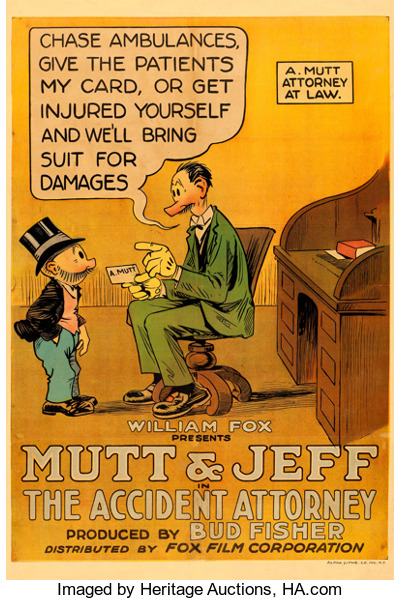
In the nascent years of the twentieth century, the intersection of the comic strip and the celluloid reel created a unique aesthetic alchemy. The Accident Attorney (1917) stands as a testament to this era, a flickering monument to the genius of Bud Fisher. While contemporary audiences might recognize the name from the 'Mutt and Jeff' pantheon, this foray into the live-action legal farce offers a fascinating glimpse into the mechanics of early screen comedy. It is not merely a film; it is a frantic, ink-stained document of social satire, capturing the litigious anxieties of a rapidly industrializing America.
The film’s structural integrity relies heavily on the physical prowess of its cast and the relentless pacing of its gags. Unlike the more refined narrative arcs found in The Sudden Gentleman, which deals with social mobility through a more traditional lens, The Accident Attorney thrives on chaos. The protagonist, a man whose ethics are as flexible as his spine, navigates a world where every banana peel is a contract and every falling brick is a windfall. This is comedy as a contact sport, a precursor to the sophisticated slapstick that would later be perfected by the likes of Keaton and Lloyd.
Fisher’s direction—or rather, his conceptualization of the space—mirrors the panel-by-panel progression of a comic strip. Each scene feels contained, yet bursting at the seams with potential kinetic energy. The framing is often static, allowing the performers to treat the screen as a stage, yet there is a rhythmic quality to the editing that suggests a deep understanding of comedic timing. This contrasts sharply with the brooding, atmospheric tension of The Other Man, proving that even in 1917, the genre boundaries were being drawn with sharp, distinct ink.
The thematic core of The Accident Attorney is surprisingly modern. The 'ambulance chaser' trope is explored with a cynical glee that feels remarkably prescient. While a film like La signora delle camelie was exploring the heights of operatic tragedy and romantic sacrifice, Fisher was down in the gutters of the urban landscape, finding humor in the exploitation of misfortune. There is a gritty, street-level realism to the settings, despite the exaggerated performances, that grounds the comedy in a recognizable reality.
This satirical edge is what elevates the film above mere low-brow buffoonery. It questions the morality of the emerging professional classes. Much like the moral quandaries presented in Her Reckoning, the film asks us to consider the cost of opportunism, albeit through the lens of a man who repeatedly falls down stairs for a paycheck. The humor is found in the gap between the attorney’s professional aspirations and his undignified reality.
Technically, The Accident Attorney is a product of its time, yet it displays a sophistication in its visual language. The use of intertitles is sparse, allowing the physical performance to carry the weight of the narrative. This reliance on the body as a communicative tool is a hallmark of the era, but Fisher’s background in cartooning gives the movements a specific, almost hyper-real quality. When compared to the more grounded, dramatic staging of Juan José, the artificiality of Fisher’s world becomes a deliberate stylistic choice.
The lighting is functional, yet it effectively highlights the exaggerated facial expressions that were necessary to convey emotion in the absence of sound. There is a clarity to the cinematography that ensures the complex physical gags are never lost in the grain of the film stock. It lacks the Gothic shadows of Das Skelett, opting instead for a bright, high-key look that emphasizes the broadness of the comedy.
In the broader landscape of 1917 cinema, The Accident Attorney occupies a unique niche. It shares a certain DNA with A Game of Wits, in that both films center on characters who must use their intellect (or lack thereof) to navigate complex social situations. However, where A Game of Wits relies on conversational maneuvering, Fisher’s film relies on the physics of failure. The 'wit' here is found in the attorney’s ability to turn a disaster into a deposition.
Furthermore, the film’s urban setting provides a stark contrast to the exoticism found in The Dust of Egypt. While other filmmakers were looking toward the ancient past or distant lands for inspiration, Fisher was firmly rooted in the chaotic present of the American city. This focus on contemporary life, even in a parodied form, gives the film a historical value that transcends its comedic intent. It documents the clothes, the streets, and the social mores of an era on the brink of profound change.
Bud Fisher’s transition from the drawing board to the film set was not merely a career move; it was an expansion of his creative universe. The same cynicism that fueled his comic strips is present here. In Zhenshchina, kotoraya izobrela lyubov, we see a focus on the artifice of emotion, but Fisher focuses on the artifice of the law. He treats the legal system as a series of panels to be manipulated, a game where the rules are just suggestions for more elaborate gags.
The film also avoids the sentimental traps of European imports like Le calvaire de Mignon. There is no room for pathos in Fisher’s world. If a character suffers, it is for the sake of a laugh or a lawsuit, never for the sake of the audience’s tears. This emotional detachment is a key component of the 'Fisher style'—a cold, calculated approach to comedy that feels surprisingly avant-garde for its time.
While The Accident Attorney is hardly a work of eroticism, its fascination with the body—specifically the body in motion—shares a tangential connection with the aesthetic preoccupations of Aphrodite. Both films are obsessed with the physical form, though Fisher’s interest lies in its resilience and its capacity for clumsy destruction rather than its idealized beauty. The attorney’s body is a tool, a piece of equipment that is constantly being tested against the hard surfaces of the world.
This physicality is also seen in the action-oriented cinema of the day, such as Bushranger's Ransom, or A Ride for Life. However, where the latter uses movement to generate excitement and suspense, Fisher uses it to generate ridicule. The speed of the film—often slightly over-cranked in modern restorations—adds to the sense of a world spinning out of control, a theme that resonates through much of the era’s best work.
As we look back at The Accident Attorney, we must view it not just as a relic, but as a precursor to the modern comedy of errors. It shares the serialized thrill of The Red Ace and the adventurous spirit of Beloved Adventuress, yet it remains distinct in its cynical focus on the mundane corruption of the legal profession. It is a film that understands the inherent comedy in the phrase Thou Art the Man—the moment of accusation, the moment of liability, and the moment the check clears.
In the end, Bud Fisher’s contribution to cinema through this short is a reminder that the roots of American humor are deeply entangled with the roots of American capitalism. We laugh at the attorney because we recognize him; he is the shadow of the American Dream, the man who finds a way to profit from the very gravity that seeks to pull him down. For any serious student of film history, this is an essential piece of the puzzle, a vibrant, violent, and hilarious exploration of the human condition in its most litigious form.
Reviewer Notes: The print quality of surviving copies varies, but the comedic intent remains sharp. Fisher's performance is a masterclass in the transition from caricature to character.
IMDb 7
1926
Community
Log in to comment.