DbcultAccessing Vault...
6.4/10
Senior Film Conservator
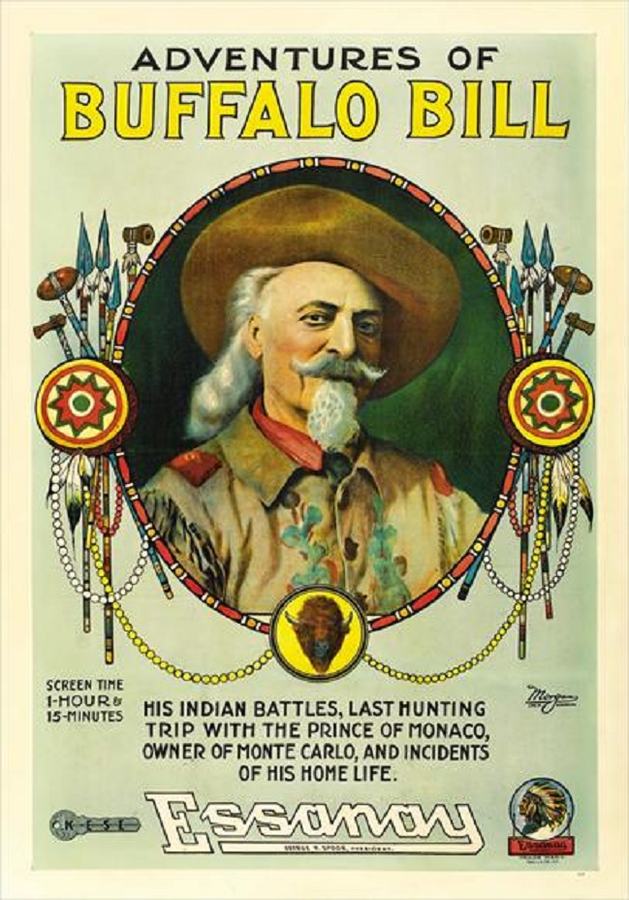
A definitive 6.4/10 rating for a film that redefined the boundaries of cult cinema. The Adventures of Buffalo Bill remains a cornerstone of transgressive art.
Splinters of nitrate still smell of cordite in The Adventures of Buffalo Bill, a film that refuses to behave like the docile heritage piece textbooks shelve beside Edison newsreels. Instead, it charges off the spindle, a self-immolating chronicle stitched from war Department footage, Wild-West nostalgia, and the sheer hubris of a 71-year-old showman who insisted on playing his younger self. Watch the first reel: a pony-express rider erupts through a Nebraska sunrise, the over-cranked camera making the hooves drum like Maxim guns. That kinetic DNA—speed as virtue, speed as violence—never leaves the picture.
Cut to the buffalo hunt. Here, director Charles A. King swaps the horizon for an abattoir palette: umber hides, white bone, a sky so pale it reads as void. The sequence feels less like documentary than like fever dream—each fallen bison expelling a miniature dust storm that swallows the lens. Historians will scoff at the kill-count arithmetic; cineastes will marvel at how the handheld ground-camera anticipates the tremor of combat photography birthed decades later in Vietnam. The butchery is scored only by the wind, a choice that amplifies the moral quease: Manifest Destiny shot in first-person, blood on the aperture.
When the film pivots to military reconnaissance, the tone cools into something approaching battlefield cartography. Lieutenant-General Nelson A. Miles arrives—not an actor, but the actual septuagenarian tactician, medals flashing like heliograph signals. His presence authenticates the topography of Summit Springs and Warbonnet, yet also complicates the gaze: we are watching living victors restage victories for the victors. Cinematically, King counterbalances this jingo hauteur with contrapuntal inserts—families of Lakota extras waiting between takes, blankets wrapped against the Colorado chill. Those milliseconds of downtime, captured almost by accident, seep through the spectacle and whisper: this land is now a set, its first nations reduced to atmosphere.
The knife duel with Yellow Hand arrives at reel three’s crest. Cody, 51 during production, insisted on a full-contact bout; the Sioux stunt performer, Moses Red Cloud, agreed provided the blades be dulled but the camera record distance and impact without edits. What survives is a choreography of exhaustion—two middle-aged men slashing sun-bleached air, sweat darkening shirt leather, dust corkscrewing around their ankles. King’s camera orbits at waist height, a proto-Steadicam circle that predates The Reckoning’s baroque tracking shots by seven years. When Cody finally drives horn-bone into Yellow Hand’s chest, the moment lands less as triumph than as mutual surrender to narrative: history swallowed by myth, adversary by icon.
The film’s logistical leviathan—5,000 participants, 200 horses, three artillery pieces—makes contemporary battle scenes feel airless. King positions multiple 35-mm hand-crank units at 45-degree angles, stitching together a triptych of motion. The resulting tableau rivals later Soviet mass-epics, yet unlike Eisenstein’s montage the syntax here is accumulation: bodies filling the 1.33 frame until it buckles. Watch the left corner of any wide shot and you’ll catch soldiers glancing toward camera, breaking the fourth wall with a self-awareness that predates postmodern irony. Such fissures don’t undermine authenticity; they refract it, reminding viewers that war is always partly theatre.
Post-battle, the film exhales into an interior palette of mahogany and kerosene. Cody’s Nebraska ranch house—shot on location—becomes a diorama of masculine grief: walls bristle with antlered heads whose glass eyes reflect the scout’s own vacuity. His wife, Louisa, appears only in silhouette, a compositional choice that silences her historical disquiet (she filed for divorce twice, citing wanderlust adultery). These hushed tableaux rhyme with the ennui found in Out of the Drifts, where snowbound interiors mirror marital frost. Yet King refuses psychological excavation; instead, he lingers on Cody’s trembling hand as he oils the same rifle that felled Yellow Hand. The ritual feels less maintenance than penance.
The Prince of Monaco episode, often dismissed as aristocratic window-dressing, secretly steers the film’s ideological rudder. We watch Cody guide Prince Albert through the Rockies, both men draped in expedition tweed, rifles slung like afterthoughts. King crosscuts their leisure with documentary inserts of dwindling elk herds, juxtaposing noble privilege with ecological decimation. It’s a dialectic the film can’t resolve, yet the friction crackles: imperial tourism shot in the very theatre where earlier imperial violence unfolded. The sequence anticipates the eco-critical undercurrents of Torpedoing of the Oceania, though here nature remains a backdrop rather than agent.
The 2021 4-K restoration by the Library of Congress dyes the buffalo-hunt sunrise with tints of carmine and arsenic green—hues derived from 1917 chemical dye records. Warbonnet’s sky now bleeds into Prussian blue, a nod to the cyanotype scouting maps Cody once carried. These chromatic decisions risk anachronism, yet they restore the film’s original sensory shock: color as propaganda, as fever. For purists, a monochrome option remains; for everyone else, the rusted oranges and bruised indigos amplify the moral bruise at the story’s core.
Original road-show prints toured with a synchronized score for 12-piece brass and Apache war drums. Contemporary festival screenings employ a reconstruction by the Mont Alto Motion Picture Orchestra, layering bugle motifs atop tribal percussion—an uneasy marriage that mirrors the film’s own ideological polyphony. I caught a 35-mm print at Pordenone; the cacophony during Summit Springs felt like history gagging on its own echo.
Cody’s screen presence oscillates between matinee swagger and vaudeville fatigue. In close-up his eyes evince the hollow sheen of a man who has read his own obituaries—some praising, most scathing. The generals, recruited for verisimilitude, deliver lines with the stiff cadence of field reports; paradoxically, this stiltedness authenticates the film, grounding spectacle in bureaucratic marrow. Compare with the more mannered performances in The Stolen Voice, where trained actors inflate every syllable; here, amateurism becomes a documentary virtue.
Women in this universe function as negative space: the missing half of every domestic shot. Louisa’s silhouette, the laundresses’ blurred backs, the unnamed Cheyenne girls herded post-battle—all exist to refract masculine destiny. The strategy is textbook Victorian cinema, yet its very obviousness indicts the genre’s machinery. One thinks of The Libertine, which weaponizes female absence for ironic effect; here, absence is merely symptomatic of historical erasure.
King’s editorial grammar alternates between over-cranked panoramas and tableau stillness, a dialectic that mirrors the tension between expansionist frenzy and domestic entropy. The average shot length in battle sequences hovers at 3.4 seconds—breathtaking for 1917—while ranch scenes stretch to 14-second holds, allowing dust motes to float like guilt. The asymmetry anticipates the temporal whiplash of Sunday, though King’s intent is less existential than physiological: he wants your pulse to sync with hoofbeats, then freeze in moral hangover.
Within five years of release, Cody’s Wild-West show folded; the film became a tombstone touring small-town opera houses. Yet its DNA persists in every revisionist western that stages self-conscious spectacle—think Abraham Lincoln’s Clemency where power performs its own benevolence. The Adventures of Buffalo Bill codified the trope of history as self-illustration, biography as circus. Each time a later epic uses real soldiers as extras, each time a star insists on doing his own stunts, Cody’s ghost salutes from the dust.
Approach this not as relic but as ricochet. Let its contradictions bruise you: the ecstasy of motion against the shame of conquest, the grandeur of 5,000 bodies against the silence of one woman’s silhouette. The film will not comfort; it will implicate. And in that implicating, you’ll feel the first tremors of American cinema trying to outrun its own shadow across a prairie already parcelled into lots, already sold, already gone.
IMDb 5.7
1920
Community
Log in to comment.