DbcultAccessing Vault...
6/10
Senior Film Conservator

A definitive 6/10 rating for a film that redefined the boundaries of cult cinema. The Adventures of Villar remains a cornerstone of transgressive art.
To witness The Adventures of Villar (1924) is to step into a time capsule of Mediterranean slapstick, a period where the cinematic medium was still shedding its theatrical skin to embrace the pure, unadulterated motion of the frame. Nikolaos Sfakianakis, performing under the moniker Villar, emerges not merely as an actor but as a cultural phenomenon—a Greek response to the global 'Tramp' archetype popularized by Chaplin, yet infused with a distinctly Balkan sense of frantic improvisation. This film, directed by Joseph Hepp, stands as a foundational pillar of Greek celluloid history, capturing a version of Athens that has long since evaporated into the ether of modernity.
The film opens within the humid, claustrophobic confines of a dry-cleaning shop, a setting that serves as a brilliant microcosm for the social pressures of the era. Villar, as the bumbling employee, is a whirlwind of well-intentioned destruction. The steam, the heavy irons, and the delicate fabrics of the Athenian bourgeoisie provide the perfect tactile playground for his physical comedy. Much like the atmospheric tension found in The City of Masks, there is an underlying sense that the protagonist is an outsider trying to maintain the facade of social order while inadvertently tearing it down. His labor is a performance of survival, a theme that resonates deeply within the silent era's obsession with the working class.
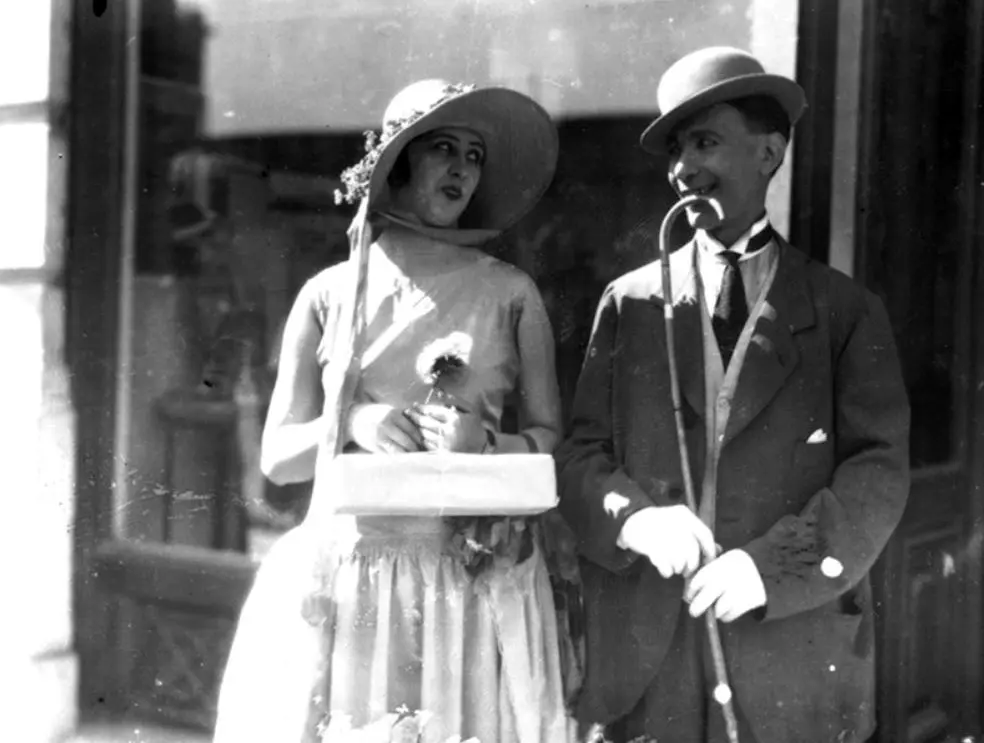
When Villar encounters the object of his affection, the tone shifts from the industrial to the romantic, yet the slapstick remains the primary vocabulary. Nitsa Filosofou provides a grounded presence that contrasts sharply with Villar's elastic physicality. Their interaction is not merely a romantic subplot; it is the engine that drives the film out of the shop and into the streets. This transition from the interior to the exterior reflects a broader cinematic trend of the 1920s, where filmmakers began to realize that the city itself was a character, a sprawling stage for human folly.
The cinematography in The Adventures of Villar is remarkably dynamic for its time. Hepp utilizes the urban landscape of Athens with an eye for geometry and movement. The chase sequences, which form the backbone of the film’s second half, are choreographed with a frantic energy that mirrors the chaotic growth of the city. While it may lack the polished artifice of The White Masks, it compensates with a raw, documentary-like quality that captures the dusty roads, the neoclassical architecture, and the burgeoning crowds of a capital in flux.

Villar’s movements are a study in controlled instability. He oscillates between moments of extreme grace and sudden, jarring collapses. This duality is central to the appeal of the silent comedian; he is both a victim of gravity and a master of it. In many ways, the film’s structure resembles the episodic nature of Der Mann ohne Namen - 1. Der Millionendieb, where the protagonist is defined by his ability to navigate a series of increasingly improbable obstacles. However, Villar’s motivations are far more humble—he isn't looking for a million, but for a moment of shared connection in a world that demands he keep scrubbing.
Beneath the surface of the pratfalls lies a subtle commentary on class. Villar’s job at the dry cleaners places him in direct contact with the garments of the wealthy, yet he remains perpetually on the periphery of their world. This theme of social aspiration and the inherent 'honor' of the domestic sphere is explored with more gravity in The Honor of His House, but in Villar’s world, the tragedy is masked by a grin. His attempts to woo Nitsa Filosofou’s character are hindered not just by his clumsiness, but by his lack of social standing. The 'adventures' he undergoes are, in essence, a series of trials meant to prove his worth in a society that views him as a replaceable cog in the industrial machine.

The film’s reliance on coincidence and serendipity is a hallmark of the genre. Whether he is getting mixed up with the wrong crowd or accidentally disrupting a public event, Villar’s trajectory is one of unintended consequences. This narrative style, while seemingly disparate, is actually quite sophisticated in its pacing. It avoids the melodramatic pitfalls of films like The Faded Flower, opting instead for a relentless forward momentum that leaves the audience breathless.
For decades, The Adventures of Villar was a ghost in the annals of film history, known mostly through stills and oral accounts. Its rediscovery and restoration have allowed modern audiences to appreciate the technical audacity of Sfakianakis and Hepp. The film captures a specific Mediterranean light—harsh, bright, and unforgiving—that contrasts with the moody expressionism often found in Northern European films of the same period, such as During the Plague. Villar’s world is one of sun-drenched chaos, where every shadow is a potential hiding spot and every open window an opportunity for a daring escape.

The writing, credited to Villar himself, shows a keen understanding of the 'gag' as a narrative unit. Each sequence is built around a central physical conflict that escalates until it reaches a crescendo of absurdity. This is not the refined drawing-room comedy of Queens Are Trumps; this is street-level humor, designed to resonate with the masses who frequented the open-air cinemas of Athens. It is a film that breathes the air of the marketplace and the tavern, far removed from the sterile environments of high-budget studio productions.
What makes Villar’s performance so enduring is its universality. Even without intertitles, the story is crystal clear. The yearning for love, the fear of the boss, the frustration of a malfunctioning tool—these are human constants. In this regard, the film shares a DNA with international contemporaries like Be a Little Sport or Somebody Lied. It is a testament to the power of the human face and body to convey complex emotional states through simple, exaggerated gestures. Villar’s face is a map of 1920s anxieties, his wide eyes reflecting a world that is moving too fast for him to catch his breath.

The film’s climax, a sprawling chase that involves various modes of transportation and a significant portion of the Athenian population, is a masterpiece of silent editing. It prefigures the grand scale of later comedies while maintaining a gritty, low-budget charm. It is reminiscent of the frantic energy in Boman på utställningen, where the protagonist becomes a catalyst for a larger social upheaval. Villar doesn't just run; he disrupts the very fabric of the city, turning a quiet afternoon into a theater of the absurd.
In the grand tapestry of early 20th-century cinema, The Adventures of Villar occupies a unique space. It is a bridge between the theatrical traditions of the past and the cinematic innovations of the future. It lacks the polish of a Hollywood production, but it possesses a vitality and an authenticity that are impossible to manufacture. Sfakianakis’s Villar is a character of immense pathos, a man who finds joy in the midst of a laundry list of failures. He is the eternal optimist, the romantic who refuses to be crushed by the weight of the world.
As we look back at this film, we see more than just a series of gags. We see the birth of a national cinematic identity. We see the influence of international stars being filtered through a local lens to create something entirely new. Whether compared to the social morality of The Torch Bearer or the identity-shifting narratives of Alias Mary Brown, Villar remains a singular figure. He is a reminder that cinema, at its heart, is about movement—the movement of the body, the movement of the heart, and the movement of a society toward an uncertain future. This film is a joyous, messy, and essential piece of history that continues to delight anyone willing to look past the grain of the film and see the soul of the performer.
Ultimately, The Adventures of Villar is a celebration of the underdog. In a world of dry cleaners and high society, Villar chooses love and chaos. It is a choice that leads him into trouble, but it is also the choice that makes him immortal on the silver screen. For those interested in the roots of comedy or the history of the Mediterranean, this film is an indispensable journey into the light of a bygone era, standing tall alongside other silent classics like Once a Mason or the experimental La luz, tríptico de la vida moderna. It is a flickering beacon of humor in a century that would soon see much darker days.
IMDb —
1913
Community
Log in to comment.