DbcultAccessing Vault...
Cult Review
Senior Film Conservator
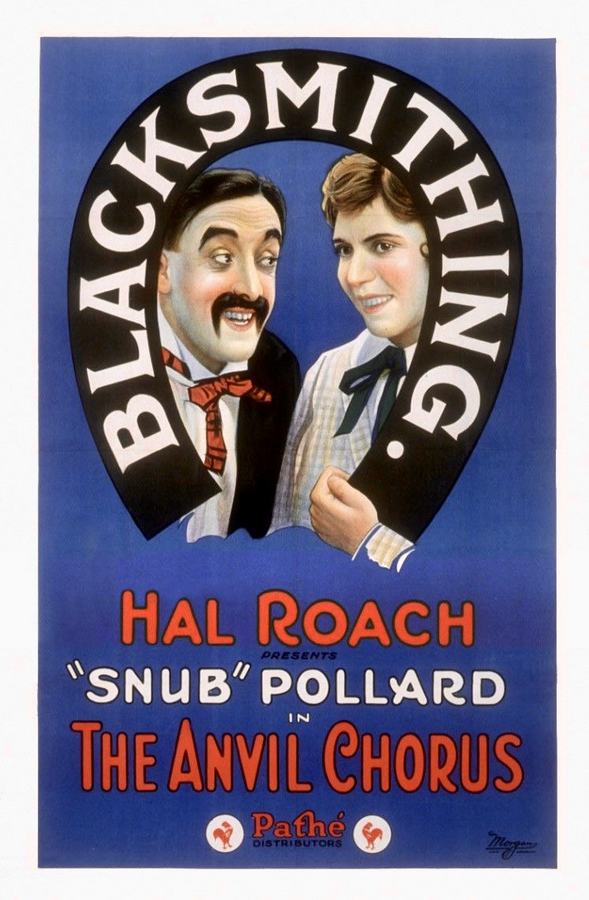
The silent era of cinema often operated on a logic of escalating absurdity, yet few shorts capture the sheer kinetic delirium of The Anvil Chorus. Starring the inimitable 'Snub' Pollard, this film serves as a quintessential artifact of the Hal Roach studio’s penchant for blending domestic anxieties with impossible physical feats. Unlike the more grounded narratives found in School Days, this picture leans heavily into the surreal, utilizing the blacksmith’s forge as a site of both industrial labor and whimsical destruction.
Pollard’s screen persona—defined by his iconic downward-sloping mustache and a perpetually startled gait—is the perfect foil for the four husky brothers he encounters. These men are not merely characters; they are forces of nature. Portrayed by the likes of Noah Young and Tom Kennedy, they represent a brand of hyper-masculinity that is both welcoming and lethal. Their method of 'playing ball' with an anvil defies the laws of physics and common sense, creating a visual rhythm that mirrors the musicality suggested by the film’s title. This isn't the romanticized history seen in Les amours de la reine Élisabeth; this is a visceral, sweat-soaked comedy of survival.
The mechanical ingenuity of the Hal Roach gag-men is on full display here. When Snub is initiated into the family, the transition from a friendly gesture to a ballistic event is instantaneous. The anvil, a symbol of static permanence, becomes a projectile of transcontinental proportions. The sequence where Snub is sent flying across state lines is a masterpiece of early editing and title-card humor. We see him bypass Kansas, Colorado, Utah, Nevada, and California in a blur of geographic shorthand. It’s a precursor to the 'traveling map' tropes of later animation, yet executed with the raw charm of 1920s trick photography.
This specific brand of humor—the 'human projectile'—was a staple of the era, yet here it feels uniquely tied to the protagonist’s social integration. To be a part of Marie Mosquini’s family, Snub must literally survive the elements of their trade. While films like Circus Day rely on the spectacle of the big top, The Anvil Chorus finds its spectacle in the mundane tools of the blacksmith, elevated to the level of mythic weaponry. The sheer scale of the brothers, particularly the towering presence of Tom Kennedy, creates a visual contrast that highlights Pollard’s vulnerability and surprising resilience.
Marie Mosquini, often an underrated presence in these comedies, provides the necessary emotional anchor. Her brothers’ affection for Snub is genuine, which makes the near-fatal nature of their hospitality even more hilarious. The chemistry between the ensemble is palpable. Noah Young, a frequent heavy in Roach comedies, brings a terrifying joviality to his role that contrasts sharply with the more subtle comedic beats of Little Miss Jazz. There is a sense of genuine camaraderie amidst the flying iron, a 'chorus' of labor and laughter that unites the men by the film's conclusion.
One cannot overlook the technical prowess required to film these sequences. The timing of the anvil tosses, the synchronization of the brothers' movements, and the integration of the 'flight' sequences required a level of precision that is often forgotten in the discussion of 'simple' slapstick. Compared to the more dramatic framing of The Woman He Married, the cinematography here is functional yet inventive, prioritizing the clarity of the physical gag over atmospheric lighting. However, the use of the Pacific Ocean as the final destination of Snub's flight adds a touch of the sublime to the ridiculousness.
When placed alongside other works of the period, such as My Lady's Ankle or the investigative parody of Sherlock Ambrose, The Anvil Chorus stands out for its structural simplicity and thematic cohesion. It doesn't need the complex plots of The Island of the Lost or the episodic nature of Scenic Succotash. Instead, it focuses on a singular, escalating conflict: the small man versus the heavy weight. This is a theme that resonates throughout the history of comedy, from the silent greats to modern slapstick.
The film’s pacing is relentless. From the moment Snub arrives at the forge, the audience is subjected to a barrage of visual stimuli. The anvil is not just a prop; it is a character that dictates the movement of every person on screen. Even the more obscure titles like Love and Lavallieres or the international intrigue of Das Geheimnis von Bombay lack the sheer, unadulterated joy found in this short's final moments. When Snub returns, bedraggled but undeterred, to join the rhythm of the forge, it serves as a triumphant affirmation of the human spirit—or at least the resilience of the slapstick comedian.
In the broader context of silent comedy, The Anvil Chorus remains a fascinating study in spatial awareness. The way the director utilizes the smithy’s interior creates a sense of claustrophobia that makes the subsequent cross-country flight feel like an explosive release. It’s a thematic journey from the cramped domestic sphere to the vast openness of the American landscape, all triggered by a single mechanical error. This use of geography as a punchline is something we see echoed in Flying Colors and even the more adventurous Southward on the Quest.
The brothers themselves represent a vanished era of cinematic 'types.' They are the salt-of-the-earth laborers who possess a terrifying, unselfconscious strength. Their inclusion of Snub is a democratization of power; through the anvil, the small man becomes part of the gargantuan collective. This ending, where they all strike the anvil in unison, is surprisingly poetic. It transforms a site of potential trauma into a site of communal harmony. While it may not have the high-stakes drama of Skottet or the epic scale of Die Herrin der Welt 6. Teil, it possesses a purity of vision that is increasingly rare.
Ultimately, Snub Pollard’s performance here is a masterclass in reactionary comedy. He doesn't drive the plot; he is driven by it—literally. His ability to maintain a sense of dignity while being tossed across several states is what makes him such an enduring figure of the era. The Anvil Chorus is a loud, clanging, and utterly delightful reminder of the power of silent film to turn the laws of nature into a playground for the imagination. It is a film that demands to be seen not just as a relic, but as a vibrant, living piece of comedic art that still manages to produce a 'good laugh' over a century later.
IMDb 6.2
1930
Community
Log in to comment.