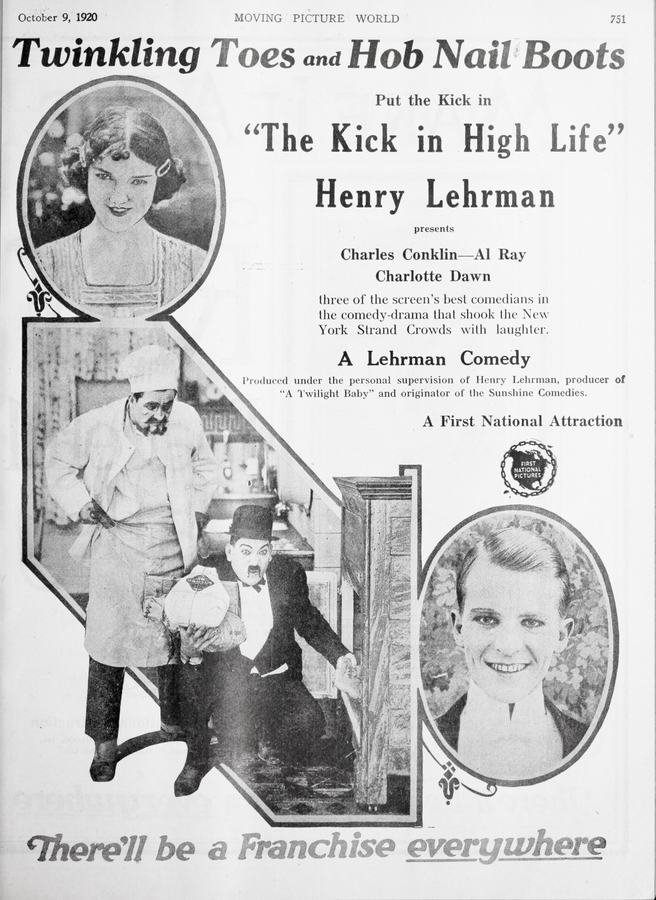
Prohibition America never partied harder than in The Kick in High Life, a 1922 one-reeler that plays like a champagne bottle shaken by a vandal and uncorked inside a dynamite warehouse. Director-writer Henry Lehrman—vaudeville sadist turned cinema prankster—doesn’t tell a story so much as detonate a piñata of social mores and pick at the scraps with a bulldog’s grin.
Every frame feels soaked in grain-alcohol mischief: white iris vignettes constrict like sphincters around Lotta Sherry’s flapper phalanx; title cards wink with punning cruelty (“Mr. Walker, looking as though he had been aged in the wood…”). Even the intertitles perspire gin. Lehrman’s camera—perched at a rakish Dutch angle—tilts so that chandeliers drip like weeping willows, an apt visual cue for a world forever sliding off the moral axis.
Hugh Fay’s Smokey Johnny Walker is a rumpled Everyman by way of a barroom Rembrandt: his walrus mustache droops, his eyes swim in bruised sockets, yet he carries himself with the dignified resignation of a man who knows the universe will pants him sooner or later. When Bud Weiser—Heinie Conklin’s elastic-limbed lothario—slaps Johnny’s back, the resulting cough-up of molars lands like a punchline told by Fate herself. Charlotte Dawn’s Lotta Sherry responds not with horror but a blasé shrug; her laconic fanning motions suggest she’s seen worse dental casualties before breakfast.
“Slapstick, at its apex, is dental tragedy wrapped in crinoline and served with a side of nitroglycerin.”
Indeed, teeth become the film’s totem: once Johnny’s ivory grinders hit the grass, the bulldog’s jaws gnash them like castanets, a percussive overture to the mayhem ahead. It’s as if Lehrman whispers: “In a world where molars are currency, expect every smile to bounce a check.”
Enter Phil Dunham’s Knockout Clancy, a pugilist whose neck seems borrowed from a draft horse. He arrives in spats and a bowler cocked like a guillotine blade, vowing restitution for Johnny’s humiliation. His flirtation with Lotta is less courtship than hostile takeover: a single uppercut sends the butler sailing into the punchbowl, a splash that baptizes the scene in sticky orange sherbet. From there the violence snowballs—each punch ricochets, each ricochet topples another guest, until the soirée resembles a Busby Berkeley number choreographed by an anarchists’ drum circle.
But Lehrman saves his blackest jest for the Bolshevik subplot. Gaston—played with wild-eyed gusto by Albert Ray—smuggles dynamite through the kitchen like a sommelier cradling vintage TNT. He crams a stick into his comrade’s pipe with the insouciance of a Parisian filling a profiterole. One ill-advised puff later, the explosion merely singes eyebrows, but the dynamite itself remains miraculously intact, now scavenged by mice that scurry into the birthday cake. The resulting visual—fur and fuses vanishing into buttercream—feels like Eisenstein’s Strike reimagined by a pastry chef with a death wish.
It’s here that Lehrman’s nihilist streak gleams brightest: the cake, icon of childhood innocence, becomes Trojan horse for annihilation. When the cat stalks the mice and detonates the dessert, the blast sprays candles like shrapnel; frosting shrapnel frosts the camera lens, momentarily blotting out the image. The screen itself seems to gag on its own excess.
Technically the film is a marvel of compressed chaos. Shot on a shoestring at L-KO Studios, it deploys under-cranked cameras to accelerate fisticuffs into a hummingbird blur. A handheld cup of prohibition-era poteen could not slosh more violently than these frames. The tinting—amber for interiors, cyan for exteriors—serves as emotional shorthand: amber means sin, cyan means catastrophe, and the oscillation between the two is as relentless as a police raid.
Yet beneath the slapstick detritus lurks a sardonic critique of Jazz-Age entitlement. Lotta’s entitlement to spectacle, Bud’s entitlement to Lotta, Johnny’s entitlement to dignity—all are gleefully pulverized. Lehrman seems to ask: What happens when an epoch built on bootleg bubbles finally hits the hangover? Answer: teeth on the lawn, dynamite in the cake, and a bulldog wagging its tail amid the ruins.
Virginia Rappe—later victim of Hollywood’s most sordid scandal—appears briefly as a flapper whose expression oscillates between ennui and schadenfreude. Her presence now carries spectral weight; we watch her sip hooch beneath bunting tainted by history, and the moment feels premonitory. The camera lingers a half-beat too long, as though already memorializing a star whose light would gutter out in courts rather than marquees.
Comparisons? Think of The Yellow Traffic’s urban anarchy filtered through A Regiment of Two’s buddy sadism, then distilled into a single reel. It lacks the maritime fatalism of The Tide of Death or the expressionist shadows of Coral, but replaces them with a kinetic cynicism uniquely American.
“Lehrman does not aim for pathos; he aims for pie-faced nihilism, and hits bull’s-eye with a custard projectile laced with buckshot.”
Still, the film isn’t flawless. Its pacing—frenetic even by slapstick standards—can numb rather than exhilarate. Characters are less people than fuse wires, burning toward inevitable bang. And the gender politics, though period-accurate, wear thin: Lotta oscillates between trophy and instigator without agency, a flapper mannequin posed for breakage.
Yet these qualms evaporate once the cake explodes. The image—frosting flung like comet tails against taffeta—transcends gag and becomes icon. It’s the Jazz Age atomized in one frame: opulence, excess, and self-immolation served à la mode.
In the final shot, Lehrman pulls back to reveal bulldog and teeth intact amid the rubble. No moral, no redemption—just a slobbering hound guarding ivory trophies against the dawn. Fade to black, and the audience—both 1922’s and ours—realizes the joke is on any civilization that believes parties end merely because the music stops.
For modern viewers, the short is available in a 2K restoration on several boutique streaming anthologies. Seek the version with Donald Sosin’s ragtime-piano score; its syncopated stomp mirrors Lehrman’s jittery visuals, and when the dynamite finally blows, Sosin unleashes a dissonant cluster that lands like a punch to the solar plexus.
Bottom line: The Kick in High Life is a shot-glass of nitrate nitroglycerin—imbibe at your own risk, but savor the burn. It won’t nourish you, yet it will tattoo your retinas with images of teeth, frosting, and feral dogs that grin like gargoyles. And sometimes, that’s all cinema needs to do: bare its fangs and bite.
Verdict: Essential for aficionados of silent mayhem, students of American excess, and anyone who ever wondered what happens when a birthday wish meets black powder.