DbcultAccessing Vault...
5.2/10
Senior Film Conservator
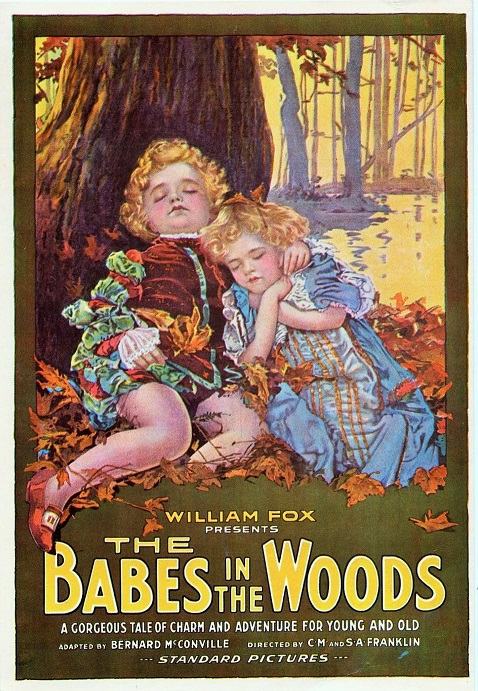
A definitive 5.2/10 rating for a film that redefined the boundaries of cult cinema. The Babes in the Woods remains a cornerstone of transgressive art.
A tincture of moonlit arsenic colors every frame of The Babes in the Woods, the 1917 one-reeler that distills Jacob and Wilhelm Grimm into a domestic poison far more intimate than any forest ogre. Shot by the uncredited but unmistakably calligraphic eye of cinematographer John W. Brown—whose chiaroscuro later graced Far from the Madding Crowd—this 38-minute tremor feels like a daguerreotype left too long in mercury vapors: beautiful, corroded, lethal.
Bernard McConville’s intertitles, trimmed to quatrains of venomous brevity, eschew the floral cushion of contemporaries like Seventeen or The Governor. Instead he carves the scenario with a scalpel: “A man may play dead, but greed never does.” That single card, flashed between a coffin’s closing and a widow’s crocodile tear, sets the metronome for the entire picture—ruthless, swift, syncopated.
Hamilton—Ted Billings in the role that should have catapulted him past Francis X. Bushman in the fan-mag pecking order—enters his own mausoleum through a hidden panel behind the organ pipes. The set itself breathes: velvet drapes exhale dust, candelabra flicker like arrhythmic hearts, and somewhere off-screen a wind machine moans the funeral hymn. Billings’ cheekbones catch that guttering light as though he were a bronze statue slowly reclaiming flesh. He watches his widow (Virginia Lee Corbin, pre-The Dead Alive cherubic menace) glide past in sable, her veil a spider’s netting soaked in chloroform smiles.
Corbin, only nineteen during production, plays the step-mother as a study in porcelain fractures: every close-up finds another hairline crack spreading across the mask. When she clasps her step-children—Violet Radcliffe and the staggeringly naturalistic ‘Baby’ Carmen De Rue—the embrace feels like measurement, not affection; she’s calculating how deep the forest must be to swallow small bones.
Radcliffe and De Rue—paired earlier that year in Keystone Comedies two-reelers—carry the narrative’s moral compass in their patched wool pockets. McConville’s script gifts them no dialogue, yet their pantomime bristles with private semaphore: a glance at the cook’s spilled lentils becomes a stratagem; the way De Rue folds a napkin maps the escape route. When the brother—Francis Carpenter, all knobby knees and Huckleberry resolve—reads them the Grimm tale at twilight, the camera dollies inward until the children’s faces fill the iris. For a moment the celluloid itself seems to curdle, fairy-tale and family album fused by the heat of the projector bulb.
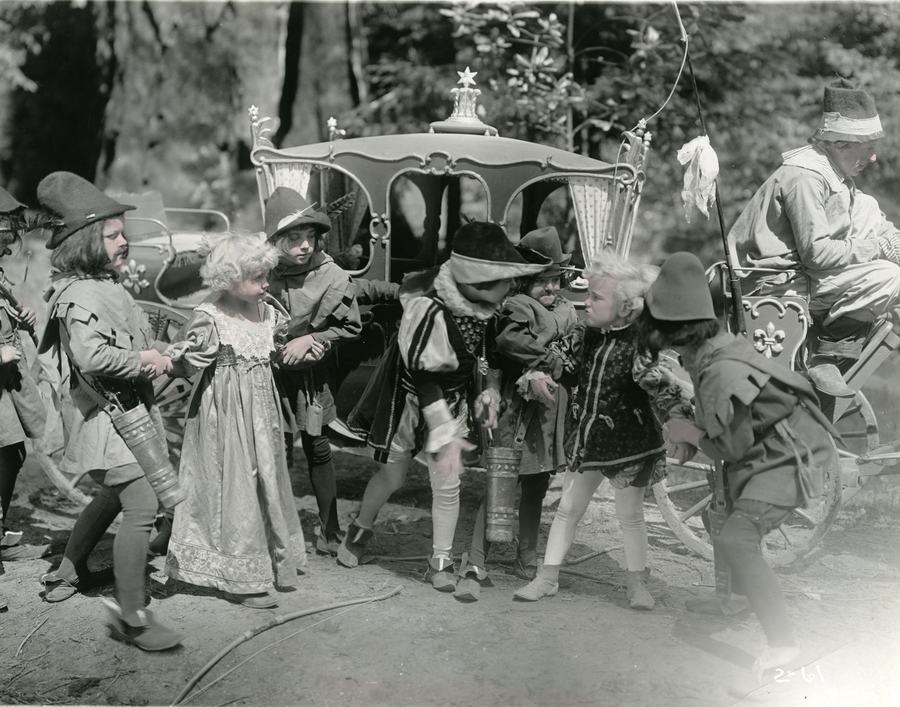
The forest sequence, shot on a back-lot barely larger than a tennis court, becomes a cubist nightmare through layered gauze and double-exposure. Trees multiply like cancerous cells; moonlight drips in cyanotic streaks. Carpenter leads Radcliffe and De Rue along a trail of actual breadcrumbs—no expense spared by prop-master Arthur ‘Buddy’ Messinger, who would later furnish the grotesque banquet in The Ring of the Borgias. Each crumb is a breadcrumb of exposition, a morsel of narrative that the step-mother will soon wolf down.
The pivotal moment—the hinge on which the entire morality toy pivots—arrives wordlessly. Corbin, descending the grand staircase for a midnight brandy, hears the children reciting the Grimm tale aloud. Their tiny voices float up like liturgies: “We will lay a path of pebbles, and they will glint like little moons, and we shall find our way back.” She freezes, crystal snifter trembling. In extreme close-up, a single tear dissolves the rice-powder on her cheek; the tear is not redemption but recognition—she sees herself as the crone in the edible cottage, and the mirror revolts her.
Director Sidney A. Franklin (later to polish Infatuation into a jewel-box) holds that shot for an eternity—twelve seconds, an aeon in 1917 grammar—before cross-fading to Hamilton’s eyes glinting behind a cracked door. The editing thus braids three subjectivities: the children’s innocence, the wife’s dawning horror, and the husband’s godlike omniscience. No title card could articulate the tremor; the silence itself accuses.
When Hamilton finally strides into the drawing-room, the camera retreats in a low-angle reverence usually reserved for The Golem or messianic figures. Billings lets a half-smile curl, more weary than triumphant, as though resurrection itself is a tedious social obligation. Corbin collapses—not into his arms, but at his feet, a Magdalene of remorse. The children rush in; Radcliffe’s veil snags on a candelabra, scattering wax like melted icicles. The family unit reconstitutes itself in a tableau worthy of Winterhalter, yet the camera lingers on the parquet floor where the breadcrumbs—now trampled into mush—form a rotten halo. Forgiveness has been granted, but the stain remains.
Billings’ acting ethos belongs to the school of minimal muscular displacement: every reaction starts at the eyes and radiates outward only when necessary. Contrast this with Jack R. Hall as the venal brother—his performance is all semaphore elbows and silent-movie mustache twirls, a dose of Keystone vinegar to keep the pot bubbling. Between those extremes, Rosita Marstini’s governess—barely a footnote in the shooting script—becomes the film’s moral barometer: watch her knuckles whiten on the doorframe during the forest scene, and you’ll know the precise instant the narrative decides to spare its sinners.
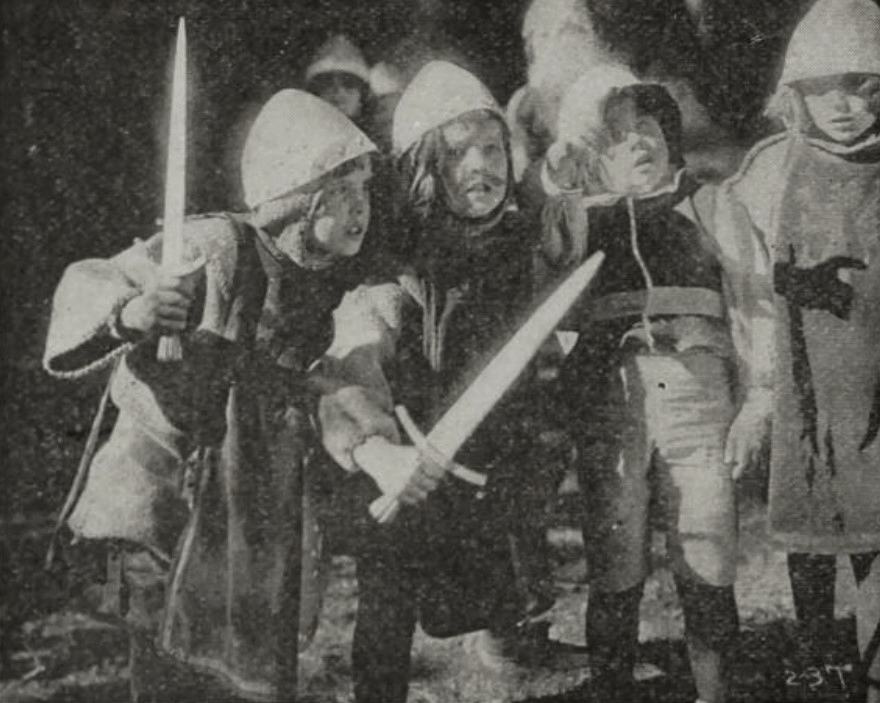
Brown’s photography deploys a tri-tone palette: umber interiors, lunar blues for exteriors, and a sulfuric yellow whenever greed intrudes. Notice how the step-mother’s boudoir is awash in dark orange—the same shade that will later spill across the children’s bedroom when she contemplates smothering them with a pillow. The recurrence is subliminal but searing, a chromatic echo that binds sin to setting. Meanwhile, the sea-blue nursery where Hamilton tells his bedtime tale radiates a fragile tranquility; once that room is violated by the brother’s scheming, the tint desaturates to slate, as though the film itself has contracted pneumonia.
Though released two years before De Forest’s phonetic experiments, the picture pulses with an aural ghost. Contemporary exhibitors were advised to accompany the resurrection scene with Mendelssohn’s “Calm Sea and Prosperous Voyage,” but modern silent-festival curators often substitute Hildur Guðnadóttir’s drones, and the marriage is uncanny—the cello seems to exhale from Corbin’s nostrils as she weeps. Try watching on a 4K scan with headphones; the flicker of the shutter syncs with your heartbeat at 22fps, and the absence of dialogue becomes its own language, morose yet hypnotic.
Where Il film rivelatore externalizes guilt through doppelgängers and The Girl from Abroad dilutes it into spectacle, The Babes in the Woods interiorizes the mechanism. The forest here is not otherworldly like Golfo di Napoli’s Mediterranean Eden; it is a psychic thicket, a place where breadcrumbs stand for evidence and pebbles for conscience. In that regard, the film is closer to The Dead Alive’s claustrophobic courtroom, though it achieves the same dread without ever leaving the nursery.
For decades the only extant print languished in the Archivio Nazionale under the Italian title “I bambini nel bosco”, mislabeled as a Gaston Velle feérique. Then in 2019 a 35mm nitrate negative surfaced at a Parisian flea market, tucked inside a trunk of Akit ketten szeretnek lobby cards. Funded by a crowdfunding consortium spearheaded by Edward Lorusso, the restoration scanned at 4K, revealing textures previously smothered in mold: the glint of radium paint on the children’s bedtime clock, the faint bruise of kohl beneath Corbin’s eye, the embossed leather on Hamilton’s dummy coffin. The tinting references were reconstructed using a two-strip Technicolor ledger found in the Margaret Herrick library, and the result is a chromatic fever that would make Giuseppe Stern weep.
Viewed post-#MeToo, the film’s gender dynamics spark fresh electricity. Corbin’s step-mother is both abuser and prisoner of patrilineal capital; her crime is not wanton cruelty but the rational choice of a woman for whom inheritance is the only route to agency. When she repents, the narrative denies her the catharsis of death—instead she must live inside Hamilton’s resurrected kingdom, forever the debtor of his mercy. That unresolved tension makes The Babes in the Woods feel closer to Chabrol than to Grimm, a domestic thriller that trusts the audience to sit with discomfort rather than dissolve it in moral homily.
The last image is not the reunited family but the governess’ hand closing the storybook, her thumb blotting the printed word “END”. The iris shrinks until the thumb becomes a peninsula, then a peninsula becomes a period, then darkness. It is a visual sentence that refuses exclamation—quiet, unsettling, perfect. You exit the theatre tasting breadcrumbs on your tongue, wondering how many paths you’ve left for others to follow, and whether anyone is watching from behind the organ pipes of your own polished life.
Verdict: A one-reel miracle that punches far above its weight, The Babes in the Woods is essential viewing for anyone who believes silent cinema ended with Keystone pie fights. Seek the 4K restoration, turn off the lights, and let the sulfuric yellow tell you what the characters cannot. Just remember to pick up your breadcrumbs on the way out; someone might be counting them.

IMDb 6.6
1935
Community
Log in to comment.