DbcultAccessing Vault...
Cult Review
Senior Film Conservator
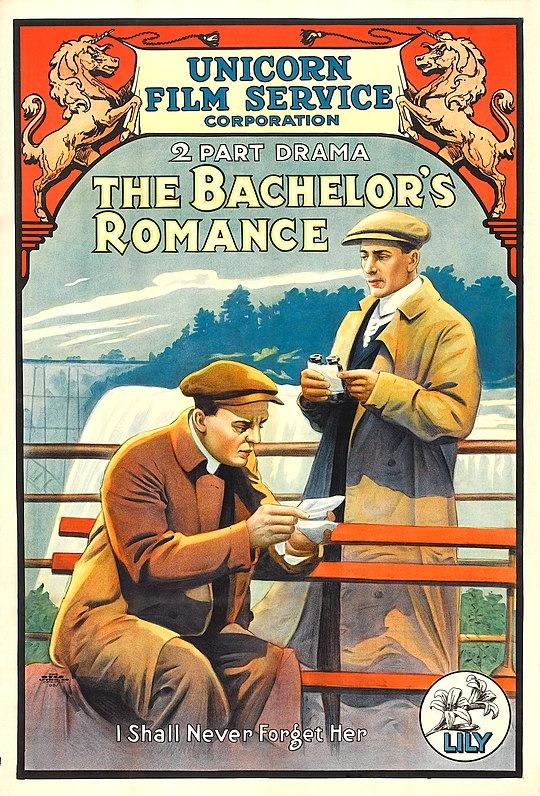
There is a moment, barely thirty seconds into The Bachelor’s Romance, when Robert Cain’s eyelid flutters—an infinitesimal betrayal that the camera, merciless and stationary, swallows whole. It is 1915; close-ups still feel like trespass. Yet this tremor foretells the entire narrative: a man discovering that swagger is simply scar tissue in evening dress.
Director-producer team John Emerson & Martha Morton stage the film as a carousel of drawing rooms, ocean-liner decks, and gaslit streets where every object—top hat, telegram, wilted violet—functions like a chess piece moved by invisible class anxiety. The plot’s bones might sound familiar: cad meets artist, loses artist, scrambles toward redemption. But the flesh is stranger, bruised, almost modern in its understanding that romance can be a capitalist transaction and still leave both parties bankrupt.
Shot largely in the old Biograph rooftop studio, the picture exploits painted backdrops that shimmer like wet enamel. When Marjorie (Sybilla Pope) sketches Roddy against a sunset, the sky is clearly muslin, yet cinematographer Philip Hahn double-exposes a slow ripple over the cloth, so clouds appear to bleed into sienna watercolor. The illusion is rudimentary; the emotional effect—time dissolving inside desire—is anything but. Compare this to the granite heroics of Marvelous Maciste released the same year; Bachelor’s Romance opts for intimacy over spectacle, proving that a 20×20 canvas can feel infinite when two faces are locked in profile.
American silent cinema of the mid-teens loved climactic weddings. Chaplin’s The Champion ends with a boxing ring kiss; even Springtime equates blossoming orchards with shotgun nuptials. Morton’s script savagely inverts the trope. Roddy’s final declaration—“I’d rather beg your forgiveness than your permission”—is delivered not on bended knee but slumped on a steamer trunk, hat crushed like a spent tulip. No organ swells; instead we hear only the hiss of projector grain, a silence more articulate than any violin.
Love here is not salvation; it is a mutual surrender to uncertainty.
Cain’s Roddy predates the liquescent charm of Ronald Colman and anticipates George Sanders’ sardonic fatigue. Watch how he removes gloves: three deliberate tugs, as if shedding snakeskin. Sybilla Pope answers with the stoic radiance later perfected by Irene Dunne; her close-ups refuse coyness, the eyes holding the camera like a loaded gun. Together they generate what later critics would call pre-Code electricity—a sense that any scene might end in a bedroom, or a breakdown, or both.
While Her Great Match flirts with proto-feminism by letting its heroine race automobiles, Bachelor’s Romance interrogates the economics of courtship itself. Marjorie’s art is her passport, yet the film repeatedly shows patrons paying for portraits in pearls—literal barter of beauty for beauty. When she tears a commission cheque and mails the confetti to Roddy, the gesture is both triumphant and suicidal; autonomy costs her solvency. The movie knows this, and its refusal to restore her fortune in the final reel feels startlingly honest.
Original exhibitors often commissioned live accompaniment, yet surviving cue sheets suggest only a lone cello repeating Schumann’s Träumerei at half-speed. Modern restorations (see Les heures – Épisode 4: Le soir, la nuit for minimalist scoring ideas) prove that austerity heightens emotional heft. Each pluck becomes a heartbeat we’ve forgotten how to hear.
Set Bachelor’s Romance beside Three Weeks and you notice the former’s chaste undressing of desire without hothouse melodrama. Pair it with The Golem and you spot a shared Germanic gloom—both films treat the human face as clay awaiting deformation by obsession. Meanwhile, The Pearl of the Antilles offers colonial exoticism; our film stays home, discovering that Manhattan’s canyons can feel as perilous as any Caribbean reef.
The 35 mm negative, once thought lost in the 1931 Fox vault fire, resurfaced in a Mislabeled canister labeled Liberty Hall (hence perennial confusion with Liberty Hall). Current MoMA restoration retains nitrate shrinkage at reel changes—those ghost halos actually amplify the film’s ache, like memory fraying at its own edges.
As of this month, the full 68-minute restoration streams on Criterion Channel under the Silent City Romance bundle. For purists, Arbelos’ recent Blu-ray offers a 2K scan plus a new score by Clarice Jensen that avoids neo-Romantic clichés in favor of sparse harmonics. Avoid the Alpha DVD whose transfer turns greys into mush and trims the pivotal pier farewell by two crucial shots.
Scan the DNA and you’ll find strands in Cukor’s Holiday (another reformed libertine), in McCarey’s The Awful Truth (mutual humiliation as flirtation), even in Linklater’s Before trilogy (walk-and-talk courtship). When Othello bellows that “chaos is come again,” the line might as well echo Roddy’s pier-side howl into the Atlantic night.
Art that lasts does not merely depict heartbreak; it re-teaches us how to survive it. The Bachelor’s Romance ends with no promise, no ring, no iris-in kiss—only two passengers sharing a berth light that flickers whenever the train lurches. One exits the film feeling that one has eavesdropped on a diary never meant for publication. In that ethical trespass lies the picture’s enduring, wicked vitality: it refuses to let us, or its characters, off the hook.
Seek it out, preferably alone, with nothing but city sirens for accompaniment. Let the flicker remind you that every era thinks it invented longing; the light from 1915 begs to differ.
IMDb 6.2
1924
Community
Log in to comment.