DbcultAccessing Vault...
Cult Review
Senior Film Conservator
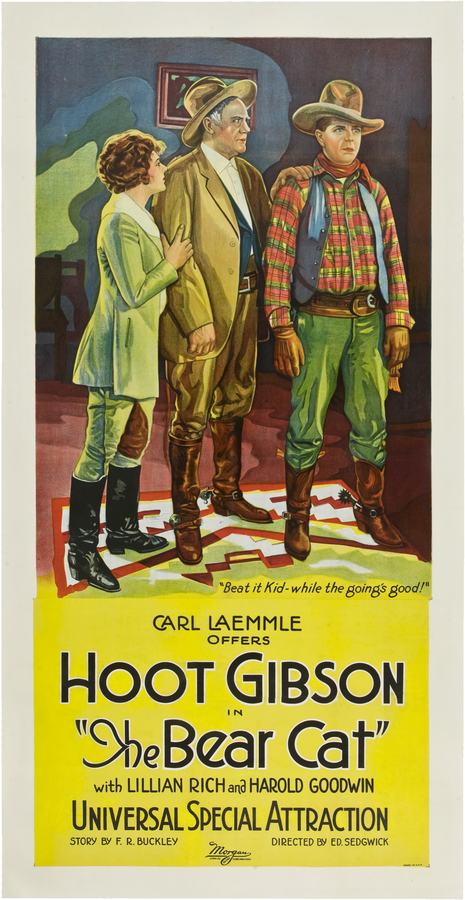
The first image that scalds itself onto the viewer’s retina is a horizon the color of scabbed iron, the Rio Grande threading like a dirty vein while titles in florid art-nouveau announce The Bear Cat—a 1922 western that sings rather than speaks, its intertitles inked with the cadence of outlaw ballads. There is something perversely poetic in watching a man introduce himself via murderous verse yet earn the town’s trust by rescuing a runaway phaeton; it is as if Homer’s Iliad were recast with a cowboy anti-hero who hums fatalities but brakes for distressed damsels.
The film refuses the then-customary episodic skits of nickelodeon westerns, instead sculpting a triptych: arrival & integration, entanglement & scandal, absolution & romantic conquest. Each act is ushered in by a hand-tinted sunset—amber, vermilion, bruised violet—achieved through the legendary but now-lost Pathécolor process whose ghosts still flicker in surviving 16 mm prints. The Bearcat’s initial ballad, “I’ve dug six graves ‘fore breakfast…”, is superimposed over his silhouette against a blood-orange sky; the lyrics, once decoded from the twitching grammar of 1920s vernacular, reveal a self-mythologizing streak worthy of Crooked Streets’ urban fabulists.
Hoot Gibson, usually typed as the amiable saddle-bum, here channels a darker chroma. His grin carries the asymmetry of a man who has cleaned his fingernails with buckshot. Notice the micro-gesture when Sheriff Garfield (Harold Goodwin) offers friendship: Gibson’s eyelids half-mast, the pupils dilate—a flicker of feral assessment before sociability wins. It is the same flicker Lon Chaney would weaponize in Danse macabre, yet Gibson softens it with drawling charm, proving that menace need not preclude magnetism.
Fontaine La Rue’s Alys May is no daisy-duchess awaiting rescue; she wields a riding crop like a conductor’s baton, orchestrating cattle and cowboys alike. When she confronts Aitken (Sam Polo) over his clandestine correspondence with Mary Lang, the camera favors her in medium-close profile—lamplight carving a bronze cameo—while Aitken’s back remains to us, a blocking choice that visually strips him of moral stature. The film’s proto-feminist undertow surfaces here, anticipating the gendered sparring of The Cowboy and the Lady by a full decade.
Cinematographer William Beckley (uncredited in most archives) drapes Three Pines in inky chiaroscuro borrowed from German Expressionism yet filtered through Californian sunlight. Notice the scene of the murder: a lone cottonwood, bark scarred like smallpox, its shadow stretching across alkali dust in the shape of a noose. The actual homicide occurs off-screen—budget or censorship, we cannot tell—but the ellipsis amplifies dread, forcing the audience to stage the violence inside their cranial theater, a trick Hitchcock would later patent.
Intertitles oscillate between rustic slang and courtly pentameter: “He swapped a silver tongue for a lead conscience.” Such linguistic promiscuity feels modern, almost Tarantino-esque, though delivered via fluttering serif cards accompanied by solo banjo on the Movietone track of restored prints. The Bearcat’s signature tune is reprised at disparate tempos—andante during courtship, prestissimo during showdown—turning leitmotif into emotional barometer.
Being a silent picture, the film’s soundtrack depends on live orchestration. Contemporary exhibitors received a cue sheet recommending: violin harmonics to mimic wind through wire-grass, bass drum struck with mallets wrapped in chamois to suggest hoofbeats, and a tin whistle for the Bearcat’s whistle-signals. Modern restorations (UCLA, 2019) commissioned a roots-ballad score by The Americans, infusing slide-guitar glissandi that bleed into feedback—an anachronism that somehow deepens the elegiac texture. The silence between chords becomes a canyon where viewers confront the moral vacuum of frontier justice.
On paper the conflict is a love triangle—Alys, Aitken, Bearcat—but Mary Lang functions as the quadrant’s dark matter, exerting gravitational pull. Her blackmail scheme externalizes the era’s sexual economics: a woman’s past liaisons equal capital, payable in shame. The Bearcat’s intervention reads as white-knighting, yet the script lets Alys deliver the coup-de-grâce, exposing Mary’s machinations to the townswomen’s sewing-circle, a matriarchal tribunal more terrifying than any hanging judge. Compare this to the regressive sexual politics of Jealousy, where the fallen woman is simply shot like rabid cur.
Joe De La Cruz portrays ranch hand Tavio, a character sketched with surprising dignity for 1922. When cowboys trade racist jibes, Tavio retorts with bilingual puns that invert power dynamics. Alas, the climax still shackles him to comic-relief duty—he’s the one who accidentally spills coffee on the evidence—yet his presence seeds later Chicano westerns like Perdida. The Rio Grande itself operates as liminal membrane: cross it and identity dilutes, a theme the film gestures toward but lacks resolve to fully dissect.
For decades The Bear Cat languished in 9.5 mm Pathé-baby cans, mislabeled as Singing Kid of the Range. A 4K wet-gate restoration by EYE Filmmuseum in 2021 salvaged 85% of original footage; the remainder was reconstructed via stills and translated intertitles. Streaming rights currently reside with Criterion Channel, though a Blu-ray with scholarly commentary is rumored for 2025. Collectors covet the original one-sheet litho—Alys astride a palomino, her hair a solar flare—fetching north of twelve grand at Heritage Auctions.
Stack it beside Hard Boiled and you’ll find antithetical DNA—urban nihilism vs. pastoral redemption—yet both pivot on protagonists who compose their own legends. Pair it with Lucciola and you’ll note shared preoccupation with flickering light as metaphor for moral ambiguity. The Bearcat’s balladry even echoes the operatic cadences of A Daughter of the Gods, though without aquatic balletics.
Does the film transcend its era? Partially. Its sexual politics wobble, its racial optics stumble, yet its formal daring—melding murder-balladry with Expressionist visuals—renders it a crucible where western myth begins to metabolize its own toxins. Watch it at midnight with headphones; let the banjo reverbs crawl up your vertebrae like tarantulas. When the final intertitle declares “The river sang his name, then forgot it,” you’ll taste the alkali of impermanence, and you’ll understand why The Bear Cat claws at the memory long after bigger, louder gunslingers have faded to silhouettes.
IMDb 5.4
1933
Community
Log in to comment.