DbcultAccessing Vault...
Cult Review
Senior Film Conservator
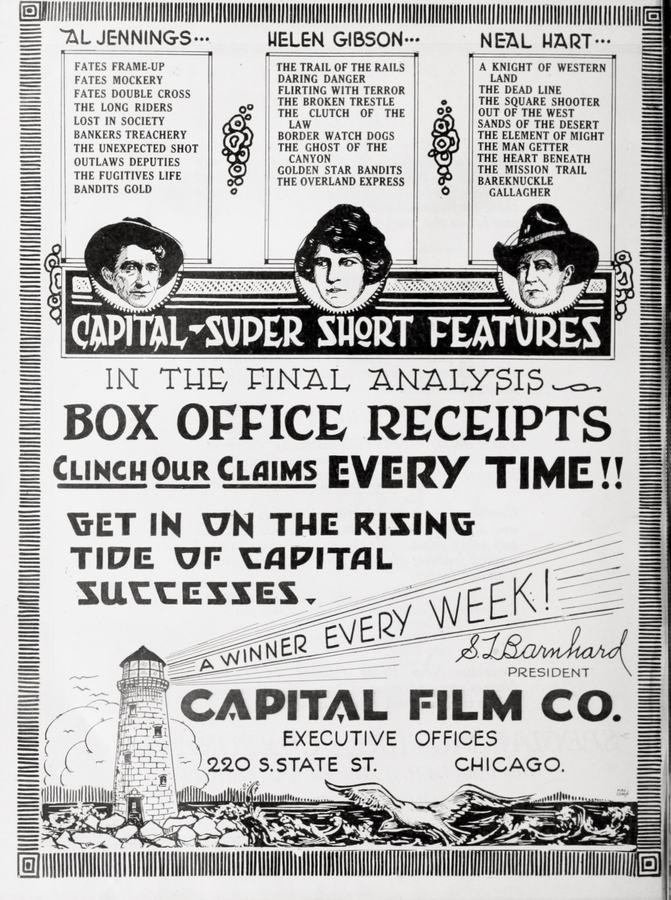
A locomotive on the brink of apocalypse has rarely looked this voluptuously lethal. In The Broken Trestle, the camera itself seems to sweat soot; every frame is glazed with the metallic sheen of a world that knows its own rivets are counterfeit.
Helen Gibson—stunt-pioneer, horsewoman of fury—embodies the film’s jittering heartbeat. She is not the damsel of melodrama but its avenging metronome, ticking off seconds with piston-speed strides across platforms that smell of tar and treachery. Directors who assume women in 1920 merely fluttered among tea roses should be lashed to this film’s speeding cow-catcher and forced to watch Gibson shinny up a telegraph pole while a freight train howls beneath her like Cerberus on rails.
The cinematographer—name lost to creditors and cemetery registers—turns nitrate into mercury. Moonlight drips across the gorge, pooling in the creosote veins of the trestle, while day-for-night shots invert the world into an aquarium of silver. Compare this chiaroscuro to the candle-crusted cloisters of Das Phantom der Oper; both films understand that darkness is not absence but a viscous substance to be ladled. Yet where the Paris opera house drips Romantic melancholy, this American ravine exudes capitalist dread—every tie is an IOU, every spike a bribe.
Original exhibitors reportedly accompanied the final plunge with a barrage of locomotive whistles and Chinese gongs. Today, even without those cacophonies, the silence screams: the grinding of iron on iron is audible in the mind’s ear, a synesthetic roar conjured by montage so rapid it feels like sprocket holes are gasping for air. When the engine tips—its boiler vomiting a geyser of steam that looks like the ghost of industry itself—one recalls the molten crucible in Thais, another 1917 spectacle where matter transcends utility and becomes theology.
The screenplay, stitched from newspaper ink and graft scandals, eschews the moral polarities of contemporaries like It’s a Great Life. Instead it offers a gradient of culpability: the station agent addicted to laudanum, the banker who mortgages ethics, the steel magnate who refers to passengers as “freight that complains.” Their machinations crisscross like steel rails, culminating in a catastrophe that feels less like accident than collective suicide. Gibson’s telegrapher alone maintains moral traction, yet even she is tainted—her father laid the trestle’s compromised beams. The sin is ancestral, the collapse predestined.
Scholars who locate proto-feminist valiance only in talkie spinsters need to witness Gibson here. She vaults between boxcars, skirts ballooning like black petals, boots striking sparks. The camera lingers not on erotic spectacle but on muscular intention—thighs that could splice iron, forearms mapped with cable-sinew. When she body-slides under the accelerating coach to sever an air-brake hose, the stunt rhymes with Douglas Fairbanks yet exceeds him: Fairbanks gambols for joy, Gibson for communal survival. The gendered stakes combust the cliché of woman-as-obstacle; she is the fulcrum upon which destiny pirouettes.
Place The Broken Trestle beside From Hand to Mouth and you chart the spectrum of silent-era peril: Harold Lloyd’s clock-dangling urban vertigo vs. Gibson’s pastoral apocalypse. Lloyd makes the city a playground; Gibson renders nature a tribunal. Both films, however, share a kinetic syntax—stunts filmed in long, unforgiving takes that flaunt their own danger. Contrast that with the Germanic swagger of Der Teufelswalzer, where movement is choreographed mood rather than existential wager; or with The Mysterious Lady, whose seductions are psychological pirouettes rather than corporeal gambits.
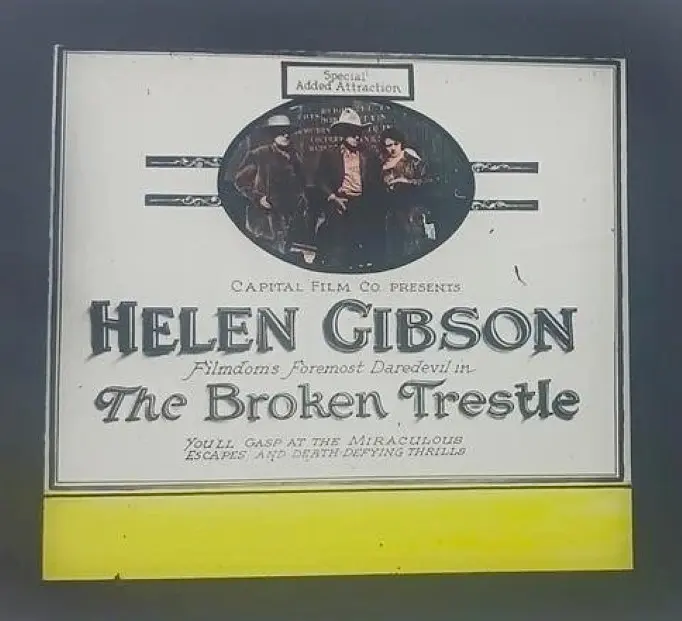
Read the film as a Marxist parable and it crackles louder than the nitrate it was printed on. The trestle—public utility gutted by private graft—mirrors the 1919 railroad strikes that convulsed the nation. The passengers, a cross-section of petit-bourgeois anxiety, pay cash to traverse a bridge already condemned by their own elected commissioners. When the crash erupts, purses burst, stocks flutter into the ravine like toxic snowflakes, and for an ecstatic instant class distinctions vaporize amid steam. Yet even here the film refuses didactic sermon: a Pinkerton detective survives by landing atop a banker’s corpse, suggesting that predation adapts, metastasizes.
Most prints were melted for their silver during WWII, leaving only shards in an Ohio barn: a reel-end here, a title card there. The extant 46 minutes—water-stained, splice-heavy—feel like a fever dream half-recalled. We discern the narrative via interpolation, much as cine-archaeologists reconstruct Ham an from stills and censorship notes. Such fragmentation intensifies the film’s thematic core: history itself is a broken trestle, patched by rumor and ideology.
Watch the crash in slo-fi (YouTube’s 60fps interpolation) and you’ll see bodies not flung but levitated, as though raptured by Moloch. One gentleman’s top-hat remains suspended mid-air, a black halo rotating in negative space. The image fuses the sacred and profane, recalling medieval triptychs where sinners tumble into hellmouths. Yet the context is industrial, not ecclesiastical; damnation here is engineered by slide-rule, not decreed by scripture.
Beyond Gibson, the ensemble crackles. The banker—played by a forgotten character actor whose jowls seem stuffed with mortgage papers—registers panic via a twitching pocket-watch chain. The child with the music box offers a lullaby motif that counterpoints the oncoming doom; when her toy shatters on impact, the tinkling keys scatter like infant bones. Even extras possess individuation: a conductor with a carnation wilted by engine-heat, a stenographer clutching a pad on which the word “profit” is repeatedly crossed out. Such granularity prefigures the humanist sprawl of The Scales of Justice.
The cut-ratio accelerates like a runaway train: from leisurely depot vignettes (ASL 8 sec) to the climactic montage where shots last 1.2 seconds, spliced diagonally to mimic sheared rails. This rhythmic crescendo predicts Eisensteinian dialectics, yet predates Potemkin by five years. Cross-cutting between Gibson’s Morse warnings and the engineer’s oblivious whistling creates a temporal vortex—the spectator becomes the very delay that dooms the passengers.
Though monochromatic, the film evokes color via synecdoche: the yellow of a caution flag, the sea-blue of a signal lamp, the orange of Gibson’s bandana—each hue survives as a ghost in the grayscale. One can almost smell creosote (black), feel the sun’s brass (yellow), taste the coppery fear (orange). Such sensory surplus rivals the Expressionist palettes of Der Hund von Baskerville, where tinting externalizes hysteria.
Scorsese cribbed the runaway-coil tension for the cocaine sequence in Bringing Out the Dead; Nolan studied the trestle collapse when storyboarding the mountain fortress in Tenet. Yet mainstream amnesia persists. Film-school syllabi still genuflect to The Sporting Duchess while ignoring this anarchic blueprint. The reason? Perhaps The Broken Trestle indicts not only robber-barons but the very spectators who profit from engineered risk—a mirror too blatant for comfort.
What survives is more than celluloid; it is a warning scorched into the collective unconscious: infrastructure is morality made tangible. Every rusted rivet you ignore on your commute is a potential plot-point in somebody’s catastrophe. Gibson’s final tap-tap-tap—Mse for “I tried”—echoes across a century, a requiem for accountability buried beneath progress’s rubble. The trestle snaps, the nation lumbers on, and the projector’s clatter becomes the very sound of our ongoing derailment.

IMDb —
1935
Community
Log in to comment.