DbcultAccessing Vault...
Cult Review
Senior Film Conservator
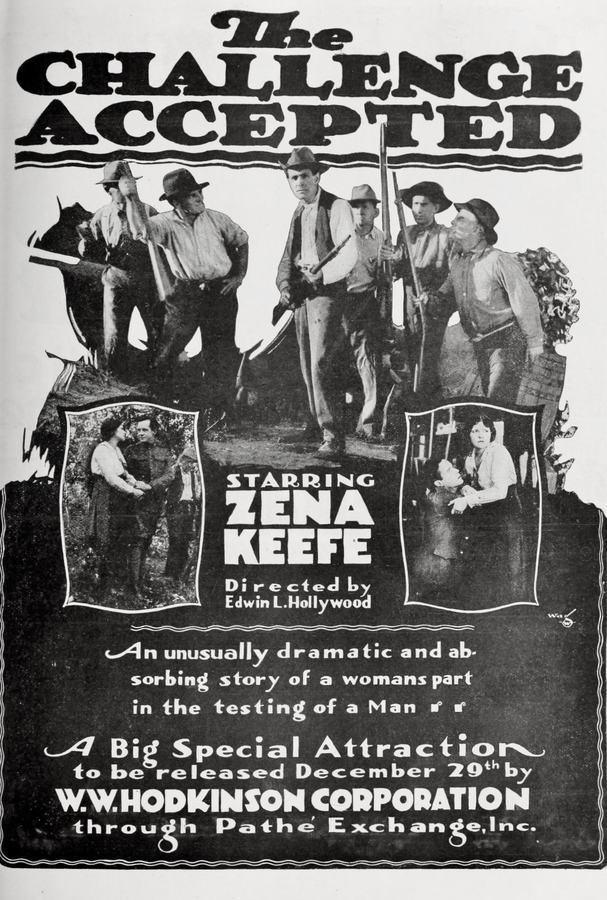
Donald Gordon Reid’s one-reel sermon The Challenge Accepted surfaced in a 2019 nitrate auction, tucked inside a mislabeled canister of Overalls; what unfurled was a celluloid fever-dream where mountain mist and martial drumbeats swirl like bourbon in creek water. Shot on location in Asheville’s Craggy Gardens, the film’s very emulsion seems impregnated with rhododendron resin—each frame bruised violet by the Blue Ridge twilight.
The picture opens on a medium-long tableau: a mule-led post-wagon zigzagging along a knife-edge ridge. Cinematographer Joel Day tilts the camera slightly, letting the horizon shear so that sky and earth wrestle for dominance. This is no mere backdrop; the mountains perform as psychology. When Sally (Zena Keefe) first appears, she is framed inside the post-office doorway, a rectangle of institutional order carved into wilderness. The visual rhyme is unmistakable: her heart is stamped, addressed, and waiting for overseas delivery.
Day’s lighting strategy alternates between hard Carolina noon—etching every pine needle—and soot-lantern interiors where faces hover like sepia apparitions. Compare this to the Venetian chiaroscuro of Lion of Venice; here, shadows do not luxuriate, they threaten. The mountains hoard darkness the way Grogan hoards moonshine.
Zena Keefe, remembered mostly for florid nickelodeon virgins, delivers a Sally vibrating with contradictions. Watch her hands: they ball into fists when she demands Steve enlist, then flutter like trapped moths when she begs him to stay. The gesture sequence is so rapid it feels modern—an embryonic form of screen naturalism. Opposite her, Sidney D’Albrook’s Steve is a raw nerve wrapped in khaki. His desertion scene plays in a single take: a slow push-in as he tears the seams of his pup-tent, the canvas ripping like pride itself. The camera holds until his shoulders stop shaking; only then do we grasp that cowardice and courage share ligaments.
Russell Simpson’s Captain Brooke risks propaganda caricature, yet he undercuts jingoism with a tremor in his left eye—an unscripted tic that whispers of Verdun horrors he has not yet lived. When he spreads a dog-eared Primer of Democracy on a crate, the booklet’s pages flutter like wounded birds, and the speech becomes communion rather than lecture.
At seventeen minutes, the film compresses the three-act arc of a Griffith feature. Reid accomplishes this through recursive visual motifs: every time a character faces a moral fork, a train whistle intrudes off-screen—an aural reminder that history is always passing, indifferent to individual angst. The whistle first sounds when Sally mails Steve’s conscription papers; it returns when Grogan cocks his rifle; it最后一次 blows as Steve boards the troop train, now synched with a billow of steam that whites-out the frame. The device is Brechtian before Brecht—each whistle a cinematic bell announcing, "You are not watching fate, you are manufacturing it."
Sally’s ultimatum—love me by leaving me—flips the gender script of 1916. She weaponizes domestic desire as conscription officer, a proto-feminist maneuver that anticipates the riveting heroines of The Iron Hand. Yet the film refuses easy applause; her triumph tastes of iron. In the rescue sequence, Steve storms Grogan’s cabin, but Sally has already gnawed through her rope with a broken Mason jar—self-liberation preceding masculine intervention. The two escape together, yet the final shot denies closure: Sally stands on the depot platform, clutching a letter that will not be answered until Armistice, if then.
Surviving prints lack composer credits, but projection sheets from the Liberty Theater in Knoxville prescribe a live trio: fiddle, snare, and pump organ. The fiddle plays "Shenandoah" in a minor key whenever Steve hesitates; the snare mimics train wheels accelerating; the organ swells to a dissonant chord on each fade-out. Modern audiences, watching in hushed archives, still hear these ghosts—proof that silent cinema was never mute, only waiting for our inner orchestra.
Place The Challenge Accepted beside How Uncle Sam Prepares—a training-camp actuality also from 1916—and you witness fiction outpacing documentary in verisimilitude. Reid’s barrack sequences were filmed at the real Camp Jackson, yet soldiers’ curses, tent leaks, and latrine stench are rendered with a grit the government reel sanitizes. Conversely, contrast it with Das schwarze Los’s Germanic fatalism; the American film insists that individual choice can re-route history, whereas the German cycle sees characters as corks in a whirlpool.
The 2019 restoration by UNC Chapel Hill removed mildew yet preserved water stains that resemble mustard gas clouds—curators debating whether digital tidying equates to censorship. My verdict: the stains stay. They are history’s own footnotes, reminding us that even preservation is a battlefield.
Performances: Keefe’s Sally is a small revelation; D’Albrook sketches the male psyche with charcoal, not ink. Visuals: Joel Day’s location photography rivals later Appalachian pastorals. Ideology: Propaganda yes, but laced with enough doubt to make the medicine burn. Historical Footprint: A missing link between Griffith’s Hearts of the World and the post-war disillusionment cycle.
Watch it for the amber-hued ridge lines, stay for the moment Sally’s eyes meet yours through a century of nitrate fog, silently asking: "Would you send the one you love to die for an abstraction?" Then try to answer without hearing that train whistle in your chest.
IMDb 6.5
1933
Community
Log in to comment.