DbcultAccessing Vault...
Cult Review
Senior Film Conservator
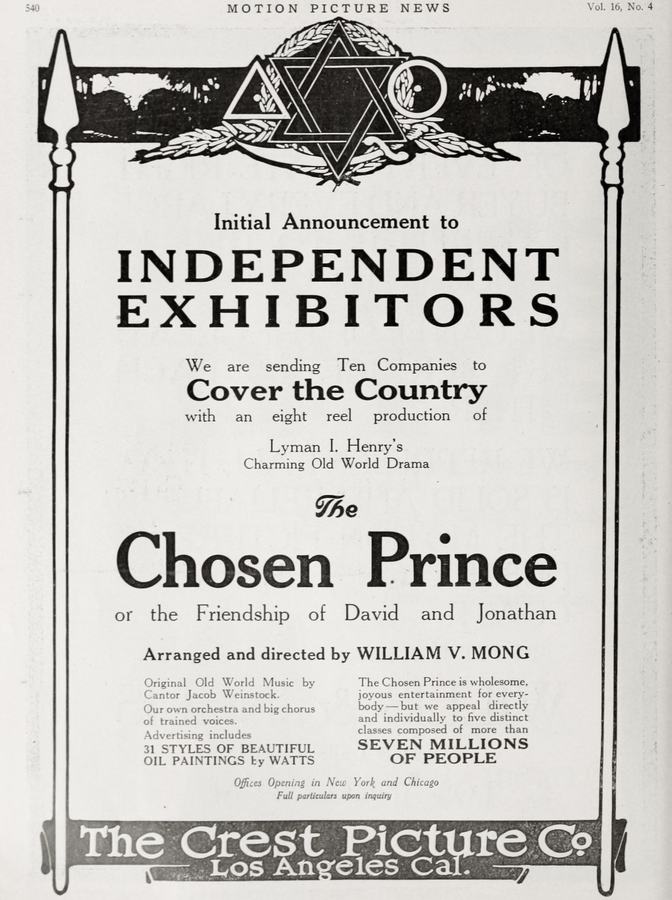
Step back into an era when moving images, devoid of spoken dialogue, communicated with an unparalleled emotional veracity. Lyman I. Henry’s ‘The Chosen Prince, or the Friendship of David and Jonathan’ stands as a testament to the silent film’s capacity for profound human drama, a work that transcends its historical context to speak volumes about the timeless intricacies of human connection, loyalty, and the insidious creep of doubt. This isn't merely a historical artifact; it's a vibrant, living narrative that dissects the very sinews of friendship with an incisive gaze, revealing the delicate balance upon which even the most robust bonds precariously rest. In an age saturated with auditory stimuli, this film reminds us that the most potent stories often unfold in the silent spaces between glances, the subtle shifts in posture, and the profound eloquence of a single tear.
The narrative pivots around David, brought to life with an earnest, almost guileless charm by Charles Perley. His David is a figure of youthful exuberance, initially depicted as inseparable from Jonathan, his stalwart companion. Their early scenes, though perhaps presented through the conventions of the era, hint at a shared history, a comfortable familiarity that only years of shared experiences can forge. It’s a friendship built on mutual understanding, an unspoken pact of unwavering support. Yet, this idyllic dynamic is destined for turbulence. The arrival of the Prince, a figure whose very presence exudes an air of consequence and novelty, acts as the catalyst for this emotional upheaval. One can almost feel the shift in equilibrium, the subtle vibration in the fabric of David and Jonathan’s world as this new star rises into David’s orbit.
The Prince, presumably portrayed with a commanding presence by a notable actor of the time, perhaps Noah Beery, embodies an allure that is both enticing and disruptive. His introduction isn't necessarily one of malice, but rather of an irresistible novelty, a new horizon that captivates David’s youthful imagination. David, perhaps unwittingly, begins to devote an increasing portion of his time and attention to this new friendship. The subtle cues in Perley's performance would have been critical here – a lingering gaze, a hesitant step away from Jonathan, a growing absorption in the Prince's world. This gradual, almost imperceptible shift is where the film truly shines, for it mirrors the insidious way in which even the strongest bonds can fray, not through dramatic rupture, but through slow, consistent neglect. It's a testament to the screenplay by Lyman I. Henry that such a nuanced erosion of trust could be conveyed so effectively without a single spoken word.
And then there is Jonathan. The heart of the film, perhaps, beats most poignantly within his character. Edward Alexander, in what must have been a challenging role, portrays Jonathan not as a figure of vindictive jealousy, but of profound, agonizing doubt. His is the quiet suffering of the overlooked, the friend who witnesses his cherished bond slowly, irrevocably altered. Jonathan's internal struggle becomes the audience's, as we watch him grapple with the gnawing uncertainty of his place in David's life. The subtle tremors of his expressions, the slumped shoulders, the lingering glances at David and the Prince together – these are the brushstrokes of a master at work, painting a portrait of a soul in anguish. It's a universal experience, this feeling of being replaced, of watching a valued connection drift, and the film taps into that raw, vulnerable nerve with remarkable precision. The silent medium, paradoxically, amplifies this internal drama, forcing the viewer to project their own understanding onto Jonathan's unspoken torment.
The thematic richness of ‘The Chosen Prince’ extends far beyond a simple tale of friendship. It delves into the very nature of loyalty, questioning its resilience in the face of new attractions, ambition, or even perceived social elevation. Is loyalty an immutable force, or a fragile construct, susceptible to the whims of circumstance and the allure of the unfamiliar? The film suggests the latter, presenting a sobering view of human nature. This exploration resonates deeply with the moral quandaries presented in films like ‘The Mark of Cain’, which also grappled with themes of betrayal and the internal conflict arising from difficult choices. While ‘The Mark of Cain’ often focused on overt moral transgressions, ‘The Chosen Prince’ explores the quieter, more insidious forms of emotional betrayal, making it arguably more relatable in its depiction of everyday human failings.
The direction of Lyman I. Henry is particularly noteworthy for its ability to extract such profound emotion from the silent form. The composition of scenes, the strategic use of close-ups on the actors' faces, and the pacing of the narrative all contribute to a compelling visual language. One can imagine the meticulous planning involved in conveying Jonathan’s mounting despair through a sequence of increasingly isolated shots, or David’s burgeoning fascination through the heightened energy of scenes with the Prince. The film would have relied heavily on the expressive capabilities of its cast, and actors like Eva Lewis, Harry Shields, Verna Felton, William V. Mong, Clara Allen, Harry Holden, Hubert Whitehead, J.V. Whitehead, and George Gebhardt, though perhaps in supporting roles, undoubtedly contributed to the rich tapestry of emotional responses depicted on screen. Their collective ability to project internal states without dialogue is the cornerstone of silent cinema's power, and this film appears to have harnessed it effectively.
The film’s title itself, referencing the biblical narrative of David and Jonathan, immediately imbues the story with a layer of mythic resonance. While the plot summary provided doesn't explicitly state it's a direct adaptation, the evocation of such a powerful, archetypal friendship and its subsequent trials suggests a deeper engagement with themes of divine favor, earthly power, and the enduring human struggle for connection. This connection to a well-known narrative adds a layer of expectation and understanding for contemporary audiences. It’s akin to how other films of the era, such as ‘Life and Passion of Christ’, leveraged existing cultural narratives to create immediate emotional and intellectual impact, allowing the silent visual storytelling to fill in the nuanced emotional beats. The strength of such foundational stories lies in their universal themes, which resonate regardless of the specific historical or cultural context.
Moreover, the film implicitly explores the intoxicating nature of power and influence. The Prince, by virtue of his station, naturally commands attention, and David's gravitation towards him can be seen as a natural human response to opportunity or perceived advancement. This isn't necessarily a moral failing on David’s part, but a reflection of the complex social dynamics that often dictate our choices and relationships. This aspect of the narrative could be fruitfully compared to the intricate social maneuverings depicted in films like ‘The Woman of Mystery’ or ‘The Vanderhoff Affair’, where external forces and social standing significantly impact personal relationships and choices. While those might focus on larger conspiracies or societal pressures, ‘The Chosen Prince’ distills this influence down to a personal, intimate level, making its impact all the more palpable.
The sheer bravery of silent filmmakers in tackling such emotionally complex subjects without the crutch of dialogue cannot be overstated. They relied solely on the visual grammar of cinema – the framing, the lighting, the acting, and the judicious use of intertitles – to convey every shade of meaning. In ‘The Chosen Prince’, one can imagine the intertitles being used not just for plot advancement, but for expressing Jonathan’s inner turmoil, perhaps a poignant question directed at David that remains unanswered, or a lament on the fleeting nature of bonds. This economy of language, coupled with heightened visual performance, often resulted in a more visceral and immediate emotional experience for the audience. The silent era, in many ways, forced a purity of storytelling that modern cinema, with all its technological advancements, sometimes struggles to achieve.
The emotional landscape painted by Henry is one that echoes the profound sense of loss and internal conflict seen in films like ‘Vendetta’, though perhaps with less overt aggression and more inward suffering. Where ‘Vendetta’ might explore the outward manifestations of conflict, ‘The Chosen Prince’ delves into the silent, corrosive nature of emotional neglect and perceived abandonment. It’s a tragedy of the heart, rather than of action. The film’s lasting impact likely stems from its universal appeal: who among us has not felt the sting of a friendship shifting, of loyalties tested, or of feeling replaced? This makes it a powerful work that transcends its niche as a silent film, speaking to the enduring human condition.
In a broader cinematic context, ‘The Chosen Prince’ contributes to the rich tapestry of early psychological dramas. It’s a film that demands active participation from its audience, inviting them to interpret the subtle cues and fill in the emotional blanks, a characteristic shared with other introspective works of the period. Its exploration of internal struggle can be seen as a precursor to more complex psychological thrillers, albeit in a nascent form. The very title, with its dual focus on 'The Chosen Prince' and 'The Friendship of David and Jonathan', underscores the central tension: the pull between individual destiny or perceived glory, and the profound, grounding power of genuine human connection. It’s a delicate balancing act, and the film, through its silent eloquence, manages to convey the profound stakes involved with remarkable clarity and emotional depth. The performances, particularly those of Perley and Alexander, would have been pivotal in anchoring this emotional journey, making the characters’ inner lives accessible and resonant to audiences of the time and, remarkably, even today.
To view ‘The Chosen Prince, or the Friendship of David and Jonathan’ today is to gain a deeper appreciation for the foundational artistry of cinema. It’s a reminder that compelling narratives and profound emotional resonance do not require complex special effects or booming soundtracks. They require keen observation of human nature, skilled direction, and actors capable of conveying the entire spectrum of human emotion through the subtle language of the body and face. The film, in its quiet power, stands as a testament to the enduring strength of storytelling, proving that some tales, particularly those of the heart, are best told in the profound silence of shared understanding. Its themes are as relevant now as they were over a century ago, a poignant reflection on the transient nature of human connection and the enduring ache of a friendship tested by new horizons.
Community
Log in to comment.