DbcultAccessing Vault...
Cult Review
Senior Film Conservator
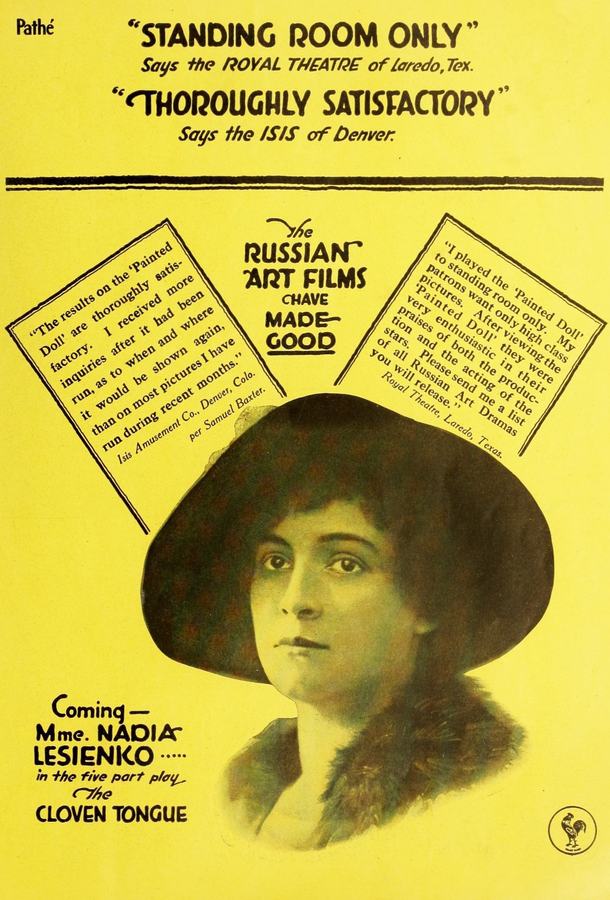
The flickering shadows of early 20th-century Russian cinema often hold within them narratives of profound social commentary, intricate psychological drama, and the raw, unvarnished emotions characteristic of the silent era. Among these cinematic artifacts, The Cloven Tongue emerges as a particularly compelling work, a melodrama steeped in the stark realities of class disparity and the corrosive power of unchecked personal ambition. This film, a product of a vibrant yet turbulent period in Russian history, transcends mere entertainment, offering a potent reflection on human frailty, societal injustice, and the devastating ripple effects of individual choices.
From its very inception, the narrative establishes a suffocating atmosphere of manipulation. We are introduced to Nicolai Orloff, portrayed with a nuanced blend of bluster and spinelessness by Nicolas Rimsky. Orloff is a horse dealer of some standing, yet his professional and personal life is entirely subjugated to the will of Glasha, his mistress. Zoia Karabanova delivers a portrayal of Glasha that is nothing short of magnetic and terrifying; her character is a veritable force of nature, driven by an insatiable avarice and a cunning intellect that she employs with ruthless efficiency. Glasha’s influence over Orloff is absolute, a silent, insidious dominion that dictates the very pulse of his household and, by extension, the lives of those dependent upon him. This power dynamic is not merely a domestic squabble; it symbolizes a deeper societal malaise, where personal greed, unchecked, can metastasize into widespread suffering. The film expertly lays bare how a man of presumed authority can be utterly emasculated by a more dominant personality, particularly when that personality is fueled by base desires.
The fragile equilibrium of Orloff’s world is dramatically disrupted by the return of his daughter, Sonia, from school. Nathalie Lissenko imbues Sonia with a luminous innocence, a stark contrast to the dark machinations swirling around her. Her arrival is not met with warmth by Glasha; instead, an immediate, palpable antagonism blossoms, a sinister foreboding that hints at the conflict to come. This tension escalates sharply when Sonia encounters and subsequently falls deeply in love with Prince Alexis, played by Pyotr Baksheyev. Baksheyev presents Alexis as an embodiment of aristocratic grace, yet also a character vulnerable to the emotional currents of this tumultuous world. The budding romance between Sonia and Prince Alexis is depicted with a tender earnestness, representing a beacon of pure affection in a narrative otherwise mired in calculated self-interest. It is a classic trope, certainly, but one rendered with conviction, making their connection feel genuinely threatened by the encroaching shadows.
Glasha, observing this burgeoning relationship, finds herself consumed by a virulent jealousy. Her desires are not merely acquisitive; they are also possessive, extending even to the romantic affections of a prince. She covets Prince Alexis for herself, a testament to her boundless ambition and an almost pathological need to control every desirable object or person within her orbit. Exploiting her absolute sway over Orloff, Glasha skillfully manipulates him into forbidding Sonia from continuing her romance with the prince. This act of paternal betrayal, orchestrated by a manipulative mistress, is a gut-wrenching moment, highlighting Orloff’s moral cowardice and his tragic inability to protect his own daughter’s happiness. The scene, likely conveyed through powerful silent acting and evocative intertitles, would have resonated deeply with contemporary audiences familiar with the rigid social hierarchies and parental authority of the era. The silent screen, in its reliance on exaggerated gesture and facial expression, was uniquely suited to conveying such intense emotional conflicts, a strength often overlooked by modern viewers accustomed to nuanced dialogue. For instance, while a film like A Man's Making might focus on internal struggle leading to self-improvement, The Cloven Tongue showcases the external forces of corruption leading to moral decay, particularly in Orloff.
The narrative then takes a startling turn with Glasha’s sudden disappearance. This event plunges the story into the realm of mystery and suspense, and predictably, Prince Alexis, the spurned lover, becomes the prime suspect in her presumed murder. The film cleverly builds this suspicion, using the established animosity and the prince’s desperate pleas to create a compelling, if misleading, criminal investigation. Such plot twists were staples of silent melodramas, designed to keep audiences enthralled and to heighten the dramatic stakes. The accusation against Prince Alexis serves not only as a narrative device but also as a commentary on the ease with which individuals, particularly those of a certain social standing, could be implicated in wrongdoing, often based on circumstantial evidence or societal prejudice. The tension here is reminiscent of the moral quandaries explored in The Bells, where guilt and suspicion drive much of the psychological drama, albeit in a more direct, externalized fashion in The Cloven Tongue.
However, the true revelation of Glasha’s fate is where The Cloven Tongue elevates itself beyond a mere romantic melodrama to a powerful piece of social commentary. The truth, when it emerges, is both shocking and deeply resonant: Glasha was not murdered by a jealous lover or a disgruntled rival, but by a collective, enraged force – the local peasant women. These women, driven to the brink by the harsh, exploitative treatment they had endured under Orloff’s management, finally snapped. Crucially, they understood that Orloff’s cruelty was not solely his own doing, but a direct consequence of Glasha’s avaricious counsel and her relentless pursuit of profit at their expense. This ending transforms the film from a personal tragedy into a stark depiction of class struggle and the inevitable explosion of suppressed grievances. It is a powerful indictment of the systemic oppression inherent in the feudal or quasi-feudal structures of the time, suggesting that even the most seemingly personal crimes can have their roots in broader societal injustices.
The portrayal of the peasant women’s uprising, though perhaps brief, is pivotal. It shifts the focus from individual culpability to collective action, providing a glimpse into the simmering discontent that would eventually boil over into revolutionary fervor in Russia. This aspect of the film aligns it with other works that dared to touch upon the volatile social landscape, perhaps more overtly than a romantic drama might typically allow. It speaks to the power of the marginalized, demonstrating that even those without conventional power can, when pushed too far, become an unstoppable force. In this regard, it shares a thematic kinship with films that explore the underbelly of society or the struggles of the common person, such as The Apaches of Paris, which delves into urban crime and desperation, or even the broader historical scope of Potop, which, while an epic, still touches on societal upheaval.
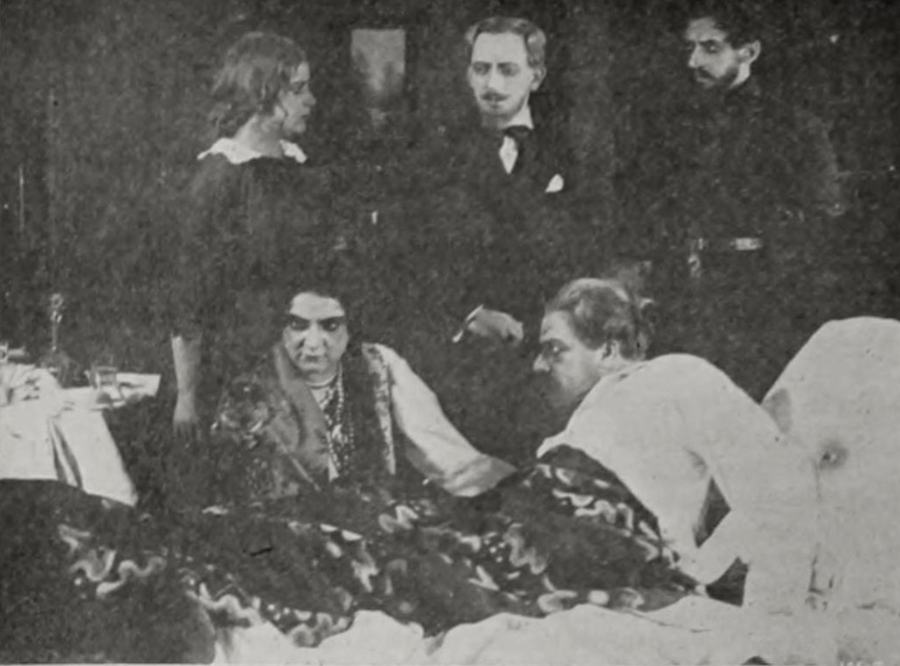
The performances across the board are crucial to the film’s impact. Zoia Karabanova's Glasha is the dark heart of the narrative, a character whose ambition and malevolence are so palpable they almost leap off the screen. Her silent performance, relying on piercing glances, subtle shifts in posture, and dramatic gestures, would have conveyed the depth of her wicked machinations. Nicolas Rimsky's Orloff, in contrast, is a study in weakness, a man utterly dominated, whose ultimate tragedy lies in his inability to assert his own moral compass. Nathalie Lissenko's Sonia provides the necessary counterpoint of purity and vulnerability, making her suffering all the more poignant, while Pyotr Baksheyev’s Prince Alexis embodies the nobility that is both attractive and, in this context, ultimately powerless against the forces of greed and societal wrath. The supporting cast, including Nikolai Panov and Vera Orlova, would have contributed to the rich tapestry of the film's world, grounding the central drama in a believable social context.
Stylistically, silent Russian cinema often embraced a melodramatic aesthetic, utilizing exaggerated expressions and grand gestures to convey emotion in the absence of spoken dialogue. Intertitles, the textual inserts that convey dialogue or narrative exposition, would have been skillfully employed to guide the audience through the intricate plot, perhaps even delivering lines that highlight Glasha's insidious influence or the peasants' growing despair. The cinematography, though likely constrained by the technology of the era, would have focused on dramatic compositions, chiaroscuro lighting to emphasize moral ambiguities, and close-ups to capture the intensity of the actors' performances. This reliance on visual storytelling is a hallmark of the period, forcing filmmakers to be incredibly inventive in their narrative delivery. The visual language of The Cloven Tongue would have been designed to evoke strong emotional responses, creating a visceral experience for the audience, much like the intense emotional journeys found in films such as The Typhoon.
Beyond its dramatic flourishes, The Cloven Tongue serves as a fascinating historical document. It offers a glimpse into the social anxieties and class tensions prevalent in Russia leading up to the revolutionary period. The film's ultimate resolution, where justice is meted out not by the formal legal system but by the collective rage of the oppressed, speaks volumes about the societal fault lines of the time. It suggests a deep-seated cynicism regarding official channels of justice and a recognition of the simmering resentment among the populace. This theme of social justice, or the lack thereof, is a recurring motif in many thought-provoking films, even those from vastly different cultural contexts, such as The Galley Slave, which also depicts individuals struggling against oppressive systems.
The film's title itself, The Cloven Tongue, is evocative and layered. It could refer to Glasha's duplicity, her ability to speak with a "forked tongue" to manipulate Orloff and others. It might also allude to the divisive nature of her influence, cleaving families and social harmony. Or perhaps, more subtly, it hints at the unspoken truths and suppressed voices that eventually erupt in violent retribution. This metaphorical richness adds another layer to the film's artistic merit, inviting deeper interpretation beyond its surface plot. It’s a title that lingers, much like the memory of its powerful story.
In an era where cinema was still finding its voice, films like The Cloven Tongue demonstrated the medium's profound capacity for storytelling, social critique, and emotional resonance. It is a testament to the enduring power of silent film to communicate complex ideas and evoke powerful feelings without a single spoken word. The absence of dialogue forces a greater reliance on visual cues, musical accompaniment (often live in theaters), and the sheer expressive talent of the actors, creating a unique and immersive cinematic experience. While not as widely known today as some of its contemporaries, its narrative depth and thematic courage cement its place as a significant contribution to early Russian cinema, a compelling drama that resonates with timeless themes of power, betrayal, love, and the explosive consequences of human cruelty. It stands as a stark reminder that the seeds of revolution are often sown in the fertile ground of personal greed and systemic neglect, making it a film that is as much a historical artifact as it is a compelling piece of art.
Revisiting such films offers more than just a nostalgic trip; it provides a vital connection to the cultural and social anxieties of a bygone era. The Cloven Tongue, with its dramatic twists and its unexpectedly poignant resolution, serves as a powerful reminder of how human actions, driven by self-interest, can ignite broader societal fires. It challenges viewers to consider the interconnectedness of individual morality and collective well-being, a theme that remains profoundly relevant. The film, therefore, is not merely a relic but a living testament to the enduring struggles of humanity against oppression and the perennial quest for justice, however brutally or unexpectedly it may manifest. Its narrative arc, from personal manipulation to collective retribution, ensures its place as a thought-provoking entry in the annals of silent film history, urging us to reflect on the unseen forces that shape our world.
The film's exploration of Glasha's influence, symbolized by the 'cloven tongue' of deceit and division, ultimately leads to a societal reckoning. It’s a stark illustration of how the abuse of power, even if exercised through a proxy like Orloff, can fester into widespread resentment. This isn't just about a woman scorned or a family torn apart; it's about the very fabric of a community being stretched to its breaking point. The tragic fate of Glasha at the hands of the peasant women is not presented as a simple act of violence, but as an almost inevitable consequence, a grim form of poetic justice delivered by those whom the system had failed. This powerful climax distinguishes The Cloven Tongue from many contemporary melodramas, imbuing it with a raw, almost proto-revolutionary spirit that anticipates the seismic shifts soon to engulf Russia. It elevates the film from a domestic drama to a poignant social statement, echoing the silent cries of the oppressed that eventually demand to be heard.
IMDb —
1924
Community
Log in to comment.