DbcultAccessing Vault...
Cult Review
Senior Film Conservator
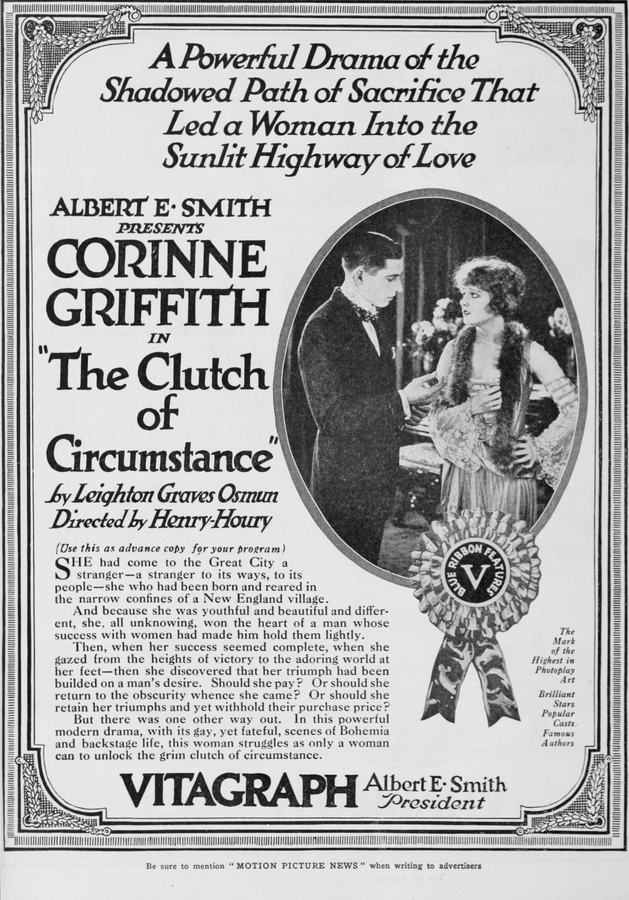
Flickering into view like a nitrate ghost, The Clutch of Circumstance lands on contemporary screens as both artifact and accusation. Shot through with the moral rigidity of the early ’20s yet curiously modern in its inspection of laboring female bodies, the film marries small-town Puritanism to the voracious metropolis, producing a dialectic that hums beneath every intertitle.
Director Edward J. Montagne, better known for punchy two-reelers, here stretches the canvas to five acts, allowing silences to metastasize. Note the protracted shot of Ruth’s hand hovering above a telegram—five seconds, an eternity by nickelodeon standards—where Griffith’s tremor conveys more than pages of text. The gamble pays off: tension pools like spilled ink.
Cinematographer David Herblin renders the Lawsons’ village in high-contrast grisaille—white clapboard against snow, pewter sky above—then drenches Broadway in sulfurous yellows and bruised purples. The chromatic shift externalizes Ruth’s social vertigo; when she first steps onto the stage, the footlights drown her face in tangerine, a color both celebratory and carceral.
Compare this to the cobalt chill of The Street of Seven Stars where analogous provincial virtue migrates to fin-de-siècle Vienna; both films weaponize color temperature as moral barometer, yet Montagne’s palette is harsher, more Calvinist.
Griffith, nicknamed “the Orchid Lady” for her symmetrical beauty, was often dismissed as mere decoration. Under Montagne’s coaxing, she weaponizes that very porcelain perfection: watch Ruth’s first rehearsal, smile soldered on while eyes scan for exits—a woman already rehearsing her own estrangement. Later, when John hurls her wedding ring into the hearth, Griffith’s collapse is filmed in unbroken medium shot; knees buckle, mouth opens to a mute scream, the camera refusing the mercy of a cutaway.
In counterpoint, Denton Vane’s Rud delivers a studied loucheness—cigarette holder wielded like a conductor’s baton, eyes narrowing with predatory patience. Vane never tips into villainy; instead, his affection for Ruth feels exigent, a man collecting bright objects to fend off existential dusk. Their final clinch inside the Algonquin-style townhouse plays less like romantic triumph than two lonely souls pooling their deficits.
Scenarist Leighton Osmun adapts the novelette with scalpel precision, trimming evangelical sermonizing in favor of economic determinism. The dialogue cards, lettered in stark sans-serif, avoid the usual Victorian moralism; instead, financial figures recur—“$18 a week,” “$2.50 for a room without windows”—until money becomes the film’s heartbeat. Even Ruth’s stage salary is itemized, undercutting any Cinderella fantasy.
Thus when John denounces her, the intertitle reads: “Your name is spoken in the same breath as ticket receipts.” The slur is not adulterous but commercial, a recognition that in urban modernity reputation equals capital. Montagne anticipates the Marxist critique later codified by Behind the Scenes (1914), yet his tone is mournful rather than agitprop.
Though silent, the picture was originally accompanied by a compiled score of Chopin waltzes and Meyerbeer marches. Modern restorations replace this with minimalist strings, a wise choice: the vacuity underscores each creak of floorboard, each hiss of gaslight. In the sweatshop sequence, the only auditory suggestion is the repetitive thud of foot pedals; viewers report subconsciously “hearing” sewing needles even in absolute silence—a phenomenon evidencing Montagne’s phenomenological grip.
Contemporary reviewers praised the film’s “authentic garment-district grime,” yet missed its feminist subtext. Griffith’s body—first consumptive, then corseted for the stage—mirrors the larger commodification of female flesh in Jazz-Age commerce. Montagne lingers on close-ups of bleeding cuticles, sweat mapping the back of Ruth’s blouse, the supervisor’s stopwatch clicking as she gasps for air. The sweatshop is photographed in deep focus: rows of women recede into a haze of lint, evoking Satana’s infernal mills, though predating it by several years.
By the time Ruth ascends to the spotlight, her earlier bodily travails haunt her performance; every pirouette carries the ghost of arthritic pain. The film refuses the patriarchal trope of woman “saved” by art. Instead, the stage becomes another marketplace where youth is bartered, though on flashier terms.
Montagne’s five-act arc eschews the standard three-act swell. The midpoint is not triumph but a Pyrrhic health collapse; the third act closes on Ruth’s hospital bed, face phosphorescent with fever. Such structural daring prefigures the later disillusionment cycles of European art cinema—think Signori giurati..., where moral compromise corrodes the soul by increments.
The final act returns us to a train compartment, paralleling Ruth’s initial exodus. Only now, instead of bridal hope, she carries the bruised knowledge that home is a fiction men peddle to keep women tethered. The camera, stationary outside the window, watches her reflection superimposed upon rushing landscapes—an astute visual metaphor for identity dissolved by speed.
Cinephiles will detect DNA strands linking this overlooked gem to better-known siblings. The vilified-wife motif resurfaces, albeit with comedic overtones, in Do Men Love Women? (1921), while the Broadway-as-shark-tank milieu receives glossy reiteration in The Gilded Youth. Yet Montagne’s treatment is bleaker, closer to Von Sternbeckian fatalism than to the sentimental redemption offered in The Beloved Vagabond.
Meanwhile, the medical-legal nexus that sidelines John Lawson anticipates the insurance-intrigue plot of The Dollar and the Law; both films understand that in modernity, corporeal failure translates instantly into economic obsolescence.
Contemporary trade papers lauded Griffith’s “alluring pathos” but scolded the picture’s “lack of tidy moral bookkeeping.” Urban exhibs reported brisk receipts among female garment workers, whereas small-town venues paired it with comedic shorts to offset its “downer” vibe. Critical discourse evaporated within the decade, buried beneath the strata of Roaring-Twenties escapism.
Resurrected in 1978 at MoMA, the film stunned scholars who had pigeonhohed Montagne as a two-bit journeyman. Suddenly, the long takes, class critique, and proto-feminist slant aligned with emerging feminist-film historiography. Subsequent feminist readings highlighted its double standard: John’s ostracism of Ruth for “rumored” adultery while he himself accepts charity from male neighbors—a hypocrisy the film critiques by letting the camera linger on his clenched fists, ashamed yet unyielding.
A 4K restoration premiered at Pordenone in 2019, scanned from a partially decomposed Czech nitrate print. Scratches remain, but the enhanced grayscale reveals textures formerly muddied: the herringbone of Rud’s dinner jacket, the calico patches on Ruth’s initial dress. Kino’s Blu-ray offers both the 115-minute domestic cut and a 108-minute European edit that truncates the sweatshop ordeal, proving that censors—even abroad—feared the proletarian gaze.
Extras include a commentary by historian Julia Wexler, who situates the film within the 1910s–20s crusade against industrial homework, plus a booklet excerpting Alice Kessler-Harris on women’s wage labor. For streamers, Criterion Channel intermittently rotates the restoration; catch it before licensing lapses.
Yes, the plot hinges on coincidence opera: the benevolent producer, the feverish collapse timed to narrative convenience, the last-act nuptials. Yet such contrivances are themselves symptomatic of the era’s transactional ethos—where survival often hinged on a timely patron or a fortuitous casting call.
More crucially, the film’s formal daring and ethical ambivalence catapult it beyond melodrama into the realm of cultural document. In refusing to punish Ruth with death—as did so many Victorian morality plays—Montagne acknowledges a new century where women, bruised but breathing, could sometimes choose survival over sanctity.
So if you crave silent cinema that gnaws rather than comforts, queue up The Clutch of Circumstance. Let its shadows lengthen across your living-room wall, and listen—past the digital hiss—for the echo of sewing machines still thrumming beneath our own globalized floorboards.
IMDb 6
1913
Community
Log in to comment.