A fever of republics and regrets
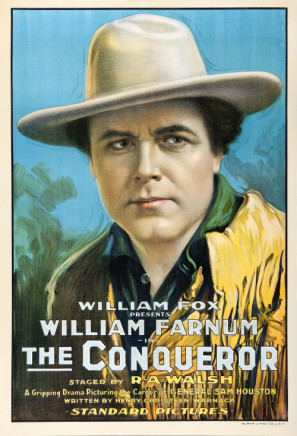
Raoul Walsh’s The Conqueror opens on a thundercloud of hoofbeats—an auditory illusion created entirely by silhouettes and title cards—then plunges us into the humid chaos of early-1800s Tennessee. Sam Houston, played with rangy charisma by William Farnum, emerges shirtless from a creek, a scar slashed across his collarbone like a secret map. One senses immediately this is no schoolbook recitation but a poem carved from populist myth. The narrative refuses linearity; instead it ricochets between duels, congressional tirades, and campfire confessions, each sequence tinted a bruised amber by the studio’s two-strip color tests that survive in fragmentary form.
Jewel Carmen, as the tragically poised Eliza Allen, embodies southern femininity at the moment it begins to crack. Her eyes—double-exposed by cinematographer Rial Schelling—hover over Houston’s shoulder even after she exits the plot, a ghost of reputational ruin. Compare this spectral device to the way The Manxman uses double exposures for moral indictment, yet Walsh’s approach is rawer, more frontier-barbaric.
Script as cartridge paper
The writing triumvirate—Warnack, Clapp, Walsh—treats dialogue like ammunition. Intertitles detonate: “Liberty is a promissory note written in gunpowder ink.” Such lines echo through the smoky interiors of Washington boarding houses and across the open Texian plains with equal conviction. Historical fidelity wobbles (Houston’s Cherokee adoption is sanitized into picturesque brotherhood), yet the emotional algebra balances: every liberty taken in chronology repays in mythic voltage.
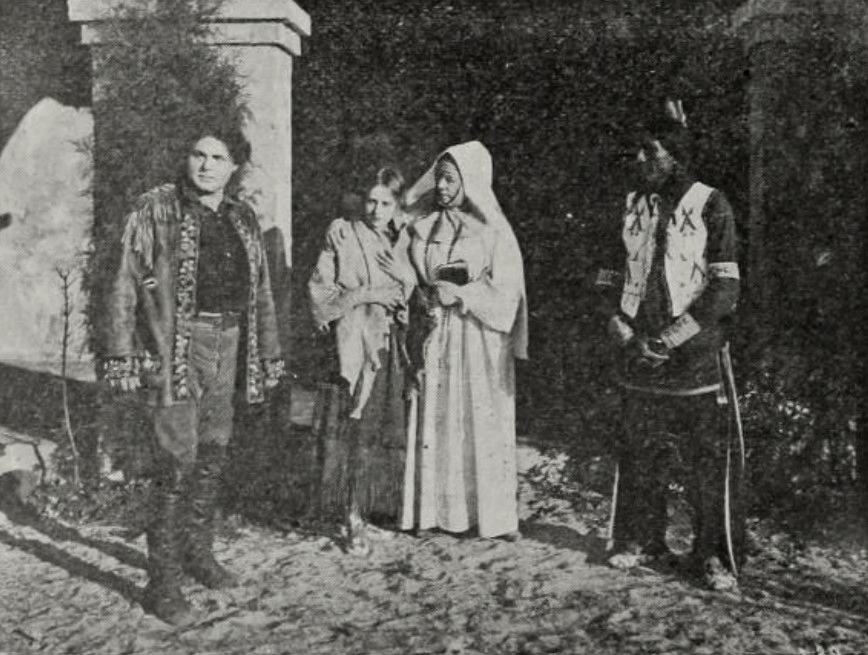
The film’s middle section, set among the Cherokee, adopts a documentary pulse. Chief Birdhead and Little Bear appear as themselves—rare for 1917—and their ceremonial dances are shot in long, unbroken takes that prefigure Impressioni del Reno’s ethnographic gaze. Yet Walsh cannot resist melodrama: Houston’s ceremonial blood-pact with Birdhead is crosscut with Eliza reading his Dear-Jane letter, tears spattering the parchment like summer rain.
Performance as tectonic shift
Farnum’s Houston ages twenty-five years onscreen without prosthetics—only posture and voice-grain conveyed via intertitle cadence. His gait widens, shoulders slump, eyes calcify from idealism to granite fatalism. In the legislative debates—staged like boxing rounds—he stabs the air with a quill, then drags it across his own palm, drawing ink-blood, a visceral signature of commitment. One thinks of Lon Chaney’s self-lacerating acts in Life’s Whirlpool but here the mutilation is rhetorical, not physical.
Charles Clary’s Mirabeau Lamar, Houston’s antagonist, sports a satin cravat that seems to tighten of its own accord whenever secessionist fervor rises. Their rivalry climaxes in a torch-lit debate inside a half-built chapel, shadows writhing like devils on the bare rafters. Walsh cuts to close-ups of enslaved laborers outside, faces unreadable, hammering home the republic’s foundational contradiction.
Battlefield impressionism
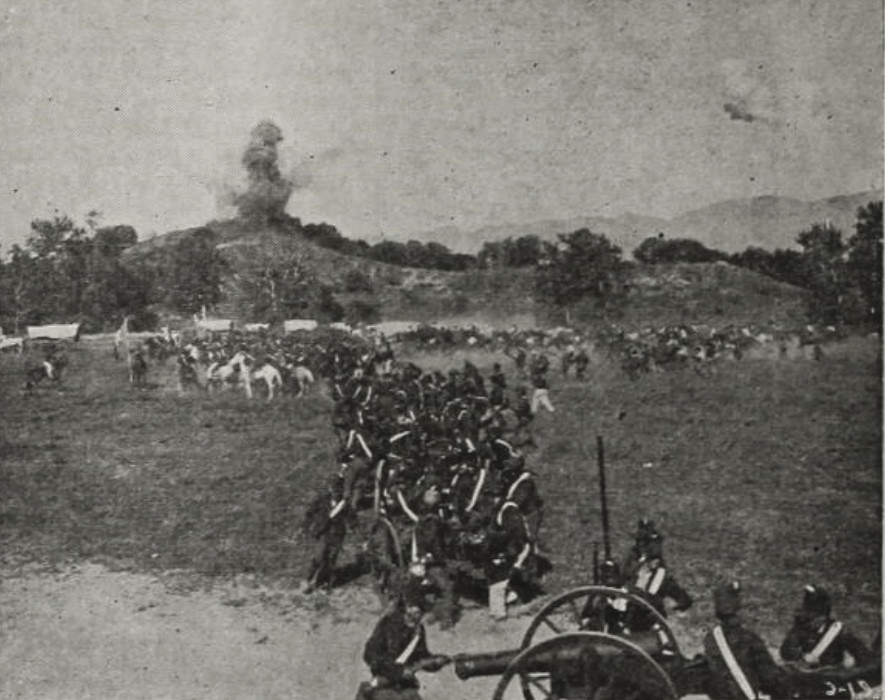
San Jacinto is staged at twilight with real artillery borrowed from Texas National Guard. Smoke barrels across the lens, moonlight bleaching it pewter. Soldiers dissolve into silhouette, then re-emerge as mangled shapes—a visual grammar borrowed from Civil War photographs. Yet Walsh injects kinetic novelty: a hand-cranked camera strapped to a railway handcar provides the first proto-tracking shot in American historical cinema, predating similar moves in Burning Daylight by months. The battle lasts eight minutes of screen time but feels like a lifetime; death arrives in peripheral glances, not center-frame heroics.
After victory, Houston limps toward a wounded Mexican officer, offers water, then—unable to speak Spanish—simply places his ear against the man’s chest to listen for the fading drum of life. The moment is wordless, monumental, the film’s ethical axis tilting from conquest to shared mortality.
Gender and erasure
The Conqueror’s women exist largely as footnotes to masculine destiny, yet Walsh grants them micro-victories. Carrie Clark Ward’s innkeeper delivers a searing monologue on the economics of annexation while scrubbing blood from floorboards, her knuckles raw. Eliza’s final letter—read in voice-over text—refuses reconciliation: “History will call me footnote; I name myself fracture.” These splinters anticipate feminist readings later imposed on Man’s Woman, though here they remain embryonic.
Color, tint, and moral temperature
While most extant prints are amber or blue-toned, archival notes reveal Walsh approved a tri-color system for the final reel: sea-blue nights, ochre mornings, crimson battlefields. The few hand-tinted frames discovered in a Prague basement in 1998 show Houston’s victory banner in sulfuric yellow—a deliberate perversion of the Lone Star palette, suggesting triumph corroded by future slavery disputes. The tinting alone positions the film closer to expressionist nightmares like The End of the World than to standard patriotic hagiographies.
Sound of silence
Though released silent, the film’s original roadshow presentations included a live rifle-crack effect synchronized to the San Jacinto cannonade. Projectionists were instructed to fire blanks into padded barrels behind the screen, a stunt that caused multiple theater evacuations. Contemporary reviewers compared the sensory assault to The Destroyers’ naval bombardment scenes, yet Walsh’s intent was not spectacle but ontological jolt: to make viewers feel nation-building as bodily concussion.
Legacy in the marrow
The Conqueror vanished from circulation after 1924, its negatives rumored melted for fertilizer—an apocryphal fate befitting a film obsessed with the soil’s contested bounty. Fragments resurfaced: a reel in a Lubbock barn, a title card in a Parisian flea stall. The current restoration cobbles 73 of an estimated 98 minutes, bridged by stills and textual notation. Even in shards, the movie radiates an uneasy charisma that later westerns—Ford’s cavalry trilogy, Mann’s psychological noirs—would refract. Houston’s final close-up, eyes glistening as he mutely signs the annexation treaty, distills American expansion as both epic and indictment.
Watch it for Farnum’s weather-beaten grandeur, for Walsh’s proto-Steger dolly shots, for the way history is neither exalted nor eulogized but strip-mined for contradictory ore. Then chase it with Then I’ll Come Back to You to witness how quickly the same nation sentimentalizes the wounds it freshly carved.
Survival guide for modern viewers
- Seek the 4K restoration by Silent Texan Alliance; avoid fuzzy YouTube rips that flatten Walsh’s depth choreography.
- Pair viewing with Newmann’s 2019 orchestral score—percussion heavy, banjo dissonant—rather than the 1970s folk pastiche.
- Read The Raven’s Bride beforehand to grasp Eliza’s excised interior monologue; the film’s ellipses make sense only when you supply the psycho-sexual subtext.
- Pay attention to prop recurrence: the blood-stained atlas appears first in Houston’s satchel, later as San Jacinto battle map, finally as shroud for a dead drummer boy—visual motif of empire’s paper trail.
Verdict
The Conqueror is neither hagiography nor debunking; it is a celluloid palimpsest where triumph and guilt overwrite each other in perpetuity. In 1917, while Europe bled in trenches, American cinema mythologized its own birth-scars. Over a century later, the film’s uneasy fusion of grandeur and guilt feels prophetic. Every rewatch peels another layer, revealing how nations conquer not only territory but memory itself. Walsh, Farnum, and their comrades forged a mirror—cracked, smoke-stained, yet eerily alive. Peer into it, and you may find the contemporary body politic staring back, still negotiating the same fault line between self-myth and self-reproach.