DbcultAccessing Vault...
Cult Review
Senior Film Conservator
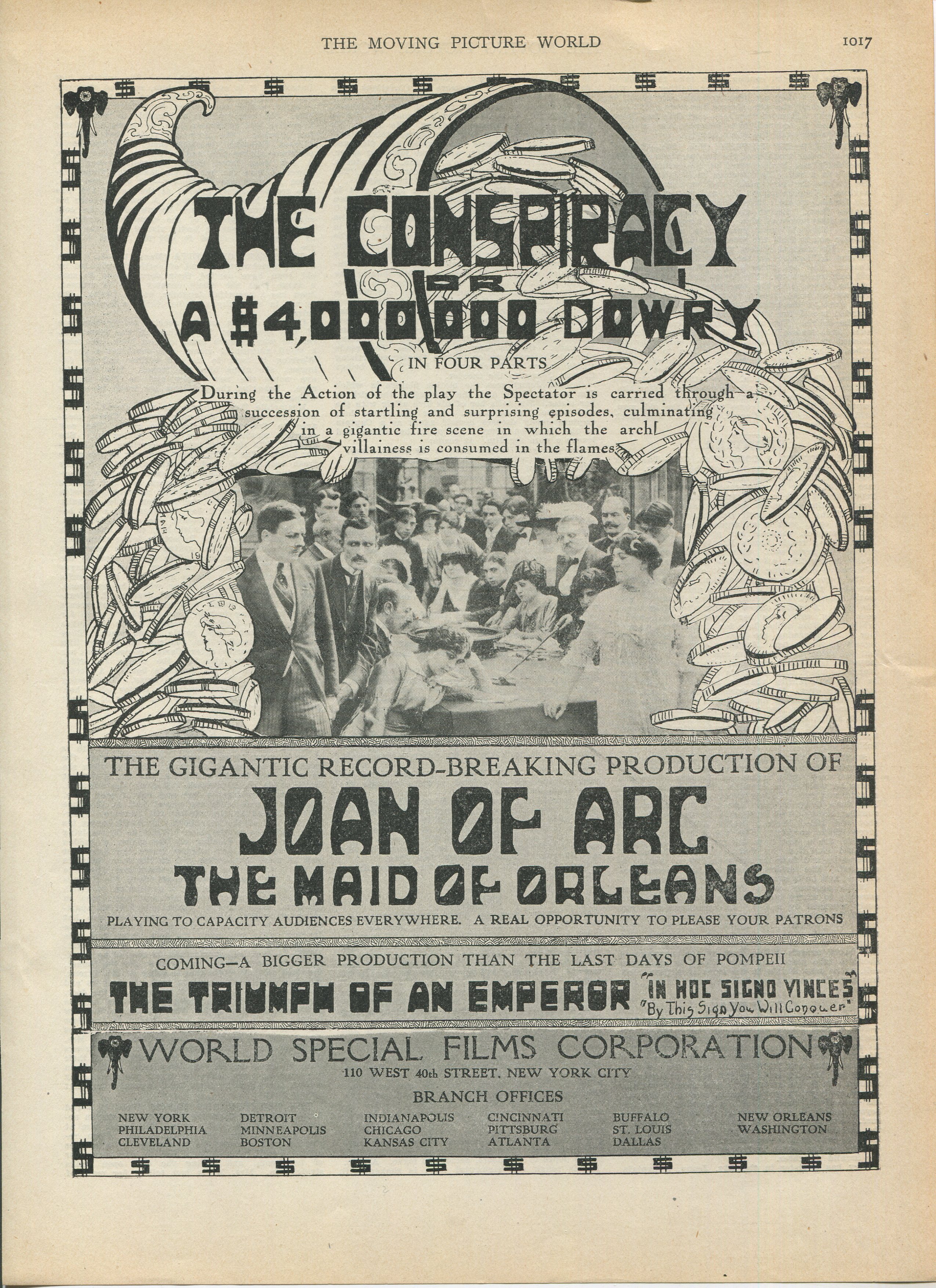
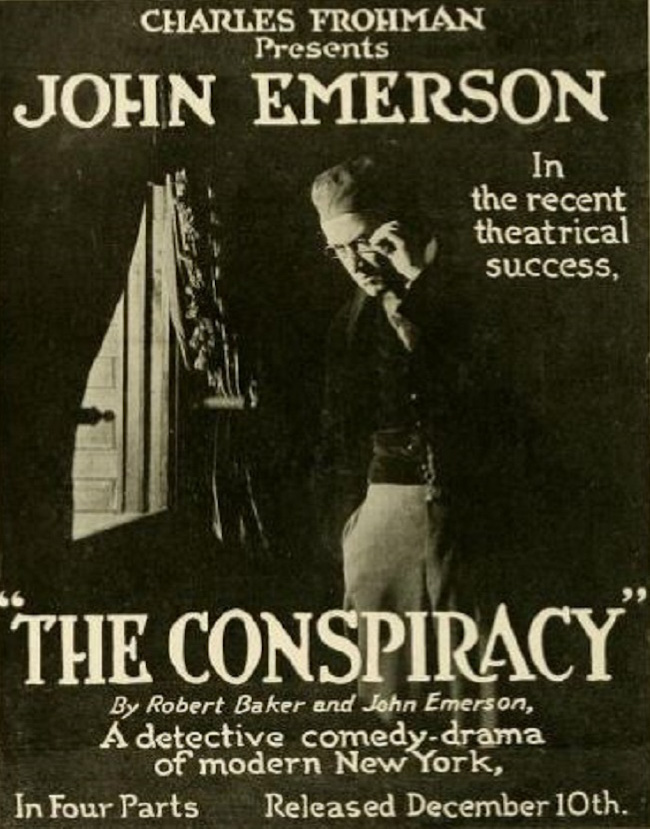
When the dust of early twentieth‑century cinema settles, few titles evoke the same blend of intrigue and social commentary as The Conspiracy. Directed by the collaborative duo Robert M. Baker and Allan Dwan, the film weaves a tapestry of crime, gender politics, and the fraught relationship between authorial imagination and lived reality. Its protagonist, Winthrop Clavering—portrayed with a wry, self‑aware gravitas by Edouard Durand—embodies the archetype of the writer whose fictional sins become the catalyst for genuine investigation.
The narrative launches with Clavering’s literary triumphs being dismissed as sensationalist fantasies. The scorn of the press and the ridicule of his peers push him toward a desperate experiment: to solve a real crime and thereby validate his craft. The inciting incident is the murder of Pedro Alvarez, a shadowy figure whose empire of white‑slave trafficking has long haunted the city’s underbelly. Alvarez’s dying whisper—"a woman"—propels Clavering into the labyrinthine world of the City Refuge for Homeless Girls.
Within the refuge, Margaret Holt (Iva Shepard) emerges as both ally and enigma. As the sister of Victor Holt, the district attorney, she carries the weight of familial expectation while nursing a secret past: abduction by Juanita, a ruthless lieutenant in Alvarez’s gang, and subsequent service as his stenographer. Her motivation is twofold—personal vengeance and the hope of dismantling the trafficking network from within.
The film’s middle act is a masterclass in suspense. Margaret’s covert note‑taking, juxtaposed with Clavering’s clumsy but earnest sleuthing, creates a rhythm that oscillates between tension and dark humor. The climax arrives when Alvarez confronts Margaret; in a swift, desperate maneuver she ends his life, an act that simultaneously liberates her and destabilizes the criminal hierarchy.
In the denouement, Clavering, assisted by the eager cub reporter Jack Howell (Harold Lockwood), corrals the remaining gang members, presents irrefutable evidence to Victor Holt, and restores Margaret’s honor. The film closes on a subtle, hopeful note: a burgeoning romance between Margaret and Howell, suggesting that truth and love can flourish even amid the ruins of corruption.
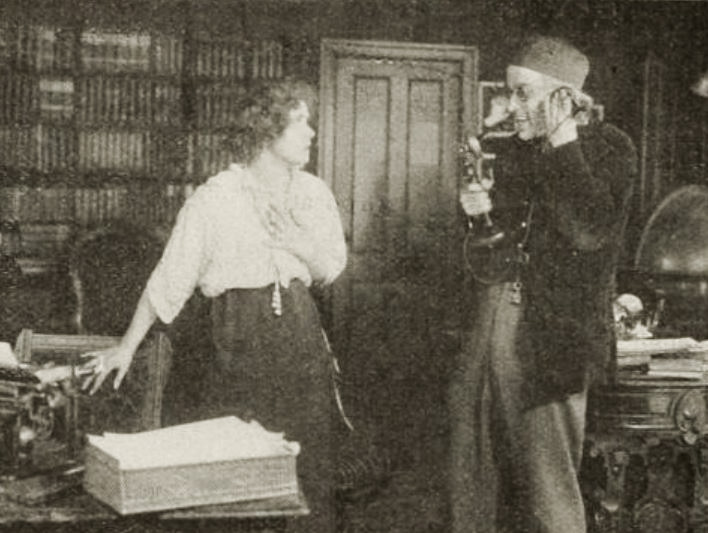
Durand’s portrayal of Clavering balances sardonic wit with earnest determination. His eyes, often the only conduit of emotion in a silent medium, convey a man wrestling with the dissonance between imagination and accountability. Iva Shepard, as Margaret, delivers a performance of remarkable depth; her gestures—tight fists, lingering glances at the refuge’s barred windows—communicate a survivor’s resilience without a single spoken line.
Harold Lockwood’s Jack Howell provides the film’s youthful vigor. His rapid‑fire typing scenes, rendered in crisp intertitles, echo the era’s fascination with modernity and the press’s burgeoning power. Francis Byrne as Alvarez exudes a chilling charisma, his presence amplified by shadowy lighting that foreshadows his eventual downfall.
Supporting actors—Dodson Mitchell (Victor Holt), Hal Clarendon (Juanita), and John Emerson (the city’s corrupt official)—populate the narrative with nuanced antagonists, each embodying a facet of early twentieth‑century societal decay.
Allan Dwan’s directorial fingerprints are evident in the film’s kinetic pacing and inventive use of space. The City Refuge set, constructed with stark, angular architecture, becomes a character in its own right—its oppressive corridors mirroring Margaret’s internal captivity. Dwan’s camera often lingers on narrow doorways, employing low‑angle shots that heighten the sense of entrapment.
The cinematography, attributed to the pioneering work of William C. Foster, utilizes chiaroscuro to accentuate moral ambiguity. Night scenes bathe the gang’s hideout in deep shadows, while the daylight sequences at the refuge are washed in a muted sepia, underscoring the contrast between the world of crime and the world of redemption.
Intertitles are sparingly used, each crafted with a typographic elegance that mirrors the film’s thematic concern with the written word. The occasional splash of color—subtle tints of the dark orange #C2410C for moments of revelation, yellow #EAB308 for scenes of hope, and sea blue #0E7490 for investigative sequences—adds a modern visual flair while respecting the film’s monochrome origins.
At its core, The Conspiracy interrogates the power dynamics of gender and class. Margaret’s journey from victim to agency‑bearing heroine challenges early cinema’s typical portrayal of women as passive objects. Her dual identity—as a sister to a powerful prosecutor and as a former captive—allows the film to explore the intersection of personal trauma and public duty.
The film also offers a meta‑commentary on the role of the writer. Clavering’s transition from fictionalizing crime to confronting it directly raises questions about artistic responsibility. Is the writer complicit when his stories echo real suffering? The narrative suggests redemption is possible when imagination is harnessed for truth‑seeking rather than mere spectacle.
Moreover, the film’s depiction of white‑slave trafficking—a topic rarely addressed in mainstream cinema of the era—positions it as an early social‑issue thriller. By exposing the mechanisms of exploitation, the film aligns itself with reformist movements of the 1910s, echoing the moral crusades seen in contemporaneous works such as Traffic in Souls and Oliver Twist.
When measured against other silent mysteries, The Conspiracy holds its own. Its narrative complexity rivals that of The Mystery of the Yellow Room, while its social consciousness parallels Les Misérables. Unlike the straightforward melodrama of Oliver Twist, it weaves a multi‑layered plot that demands active audience engagement.
In terms of visual style, the film’s use of color tints anticipates later experiments seen in D.W. Griffith’s The Life and Passion of Christ, where selective coloring underscores thematic moments. The dark orange hue used during the climax mirrors the fiery intensity of moral reckoning, while the sea blue tint during investigative sequences evokes a cool, analytical calm.
Although The Conspiracy has slipped into relative obscurity, its relevance endures. Contemporary audiences, attuned to discussions about media responsibility and gendered violence, can find resonance in Clavering’s struggle to reconcile art with ethics, and Margaret’s transformation from silenced victim to empowered agent.
Film scholars have begun to reassess the work, noting its early feminist undertones and its daring confrontation of human trafficking—a subject that would not receive mainstream cinematic attention again until the late twentieth century. The film’s preservation status remains precarious, but recent restorations have allowed festivals to showcase its restored frames, complete with the original color tints.
In sum, The Conspiracy stands as a testament to silent cinema’s capacity for narrative sophistication. Its intricate plot, robust performances, and daring thematic concerns render it a vital study for anyone interested in the evolution of mystery storytelling. Whether you are a cinephile tracing the lineage of crime dramas or a scholar examining early feminist representations, this film offers a rich, layered experience that rewards repeated viewings.
IMDb —
1925
Community
Log in to comment.