DbcultAccessing Vault...
Cult Review
Senior Film Conservator
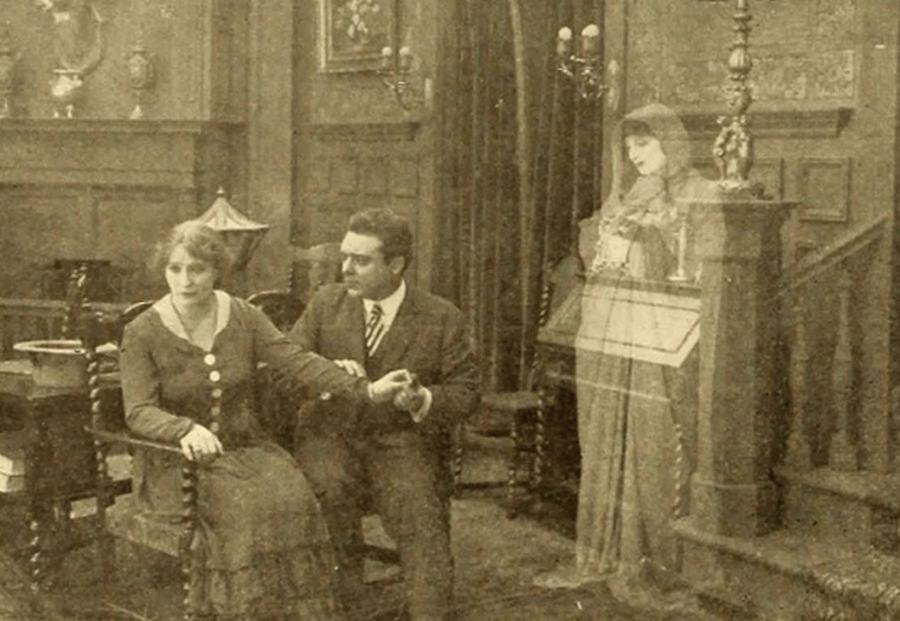
To witness The Cowardly Way is to step into a time capsule where the nascent language of cinema collided with the ancient, swirling currents of theosophy and occultism. Released in an era often dismissed as primitive, this 1915 production—penned by the legendary astrologer and writer Marc Edmund Jones—offers a narrative complexity that shames modern blockbusters. It is a film that dares to ask what happens to the soul when it attempts to flee its earthly obligations, and the answer it provides is both visually haunting and philosophically rigorous.
The film opens with a portrait of Eunice Fielding, played with a delicate, nervous energy by Isabel MacGregor. Eunice is not a villain in the traditional sense; she is a product of a society that treats women as ornamental, shielding them from the harsh mechanics of survival until they are utterly unequipped for the friction of reality. Her marriage to Jack Harcourt (Bennett Southard) is framed not as a romantic triumph, but as a collision of incompatible worlds. Jack, the 'brave' man of the title, represents the stoic ideal of the early 20th century, while Eunice represents the 'cowardly' fragility of the leisure class.
Unlike the more grounded domestic dramas of its time, such as Lena Rivers or the social realism found in The White Terror, The Cowardly Way quickly discards the mundane to embrace the mystical. The introduction of Nance St. Germain, a student of theosophy, signals the film's intention to explore the 'unseen' forces governing human destiny. Nance’s warnings aren't just moralistic finger-wagging; they are metaphysical forecasts. She speaks of the soul's debt, a concept that becomes literal as Eunice’s gambling debts mount and Jack’s financial stability crumbles.
The midpoint of the film contains one of the most daring sequences in silent cinema. When Eunice, overwhelmed by the realization that her husband is broke and she is pregnant, chooses to end her life via gas, the screen does not fade to black. Instead, we are ushered into the Halls of Death. This is where Marc Edmund Jones’s influence is most palpable. The afterlife depicted here isn't a Christian heaven or hell, but a bureaucratic, liminal space where souls wait for their 'time' to align with cosmic cycles.
The visual effects used to render Eunice as an invisible observer of her own tragedy are remarkable for 1915. We see Jack succumb to a profound, clairvoyant insanity. His madness is not portrayed as a simple mental break, but as a thinning of the veil. He can see Eunice when others cannot. This psychological fracturing provides a stark contrast to the more theatrical madness seen in Chicot the Jester. Here, insanity is a superpower—a tragic gift that allows him to perceive the spiritual fallout of Eunice’s suicide.
Perhaps the most provocative element of the film is the handling of the unborn child. In a sequence that must have been shocking to contemporary audiences, Death informs Eunice that the soul intended for her womb will now be born to Marjorie, Jack’s sister. This concept of metempsychosis—the transmigration of souls—elevates the film from a mere melodrama to a profound meditation on interconnectedness. The child is not a 'replacement' but a displaced essence, a victim of Eunice’s refusal to participate in the cycle of life.
When Jack, in his state of heightened perception, announces that 'Marjorie is to have a little girl' before the pregnancy is even known, the film bridges the gap between the supernatural and the biological. It suggests a world where every action has a ripple effect across generations. This thematic depth is far more sophisticated than the straightforward moralizing of The Pretenders or the lighthearted escapism of A Trip to the Wonderland of America.
The climax of the film is a masterclass in tension and emotional stakes. Jack’s insanity reaches a fever pitch where he threatens the very child that was supposed to be his. Eunice, existing on the periphery of the living world, is faced with a choice that mirrors her original 'cowardly' act. To save the child and restore Jack's mind, she must call upon Death and agree to never be seen by Jack again. This is the 'brave way'—the ultimate renunciation of the self for the sake of others.
The final image of Eunice looking at the Book of Death, seeing her name recorded as one who has redeemed herself, is a powerful conclusion. It avoids the easy happy ending of films like Aloha Oe. Instead, it offers a bittersweet resolution where the protagonist is essentially erased from the physical world she so desperately tried to cling to. She finds peace only through the complete abandonment of her ego.
From a technical perspective, the film utilizes lighting to distinguish between the domestic sphere and the spiritual realm. The scenes in the Harcourt household are often cluttered, reflecting the 'embarrassment' of their financial state, while the scenes involving Death are stark, high-contrast, and cavernous. This visual dichotomy reinforces the film’s central theme: the heavy weight of material life versus the terrifying vastness of the spiritual.
The performances are heightened but effective. Ferdinand Tidmarsh and Florence Reed provide solid support, but the film belongs to Isabel MacGregor and Bennett Southard. Southard’s portrayal of Jack’s 'clairvoyant insanity' is particularly nuanced; he manages to convey a man who is both lost and more 'found' than he has ever been. His performance stands in contrast to the more traditional heroics found in The Hazards of Helen.
The Cowardly Way is a demanding film. It asks the viewer to accept a world where mysticism is a hard science and where the consequences of one's character are written into the very fabric of the universe. It lacks the populist appeal of His Last Dollar or the grand spectacle of Joseph in the Land of Egypt, but it possesses a haunting, internal logic that stays with the viewer long after the final frame.
In the pantheon of silent cinema, it deserves a place of honor as a pioneering work of psychological and spiritual exploration. It reminds us that cinema, even in its infancy, was never just about moving pictures; it was about the moving soul. If you are looking for a film that explores the dark corners of human frailty with the light of ancient wisdom, The Cowardly Way is an essential, if harrowing, journey.
Recommended for fans of:
IMDb 6.9
1931
Community
Log in to comment.