DbcultAccessing Vault...
Cult Review
Senior Film Conservator
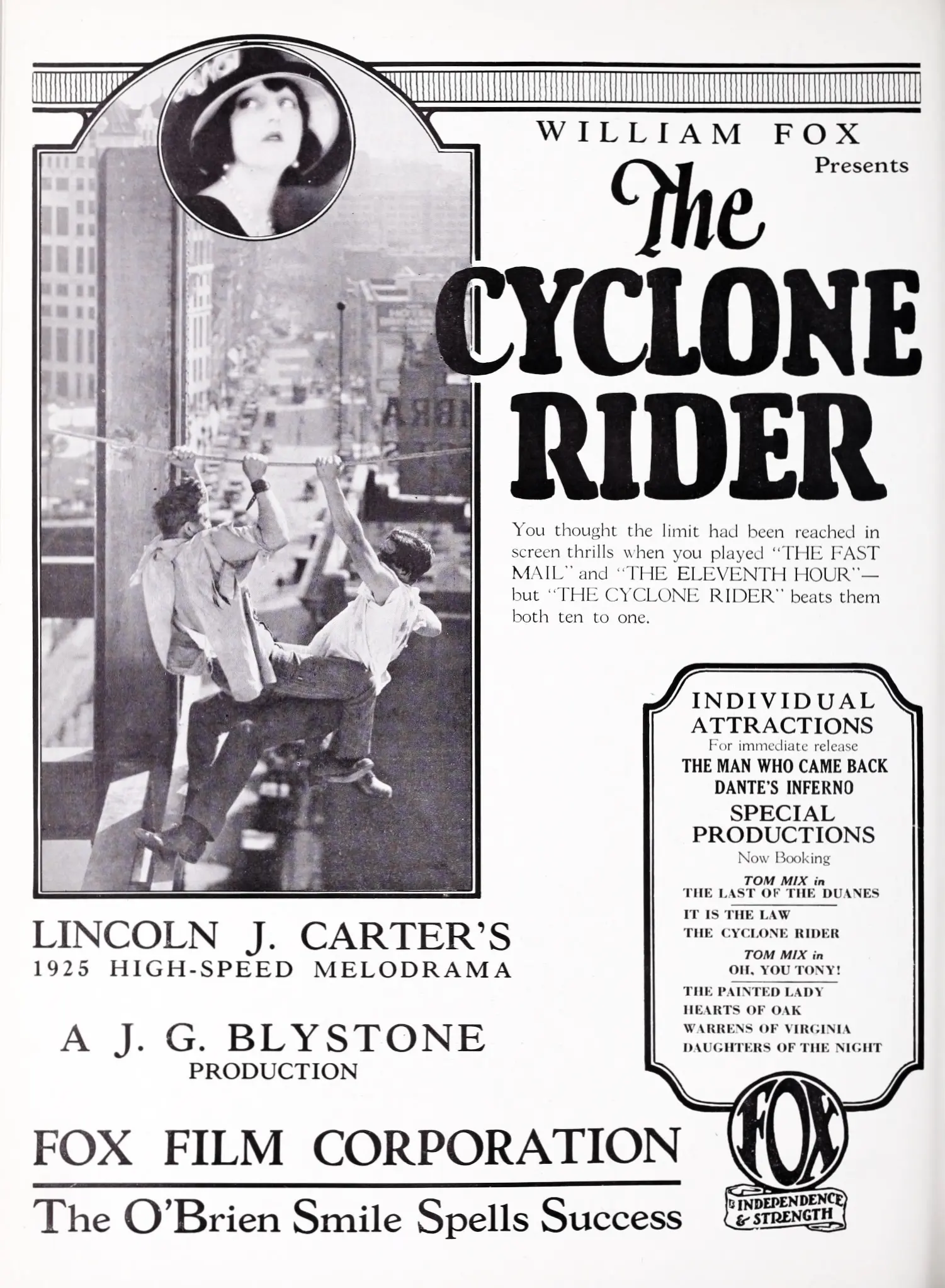
The silent era often functioned as a fever dream of industrial optimism, and few films encapsulate this kinetic energy as vividly as The Cyclone Rider (1924). Directed with a frantic, pulsing rhythm by Tom Buckingham, the film serves as a celluloid testament to the era's obsession with velocity, verticality, and the self-made man. It is a work that bridges the gap between the perilous heights of skyscraper construction and the horizontal sprawl of the burgeoning American road race. In many ways, it mirrors the thematic weight of The Man Who Played God, where the protagonist must navigate the whims of fate and the rigidity of social standing to find a semblance of personal agency.
Reed Howes, embodying the archetype of the clean-cut American hero, portrays Richard Armstrong not merely as a laborer, but as a visionary tinkerer. The film opens amidst the dizzying heights of a steel construction site, a setting that visually echoes the precarious nature of his social climb. Much like the existential dread found in La montagne infidèle, the environment here is both a provider and a threat. Armstrong’s invention—a carburetor that promises unparalleled speed—is his ticket out of the manual labor of the sky and into the prestige of the track.
The narrative tension is expertly wound around the figure of Richard Steele, played with a stern, patriarchal gravity. Steele represents the old guard, a man who values the tangible power of his skyscrapers but remains blind to the shifting gears of the new world. His preference for Trask, the 'underworld king,' serves as a sharp critique of how the upper echelons of society often find more common ground with organized crime than with the industrious poor. This dynamic of corrupted morality and social gatekeeping is a trope explored with similar nuance in The Sin of Martha Queed.
When the film shifts from the verticality of the skyscraper to the horizontal intensity of the road race, the cinematography adopts a breathless quality. The road race in The Cyclone Rider isn't just a sporting event; it’s a moral battleground. The carburetor becomes a symbol of Armstrong’s intellectual labor, a physical manifestation of his right to ascend. The sabotage orchestrated by Trask adds a layer of pulp friction that keeps the stakes dangerously high. While films like Back from the Front utilize action for comedic relief, Buckingham treats these sequences with a visceral seriousness that anticipates the high-octane thrillers of the later talkie era.
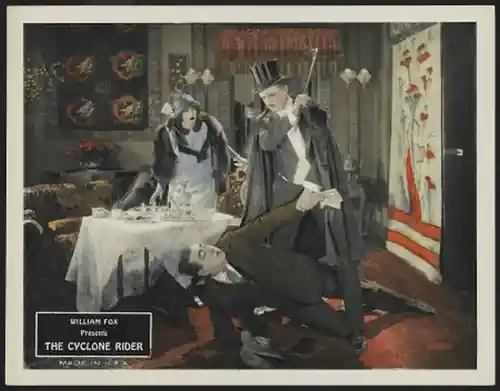
The sequence where Armstrong narrowly avoids Trask’s lethal traps is a masterclass in silent editing. The intercutting between the roaring engines, the dusty tracks, and the stoic faces of the competitors creates a sensory experience that compensates for the lack of synchronized sound.
Alma Bennett provides a luminous performance as Doris Steele. While the script initially positions her as a prize to be won, Bennett imbues the character with a quiet agency. Her chemistry with Howes is palpable, providing the emotional ballast necessary to anchor the film’s more outlandish action beats. The supporting cast, featuring stalwarts like Eugene Pallette and Margaret McWade, adds layers of texture to the world. Pallette, long before his iconic turn in The Adventures of Robin Hood, shows a commanding screen presence that grounds the film’s more melodramatic tendencies.
Comparatively, the romantic entanglements here feel more grounded than the ethereal longing found in Lulù. There is a pragmatism to Armstrong and Doris’s love; it is a union forged in the fires of industrial competition and the shared desire to break free from the manipulations of men like Trask and Steele. This sense of yearning for autonomy is a recurring motif in silent cinema, often seen in works like Lucille Love: The Girl of Mystery, though here it is stripped of mystery in favor of raw, mechanical ambition.
The screenplay by Tom Buckingham and Lincoln J. Carter is remarkably efficient. It avoids the bloated intertitles that plagued many of its contemporaries, allowing the visual storytelling to carry the narrative weight. The dichotomy between the 'clean' invention of the hero and the 'dirty' dealings of the villain is a classic structure, but the setting—the intersection of construction and racing—gives it a fresh coat of paint. Even when the film dips into the tropes of the era, such as the 'bashful hero' archetype seen in The Bashful Lover, it quickly pivots back to the grit of its central conflict.
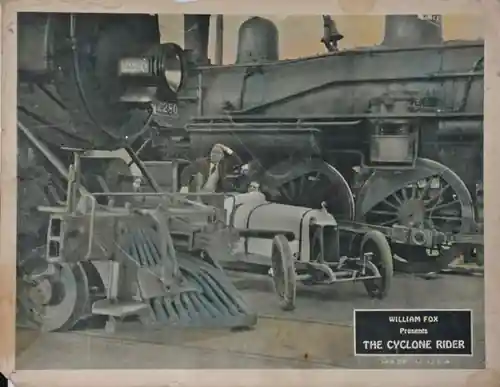
One cannot overlook the contribution of the stunt work. In an age before CGI, the peril captured on screen was terrifyingly real. The shots of Armstrong suspended above the city streets or hurtling around unpaved corners at high speeds possess a documentary-like urgency. It reminds one of the physical comedy and danger found in Toonerville's Fire Brigade, yet framed through the lens of a high-stakes drama rather than a slapstick short.
Deep beneath the surface of the race and the romance lies a poignant commentary on the American Dream. Armstrong doesn't win the race in the traditional sense; he 'loses' the prize money but wins the moral victory. This subversion of the 'winning' trope is sophisticated for its time. It suggests that the system—represented by the race and Steele’s rules—is inherently rigged, but the individual can still triumph through sheer force of character. This mirrors the social stratification explored in Egyenlőség, where the struggle for equality is fought on multiple fronts.
The film also brushes against the themes of urban decay and the 'underworld' that would later define the noir genre. Trask is not just a rival suitor; he is a manifestation of the rot within the city’s growth. His attempt to kill Armstrong is an attempt by the corrupt status quo to stifle innovation and meritocracy. In this light, The Cyclone Rider is more than just a car movie; it’s a battle for the soul of the modern city.
While perhaps not as widely discussed today as the works of Keaton or Lloyd, The Cyclone Rider remains a vital piece of the silent cinematic puzzle. It captures a specific moment in time when the world was moving faster than its inhabitants could keep up with. It shares a certain pastoral-meets-modern tension with Lena Rivers, though it swaps the rural melodrama for urban adrenaline. Even the inclusion of Bud Jamison and Heinie Conklin provides a bridge to the broader slapstick culture of the 1920s, showing how diverse the talent pool was for such a production.
For those interested in the evolution of the action hero, Reed Howes' performance is essential viewing. He possesses a physicality that is less about choreographed fighting and more about the mastery of machines. This mechanical prowess is a precursor to the sporting heroes we see in films like Play Ball with Babe Ruth, where the athlete becomes a symbol of national capability. Ultimately, The Cyclone Rider is a film about breaking through the ceiling—both literally, on the skyscraper, and figuratively, in the heart of a society that wants to keep the riders in their place.
In the grand tapestry of 1924 cinema, which included the heavy moral weight of The Devil's Garden and the epic scope of Paradise Lost, this film holds its own by being unapologetically fast and surprisingly deep. It is a reminder that even in the silent era, the roar of an engine could be heard loud and clear through the medium of light and shadow.
IMDb 7.1
1927
Community
Log in to comment.