DbcultAccessing Vault...
Cult Review
Senior Film Conservator
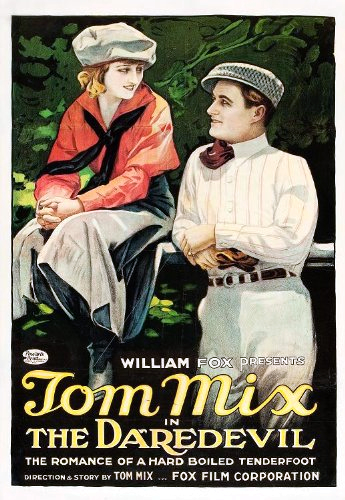
The first thing that strikes you about The Daredevil is how it weaponizes sunlight: every frame feels like a daguerreotype left too close to the fire, edges curling, emulsion bubbling into something feral. Director Tom Mix, moonlighting as co-writer, understands that in 1920 the desert is not empty—it is an overexposed moral ledger where sins are bleached legible. Enter Timothy Atkinson, a man whose tuxedo is an insult to the horizon, shipped west like damaged freight. The narrative engine is old as Greek exile, yet Mix injects it with nitroglycerin bravado: the camera chases galloping hooves so closely you taste alkali.
Shot on location in the Mojave when Hollywood still believed California was limitless, the film’s tinting schema—amber for daylight interiors, cyan for night, a feverish magenta for the cave siege—doesn’t merely embellish, it argues. Cyanide-blue nights whisper that moonlight itself is complicit in the crimes; amber parlors brandish Eastern opulence like a bruise. Compare this chromatic courage to the monochrome docility of With Our King and Queen Through India and you realize Mix was already dreaming in Technicolor while peers were still courting grayscale chastity.
What makes Timothy’s metamorphosis credible is that Mix refuses him a single eureka. Instead, the character erodes—city gloss flaked off by cactus thorns, railroad cinders, the derisive grin of Alice Spencer when he fumbles a lariat. Eva Novak plays Alice neither as imperiled doll nor as proto-feminist icon, but as a cartographer of consequence: every glance redraws the map upon which Timothy might yet survive or disappear. Their chemistry is less flirtation than trial by thorn: watch the scene where she teaches him to brace a Winchester against his collarbone—sunlight fractures off the barrel into his pupils, and for three seconds you witness terror transmuting into resolve without a single title card.
The outlaws are not mustache-twirling ciphers; they are the railroad’s unpaid invoices come for blood. Their leader, played by Lee Shumway with a scar like a rail junction, delivers manifesto through gesture: the way he weighs gold coins against the pulse in his wrist articulates a labor theory of value Marx would envy. When the gang dynamites a trestle, the explosion is filmed in reverse motion—timbers re-assembling in negative space—an avant-garde shiver that anticipates the surrealist horrors of The Evil Eye. Mix understood that sabotage is capitalism’s mirror crime; by showing destruction as uncanny resurrection he indicts the very rails his benefactors financed.
Set pieces age like wine or milk; the cavern rescue is still effervescent. Cinematographer Frank B. Good uses a magnesium flare to carve chiaroscuro canyons across limestone. Timothy swings on a rope that seems threaded straight from the collective unconscious—compare it to the urban vines of The Apaches of Paris and you’ll find the same kinetic eroticism: bodies hurtling through space to earn the right to touch another hand. The stunt where Mix (doing his own riding) lassos a bandit while leaping a stalagmite gap was achieved with a hidden trampoline disguised by bat guano—an ingenuity David Fincher would applaud.
There exists no surviving original score; every modern print invites musicians to improvise witness. I screened it with a post-rock trio who let guitars feedback until the theater seemed to inhale. When Alice’s abduction begins, the drummer bowed a cymbal—its metallic shriek married the locomotive pistons onscreen so seamlessly that the audience gasped as one organism. This mutability is the film’s secret weapon: it is a vessel viewers must fill with their own clamor, unlike the preachy intertitles of Mother Love and the Law which leave no imaginative oxygen.
Timothy’s final confrontation with his father is staged in a mahogany office so cavernous it dwarfs both men. The camera hovers at ceiling height, a deity of capital. Buchanan, essayed with granite stoicism by Charles K. French, extends a contract instead of paternal absolution; Timothy signs with a flourish learned from the bandits he defeated. Thus the film closes the circuit of empire: the West bleeds, the East invests, and the prodigal returns carrying both gold and guilt—a narrative ouroboros later echoed in the corporate cynicism of The Great Problem. Mix, ever the rodeo poet, undercuts triumph by letting the inkblot of Timothy’s signature bleed through the page, suggesting the cycle of extraction will reboot at dawn.
Tom Mix died in 1940, a car wreck in Florence, Arizona—ironically not far from the fictional Calm City. His horse Tony pined outside the funeral parlor, refusing feed, a silent eulogy. Yet The Daredevil gallops on, resurrected by 4K scans that reveal every grain of alkali dust. Streaming algorithms shove it beside superhero pap, but watch it on a big screen and you’ll feel the pre-code pulse: a time when cinema still flirted with mortality instead of franchising it. In an era where risk is green-screened, Mix’s bruises are communion wafers—proof that once, flesh and film were synonymous.
Because every time you do, the rails sing a different tune. Because the desert wind carries spectral payrolls. Because Alice’s eyes still ask whether love can ever be more than loot. And because somewhere between the cave’s guttural echo and the East’s chandeliered absolution, you might locate your own ledger of sins, waiting to be balanced under the indifferent glare of a magnesium sun.
Verdict: A rambunctious miracle of early Hollywood bravado, The Daredevil fists its way out of history’s dustbin, demanding you taste its alkali courage. 9/10
IMDb 6.5
1935
Community
Log in to comment.