DbcultAccessing Vault...
Cult Review
Senior Film Conservator
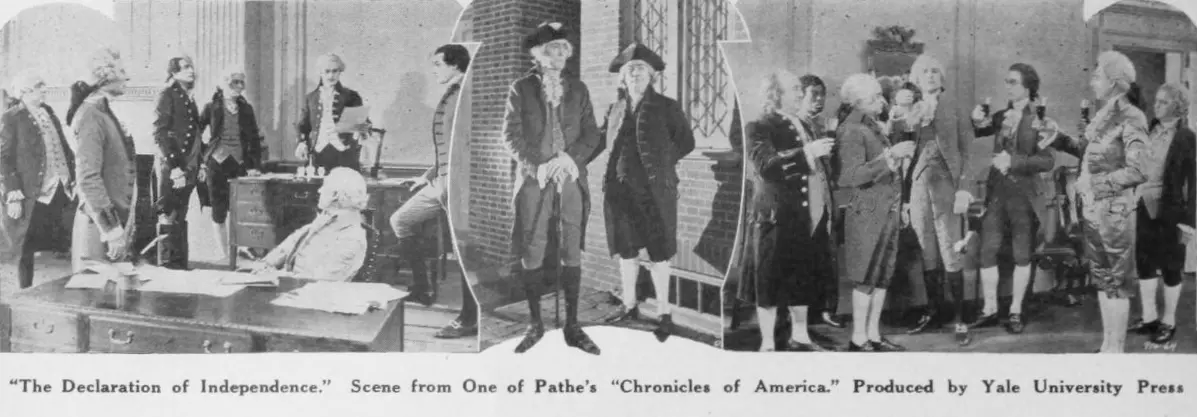
In the pantheon of early historical cinema, few works attempt to condense the sheer metaphysical weight of a nation's birth into the restrictive confines of a short film with the same earnestness as The Declaration of Independence. This production, penned by the structurally astute William B. Courtney, eschews the bombastic pageantry often associated with patriotic hagiography, opting instead for a granular focus on the intellectual labor that preceded the ink’s drying. It is a work that demands our attention not merely for its subject matter, but for its attempt to humanize the monumental, turning the 'latter part of June' into a ticking clock of revolutionary inevitability.
William B. Courtney’s screenplay is a masterclass in narrative economy. While many contemporary features of the era, such as the 1924 adaptation of Tess of the D'Urbervilles, relied on sprawling emotional arcs, Courtney focuses on the 'drawing and consummation' of a single idea. The script treats the document as a living character, a synthesis of collective will that requires both intellectual precision and physical endurance. The dialogue, though period-appropriate, avoids the stilted artifice that often plagued early talkies or intertitle-heavy silents, aiming instead for a resonance that feels immediate and precarious.
The pacing here is deliberate, mirroring the sweltering heat of the Pennsylvania State House. There is a palpable sense of the 'consummation' mentioned in the plot—a word that suggests not just completion, but a sacred union of disparate colonial interests. This focus on the process over the result allows the film to bypass the cliché of the 'founding fathers' as statues, presenting them instead as men operating in a vacuum of uncertainty. This narrative strategy reminds one of the thematic gravity found in Damaged Goods (1918), where the weight of social consequence looms over every decision made behind closed doors.
The cast, led by stalwarts such as Warner Richmond and a young Douglass Dumbrille, provides a grounded realism that anchors the film’s loftier ambitions. Richmond, in particular, carries a gravitas that suggests the heavy burden of leadership without resorting to theatrical flourishing. His performance is one of restraint, a necessary counterpoint to the high-stakes political maneuvering occurring within the frame. Dumbrille, who would later become a staple of Hollywood villainy, shows early glimpses of his commanding screen presence, though here it is channeled into the fervor of revolutionary conviction.
The supporting cast, including J. Moy Bennett and Henry W. Pemberton, functions as a cohesive unit, representing the diverse and often conflicting perspectives of the Continental Congress. Unlike the frantic energy seen in Double Speed, the movement of the actors in this film is measured and heavy. Each gesture—the dipping of a quill, the wiping of a brow, the exchange of a glance—is imbued with the significance of the historical moment. It is a collective performance that prioritizes the ensemble over the individual, mirroring the very document they are ostensibly creating.
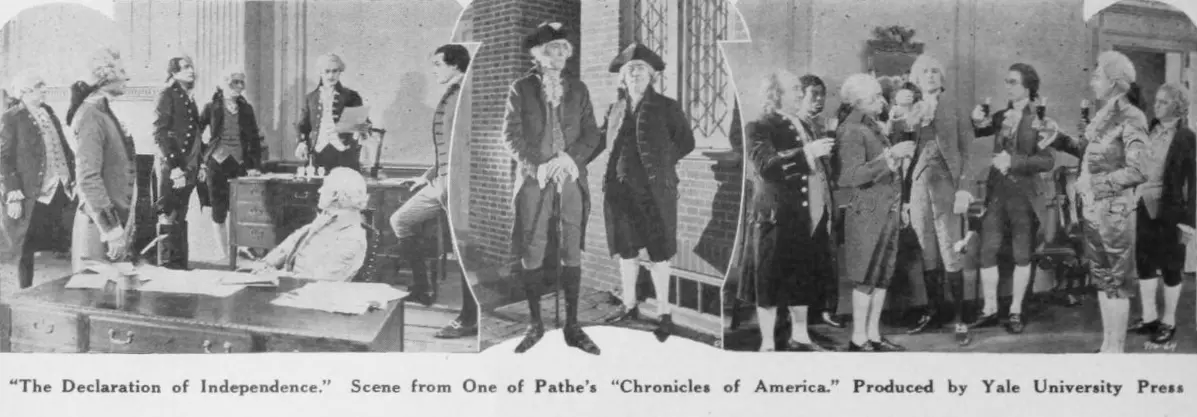
Visually, the film utilizes a palette of deep shadows and sharp highlights, a technique that emphasizes the clandestine and dangerous nature of the proceedings. The cinematography captures the tactile quality of the 18th century—the texture of the parchment, the flickering of candlelight, the dust motes dancing in the humid air of the hall. This aesthetic choice elevates the film from a mere educational short to a piece of evocative art. The lighting, in particular, evokes a sense of moral clarity emerging from the darkness of tyranny, a visual metaphor that is never explicitly stated but constantly felt.
When compared to the rugged, outdoor cinematography of Canyon of the Fools, The Declaration of Independence is an exercise in interiority. The drama is confined to rooms, yet the stakes feel infinitely larger because the dialogue and the visual framing suggest a world outside that is waiting to be irrevocably changed. The set design is meticulous, avoiding the hollow look of many low-budget historical recreations and instead opting for a lived-in authenticity that suggests these men have been debating in these chairs for weeks on end.
At its core, the film explores the concept of liberty not as an abstract gift, but as a hard-won moral imperative. The 'drawing' of the document is depicted as an act of profound courage, a sentiment that echoes the ethical dilemmas found in The Price of Her Soul. Here, the 'soul' in question is that of a nascent country, and the price is the potential execution of every man in the room. This tension is the film’s greatest strength; it never lets the audience forget that the Declaration was, at its moment of inception, a death warrant for its signatories.
The film also touches upon the fragility of consensus. The 'latter part of June' was a time of immense disagreement and regional friction. The narrative doesn't shy away from the difficulty of achieving the 'consummation' of the document. It highlights the compromises and the intellectual rigor required to unite thirteen disparate colonies under a single banner. This focus on the difficulty of the process makes the eventual success feel earned rather than inevitable, providing a sophisticated take on history that remains relevant to contemporary audiences.
While it may lack the experimental whimsy of Capitan Groog and Other Strange Creatures, The Declaration of Independence succeeds because of its steadfast commitment to its central premise. It is a film that understands the power of the written word and the cinematic potential of intellectual struggle. By focusing on the specific timeframe of late June to early July 1776, it provides a snapshot of a turning point in human history, captured with a level of detail and emotional honesty that is rare for short-form historical drama.
In the final analysis, this production is an essential artifact for anyone interested in the intersection of film and historiography. It manages to be both a respectful tribute and a compelling drama, proving that the most 'famous document' in American history is best understood through the lens of the human beings who bled, sweated, and argued it into existence. It is a testament to the power of focused storytelling, demonstrating that you don't need a three-hour runtime to capture the essence of a revolution. Like the document itself, the film is concise, powerful, and enduringly significant.
IMDb —
1915
Community
Log in to comment.