DbcultAccessing Vault...
6.8/10
Senior Film Conservator
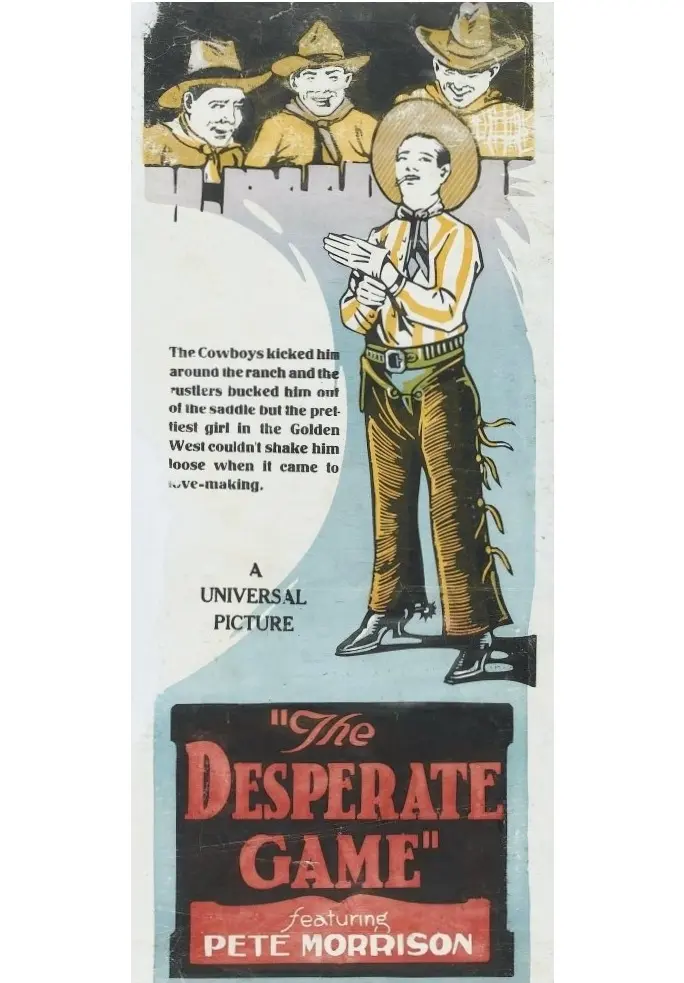
A definitive 6.8/10 rating for a film that redefined the boundaries of cult cinema. The Desperate Game remains a cornerstone of transgressive art.
Is The Desperate Game a timeless western classic or a dusty relic of a bygone era? Short answer: It is a functional, if formulaic, piece of silent-era entertainment that offers a fascinating look at the 'college-educated cowboy' trope. This film is for silent film completionists and fans of classic horse-led action; it is not for those who demand high-stakes psychological depth or modern pacing.
The film sits in a curious position within the 1924 landscape. While other productions were experimenting with grander scales, like In the Palace of the King, this production keeps its feet firmly in the stirrups. It’s a bit of a slog in the middle, but the payoff is there.
1) This film works because of the genuine chemistry between Pete Morrison and his horse, Lightning, which provides the only real emotional stakes in an otherwise standard plot.
2) This film fails because the antagonist's motivations are thin and the central 'disputed boundary' conflict is resolved with a predictable fistfight rather than clever narrative subversion.
3) You should watch it if you appreciate the era's transition from melodrama to action-oriented storytelling or if you want to see how early cinema handled the 'East meets West' culture shock.
Yes, The Desperate Game is worth watching if you are a fan of early 20th-century Westerns that prioritize animal stunts and physical action over complex dialogue. It provides a rare look at the 'educated cowboy' archetype that was popular in the 1920s. However, casual viewers may find the pacing slow compared to modern action films. It doesn't have the comedic brilliance of Why Worry?, but it possesses a rugged sincerity.
One of the most striking elements of the film is the introduction of Jim Wesley. When we first meet him, he is the 'college boy'—a character type that often served as the butt of the joke in earlier silent shorts. Here, however, writers Frank S. Beresford and George Elwood Jenks treat his education as a temporary veneer. The moment Jim sheds his city clothes and mounts Lightning, the film transforms.
This transition is best exemplified in the scene where Jim first confronts the land-grabbers near the disputed boundary. Instead of relying on brute force immediately, he attempts a level-headed negotiation. It is a subtle nod to his 'Eastern' sensibilities. But when the villains respond with a sneer, Jim reverts to the primal justice of the West. It works. But it’s flawed. The shift is almost too fast, leaving the audience wondering why we spent the first twenty minutes establishing his academic background at all.
Compare this to The Remittance Man, where the outsider status is maintained for much longer. In The Desperate Game, the 'college' aspect feels more like a marketing hook than a deep character trait. Pete Morrison plays the ruggedness well, but his 'intellectual' side is mostly just a clean shave and a stiff collar.
Let’s be real: Lightning the Horse gives a better performance than half the human cast. In the 1920s, animal stars were a major draw, and this film leans into that trend heavily. Lightning isn't just a mode of transportation; he is a character with agency. There is a specific moment during the final chase where the camera stays tight on the horse’s gallop, capturing the raw power and coordination required for these early stunts.
Unlike the more theatrical animal work in Bobby Bumps and the Hypnotic Eye, the action here feels grounded. When Jim is in trouble, Lightning doesn't just show up; he navigates obstacles that feel genuinely dangerous. The cinematography by the uncredited cameraman captures these sequences with a wide-angle clarity that allows the viewer to appreciate the lack of safety nets. It’s visceral in a way that modern CGI horses can never replicate.
The visual language of The Desperate Game is surprisingly sophisticated for a mid-tier Western. The use of natural lighting during the exterior shots of the Grayson ranch creates a sense of immense, unforgiving space. This isn't the stylized West of later John Ford films; it’s a dusty, utilitarian landscape that feels lived-in.
I was particularly impressed by the interior lighting in the scene where the two fathers discuss the boundary line. The shadows are long and heavy, emphasizing the weight of their legacy and the bitterness of their dispute. It reminded me of the somber tones found in Over the Hill, though without the crushing melodrama. The camera remains mostly static, but the framing of the actors within the ranch doorways creates a 'frame within a frame' effect that highlights their entrapment by tradition.
If there is a major weakness, it lies in the antagonists. Jere Austin and Lew Meehan do what they can with the material, but they are essentially mustache-twirling archetypes. Their plan to 'stop the marriage' is never fully articulated beyond a vague desire for land. We don't see the systemic pressure or the desperation that usually drives these plots in better films like The Doom of Darkness.
The villains are just 'bad' because the plot requires them to be. This lack of nuance makes the stakes feel lower than they should. When Jim finally rides out to 'put an end to the scheme,' it feels less like a desperate struggle and more like a scheduled appointment. The tension is external, never internal.
The film follows a classic three-act structure, but the second act is where the wheels start to wobble. The romance between Jim and Marguerite (Virginia Warwick) is handled with the subtlety of a sledgehammer. Their 'college romance' is told through a series of static shots of them walking through fields, which slows the momentum established by the opening land-dispute scenes.
It lacks the rhythmic editing found in Live Wires. However, once the 'game' of the title begins in the final thirty minutes, the film finds its pulse. The cross-cutting between the saboteurs and Jim’s ride is effective, building to a climax that is satisfying, if entirely expected. It’s a meat-and-potatoes Western that knows exactly what its audience wanted: a hero, a horse, and a happy ending.
Pros:
- Pete Morrison is a convincing, physical lead.
- Exceptional horse stunts that still look impressive today.
- High-quality location scouting that captures the 'Old West' feel.
- A clean, easy-to-follow narrative for those new to silent film.
Cons:
- The 'college' backstory is mostly irrelevant to the actual plot.
- Female characters are given very little to do other than look concerned.
- The resolution of the land dispute is overly simplistic.
- Some of the title cards are repetitive and slow down the action.
The Desperate Game is a solid, workmanlike Western that serves as a perfect time capsule for 1924. It doesn't reach the heights of cinematic innovation seen in Christus or the pure entertainment value of Rip Roaring Rivals, but it doesn't have to. It’s a film that knows its strengths—namely Pete Morrison’s grit and Lightning’s speed—and plays to them consistently.
While the 'desperate' part of the title might be an exaggeration, the 'game' is played with enough sincerity to merit a look. It’s a reminder of a time when a man and his horse were all you needed to fix a broken world. It’s simple. It’s dusty. It works.
IMDb 6.6
1926
Community
Log in to comment.